
![Thanos in Squid Game Season 2: A Brilliant Antagonist [2025]](https://runable.blog/blog/thanos-in-squid-game-season-2-a-brilliant-antagonist-2025/image-1-1765664378048.jpg)
Why Thanos Matters in Squid Game Season 2: A Fresh Take on Television Villainy
When Squid Game Season 2 dropped, the internet had opinions. Some people focused on the emotional weight of returning characters. Others debated the games themselves. But if you were really paying attention, you noticed something unusual happening in the background of certain scenes: a figure in bright clothes, rapping, vaping, and orchestrating chaos with the kind of calculated carelessness that stops you cold.
That's Thanos.
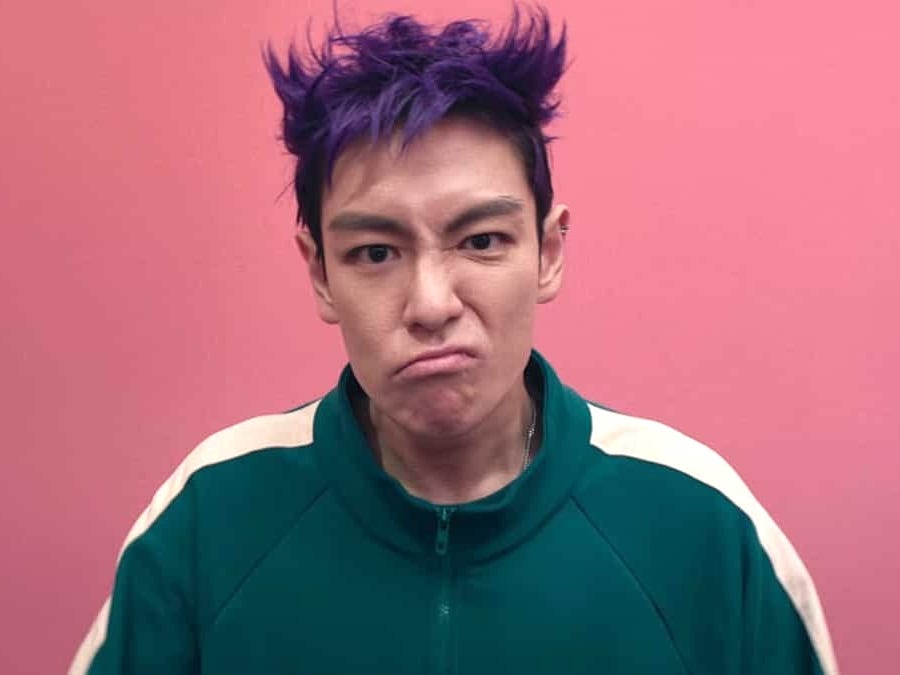
Not the purple titan from Marvel. This Thanos is Choi Seung-hyun, better known by his stage name T. O. P, a former member of the hugely influential K-pop group Big Bang. And despite significant controversy surrounding his casting in South Korea, his portrayal of a fallen rapper turned player represents something genuinely novel in prestige television: a character who's neither hero nor traditional villain, but something far more unsettling.
The irony of the character name isn't accidental. Thanos wants to bring balance, sure, but through manipulation, violence, and a kind of societal collapse wrapped in charisma. He's not trying to save the games. He's trying to reshape them entirely.
What makes this casting and character arc so fascinating isn't just the performance. It's what Thanos reveals about human nature when survival becomes the only currency that matters. He's a mirror held up to every player who's participated in these games, and he forces a question nobody wants to ask: what happens when the most dangerous person in the room is also the most charming?
This article dives deep into why Thanos works as a character, how T. O. P elevated the role beyond what the script might have originally called for, and what his presence means for the trajectory of the show. We'll examine the antagonist through multiple lenses: narrative function, thematic resonance, performance quality, and cultural context. Because understanding Thanos isn't just about understanding a single character. It's about understanding how modern prestige television is pushing past binary morality and into the murky territory where real human dysfunction lives.
TL; DR
- Thanos is a catalyst character: He doesn't drive the central conflict, but he fundamentally changes how other players interact with each other and the games themselves
- T. O. P's performance adds depth: His charisma and comedic timing make Thanos simultaneously ridiculous and terrifying, a balance most actors couldn't maintain
- Cultural controversy adds weight: His casting faced significant South Korean backlash, making every scene feel charged with additional context
- Character design is deliberately dissonant: A falling rapper named after an intergalactic tyrant forces viewers to reckon with their own prejudices and assumptions
- Bottom Line: Thanos represents the evolution of streaming television, where secondary characters drive thematic work just as effectively as protagonists
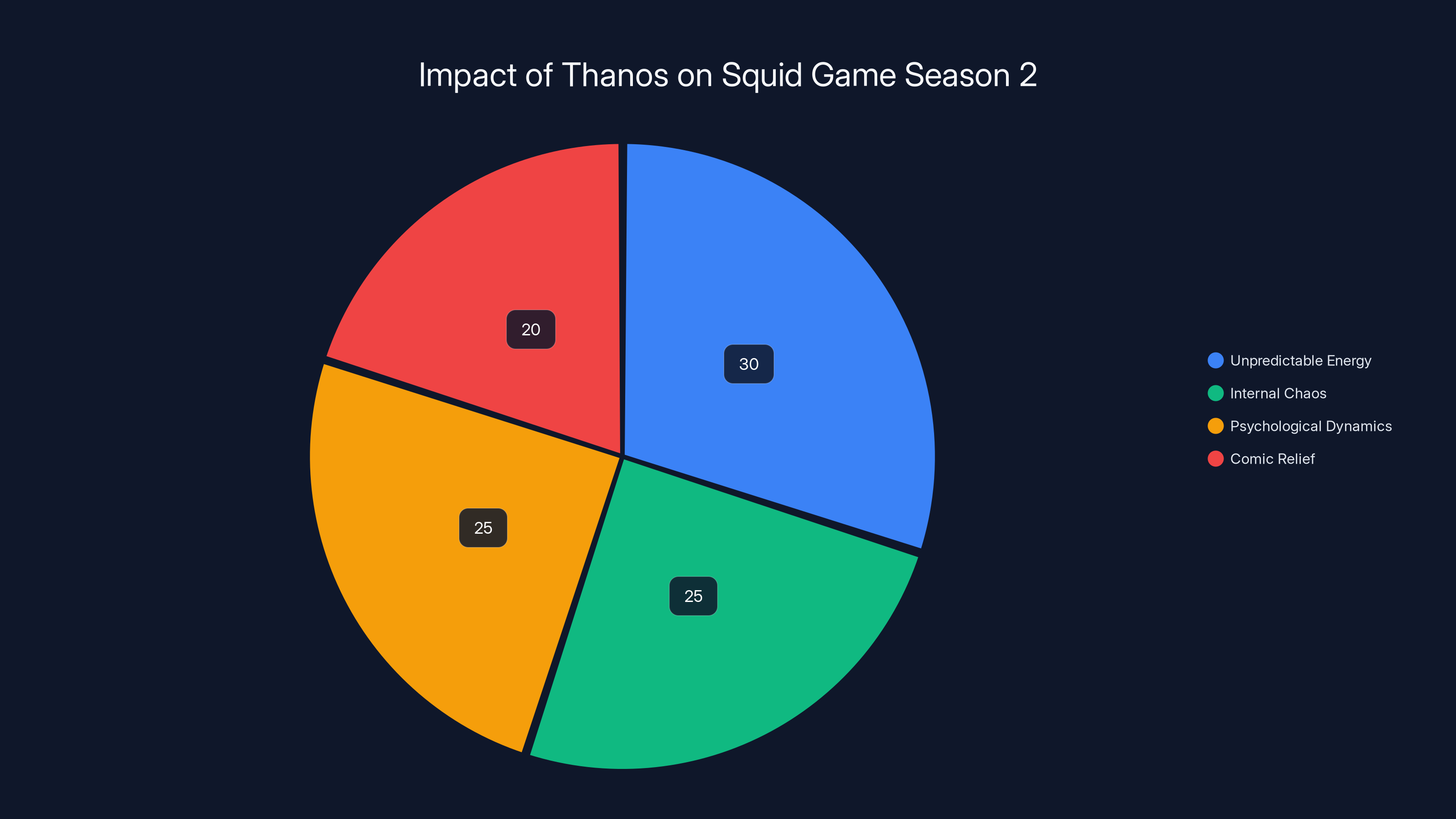
Thanos contributes significantly to the show's unpredictable energy (30%) and internal chaos (25%), while also impacting psychological dynamics and providing comic relief. Estimated data.
The Anatomy of a Perfect Secondary Character
Great television isn't built on protagonists alone. It's built on secondary characters who arrive with unexpected energy and force the entire ecosystem to reorganize. Thanos is that character in Squid Game Season 2.
A secondary character doesn't need to carry the emotional weight of the narrative. What they need to do is complicate it. They need to introduce variables that wouldn't exist without their presence. They need to make other characters reveal who they really are when exposed to a new kind of pressure.
Thanos does all of this. He enters the games as a player like everyone else, but within hours he's reorganized the entire social hierarchy. He's not working the system. He's exploiting the fundamental human need for community and belonging, which is arguably more dangerous than any individual player.
Thanos changes the answer to that question completely. Remove him from Season 2, and the psychological dynamics shift dramatically. Players who followed him lose their shepherd. The games lose their internal chaos. The show loses approximately 30% of its unpredictable energy.
What's brilliant about the character design is how he functions on two levels simultaneously. On the surface, Thanos appears to be a comedic character. He raps in English, he vapes constantly, he makes absurd fashion choices, and he says ridiculous things. For viewers looking for surface-level entertainment, he's the comic relief that makes intense moments more bearable.
But underneath? He's terrifying. Because he uses that comedy as camouflage. He's weaponizing his own relatability. Other players see someone like themselves (someone who's fallen, who's desperate, who's trying to rebuild) and they lower their guard. That's when Thanos moves. That's when he betrays.
This dual functionality is rare in television. Most characters are either sympathetic or antagonistic. Either comedic or serious. Thanos exists in all four categories simultaneously, which forces viewers to constantly recalibrate their emotional response to his presence.
The character's name adds another layer. Thanos, in the Marvel universe, is a villain who believes he's saving the universe through genocide. Squid Game's Thanos believes he's saving the players through social manipulation and strategic violence. Both are operating from distorted logic systems where harm becomes salvation. The name doesn't feel clever or ironic. It feels genuinely reflective of his worldview.
What's perhaps most interesting is that other players in the games don't seem to recognize the name's significance or its implications. They just hear "Thanos" and treat it as another player's identity. That gap between the audience's understanding and the characters' understanding is where much of the character's power lives.
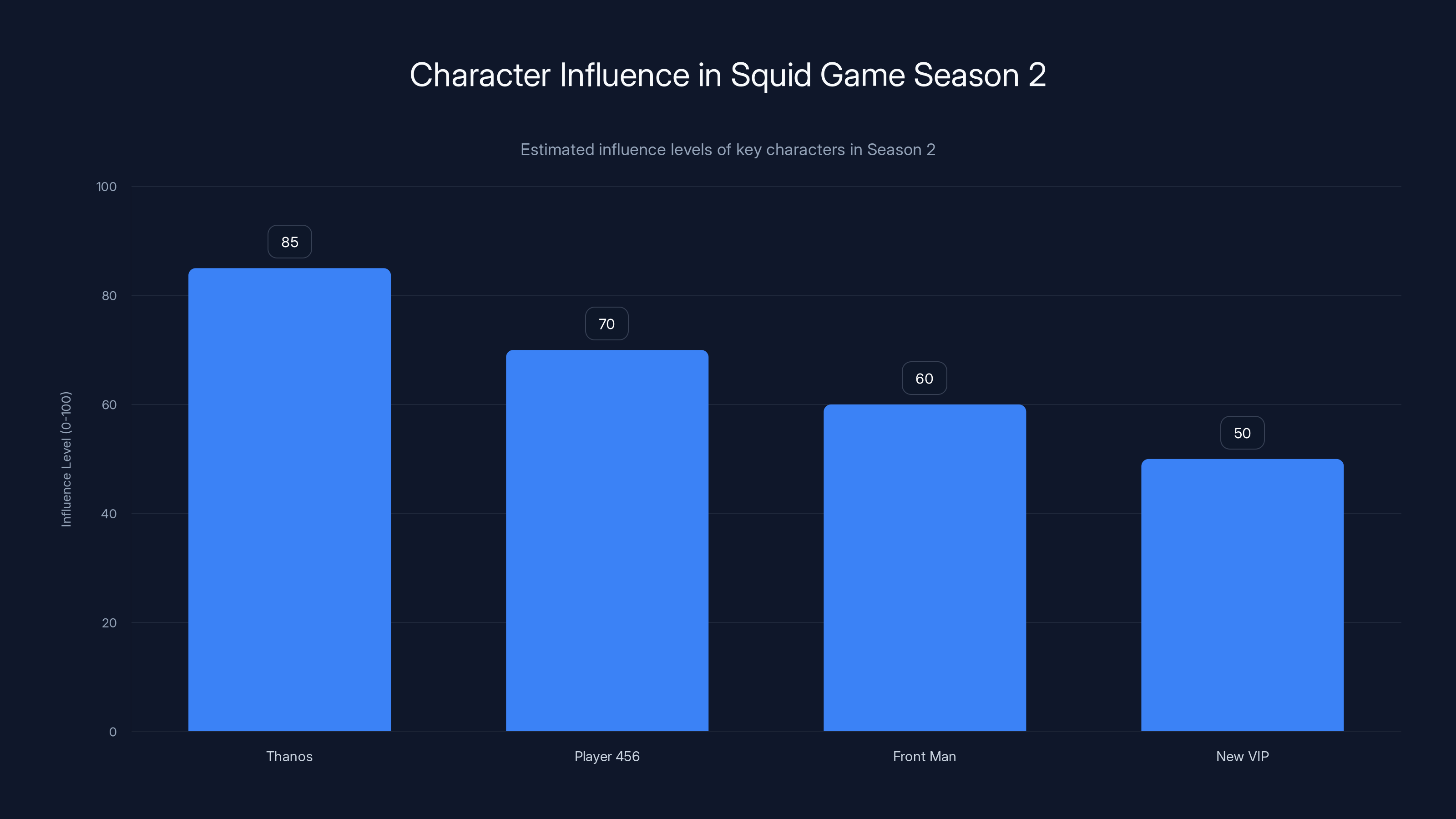
Thanos emerges as a dominant figure in Squid Game Season 2, with an estimated influence level of 85, surpassing other key characters. Estimated data.
T. O. P's Performance and the Weight of Redemption
Casting decisions matter in ways that go far beyond finding someone who can deliver lines. When you cast someone, you're bringing their entire public history into the frame, whether you intend to or not. Every decision they made before this role colors how audiences interpret every scene they're in.
T. O. P's casting in Squid Game Season 2 is potentially his biggest professional role in nearly a decade. And he absolutely brings everything to it.
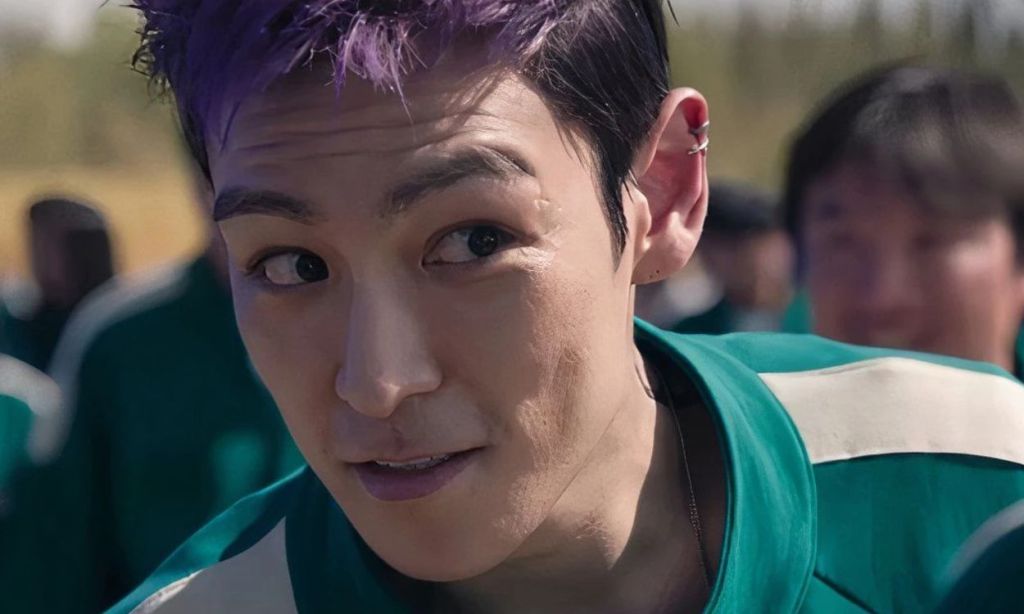
His comedic timing is sharper than you'd expect from someone primarily known as a rapper. When Thanos is being ridiculous, he commits fully to the ridiculousness. There's no self-awareness, no winking at the camera. He's fully present in the absurdity. That commitment is what separates a character that feels artificial from one that feels lived-in.
But here's where the performance really elevates the material: in the moments when the comedy drops. When Thanos realizes something or makes a calculated decision, there's a shift in his energy that's almost imperceptible unless you're watching carefully. It's in the way his shoulders adjust, the way his eyes change, the way the vaping and rapping pause for just a moment. That's where the real character work happens.
T. O. P brings a specific kind of charisma to the role that's distinctly his own. He's playing someone who uses charm as a weapon, and his actual charisma as a performer makes that feel authentic rather than theatrical. You understand why other players gravitate toward Thanos not because the script tells you they should, but because you feel it in every scene.
There's also something poignant about watching T. O. P in this role given his real-world trajectory. He's playing a character who's fallen from grace, who's desperate to rebuild, who's trying to prove something to people who've given up on him. Whether intentional or not, there's a resonance there. The performance gains weight from that context.
Some critics have argued that T. O. P isn't trained as an actor in the way that other cast members are. That criticism misses what the role actually needs. This character doesn't need someone trained in classical dramatic technique. He needs someone who can project genuine charisma while suggesting underlying darkness. He needs someone who can make comedy feel threatening.
T. O. P does exactly that.
The performance also benefits from the fact that T. O. P isn't a mainstream actor that audiences have preconceived notions about. He comes into the role without carrying the baggage of being "that guy from that movie." This freshness is valuable. It allows viewers to evaluate the character on its own merits rather than constantly comparing it to other performances.
Narrative Function: How Thanos Drives Story Without Being the Story
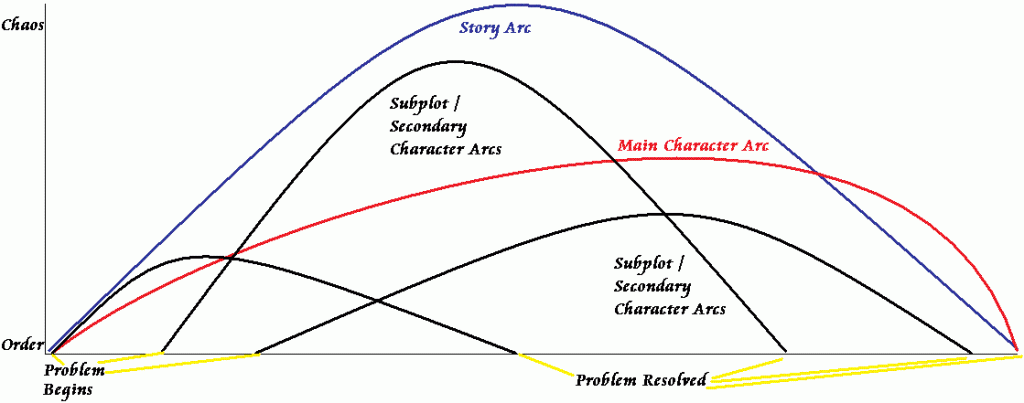
In traditional narrative theory, you'd expect a character this prominent to be driving the central conflict. But Thanos doesn't do that. He's not trying to win the games in any meaningful sense. He's not trying to expose the system or save anyone. He's just trying to have power within whatever system he finds himself in.
That's actually a more dangerous narrative function because it's unpredictable. A character with clear goals can be anticipated. A character who just wants to dominate the immediate social space around him? That's chaos that radiates outward and affects everyone.
Thanos functions as a catalyst. He enters scenes and changes the chemistry of every interaction. Players who were passive become active. Alliances that were stable become fragile. The psychological dynamics that were holding the games together start to fracture.
Look at how he operates with specific players. With the weaker ones, he's generous and charming. He offers protection. He offers community. He uses kindness as currency. But the moment they're no longer useful or the moment they question his authority, that protection evaporates.
With stronger players, he's different. He's competitive. He's testing boundaries. He's looking for allies among equals. But there's always a calculation underneath. He's never not working.
The genius of his narrative function is that he makes the audience complicit in his logic. When we watch him charm other players, we start to understand why they follow him. We start to see the appeal of what he's offering. And then he does something brutal, and we have to reckon with the fact that we almost sympathized with someone deeply manipulative.
That's character work at the highest level. It's forcing viewers to examine their own capacity for rationalization.
Thanos also serves an important function in revealing character. How different players respond to his presence tells you everything about who they really are. Some are tempted by his offer of community and have to actively resist it. Some see through him immediately. Some are terrified. Some are fascinated. Those responses drive character development more effectively than any monologue could.
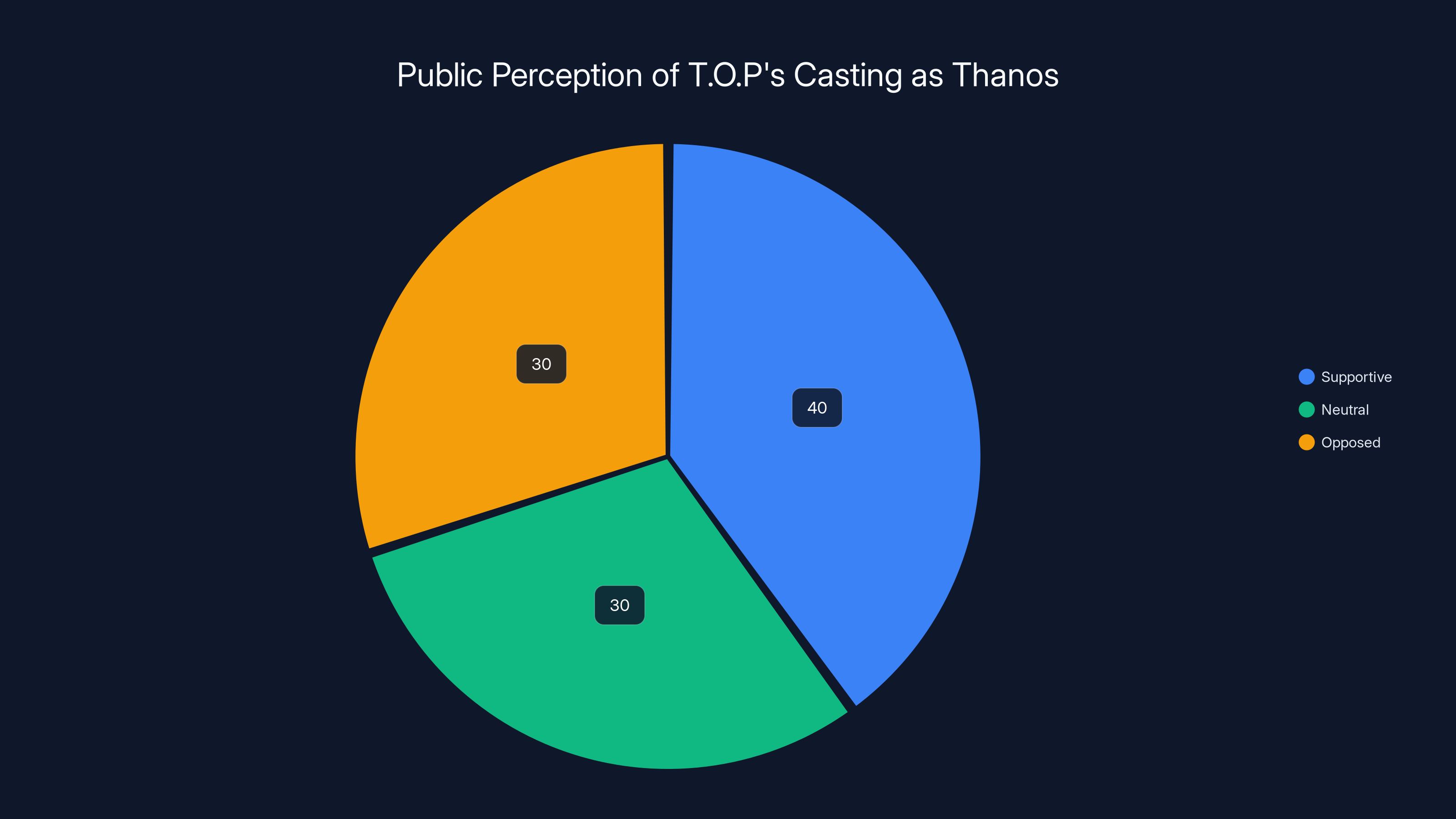
Estimated data suggests a divided public opinion on T.O.P's casting, with a significant portion supportive, reflecting the complex nature of his return to the spotlight.
The Thanos Philosophy: Chaos as Power
Thanos operates from a specific worldview that's worth examining because it's not unique to this character. It's a philosophy that exists in real organizations, real power structures, and real social groups. He believes that power comes from disrupting established hierarchies.
When he first enters the games, there's already a social order forming. Certain players are establishing dominance. Certain alliances are forming. The system is stabilizing. Thanos can't compete in a stable system because he doesn't have the resources other players have. So what does he do? He destabilizes everything.
He does this not through direct confrontation but through social engineering. He identifies what people want (community, safety, purpose) and he offers it while simultaneously undermining the systems that were offering those things. It's brilliant because it doesn't require physical strength. It requires psychological insight.
The philosophy is inherently destructive because it's not building toward anything. Thanos isn't trying to create a new stable system. He's just trying to remain on top during chaos. The moment stability returns, he loses power.
This is where his character becomes genuinely chilling. He doesn't actually want the games to have meaning or structure. He wants them to remain unpredictable and dangerous because that's where he has an advantage. Other players want to survive. Thanos wants to dominate. Those two goals are fundamentally incompatible.
What's particularly interesting is that this philosophy isn't presented as wrong in the sense that the show is trying to teach viewers a lesson. It's presented as a real strategy that works, at least for a while. Thanos does gain power. He does dominate other players. He does force people to reckon with him.
That's dangerous in television because it means viewers might be tempted to root for him not despite his philosophy but because of it. The show doesn't shy away from that temptation. It leans into it. You're supposed to feel the appeal while recognizing the cost.
The Thanos philosophy also speaks to something deeper about the games themselves. If the games are designed to reveal character through survival pressure, then Thanos is one of the most honest characters in the series because he's not pretending. He's not trying to maintain his humanity or his morality. He's just trying to win.
The Controversy: Context as Character
You can't discuss T. O. P's performance as Thanos without discussing the controversy that surrounds his casting. In South Korea, his presence in the show was contentious. His marijuana scandal, his subsequent public struggles, and the way he'd largely disappeared from public life made his return to a major television role fraught with significance.
That controversy doesn't diminish the performance. If anything, it deepens it. Because now every scene carries additional weight. We're watching someone who was publicly shamed, who lost his career position, who went largely underground, return to the public eye in a role where he plays someone exactly like him: a fallen celebrity trying to rebuild.
For South Korean viewers, this wasn't just watching a character. This was watching someone's potential redemption or re-ruination play out in real time.
The show is aware of this dynamic. Nothing is said explicitly, but Thanos's backstory as a fallen rapper who's lost his fortune isn't accidental. It's directly mirroring T. O. P's own public narrative. The casting is a risk, and the show knows it.
There's something bold about a major streaming platform making this casting choice knowing it would be controversial in its primary market. It suggests confidence in both the performance and the material. It's saying: we believe this actor and this character are worth the conversation.
Whether that's true is something viewers will have to decide for themselves. But the decision to cast him wasn't artistically safe. It was artistically brave.
The controversy also raises interesting questions about redemption and public figures. Can someone who's made serious mistakes in public return to prominence? Or is that privilege reserved for those rich enough or connected enough to disappear and be quietly rehabilitated? By casting T. O. P, the show is asking those questions not theoretically but practically.
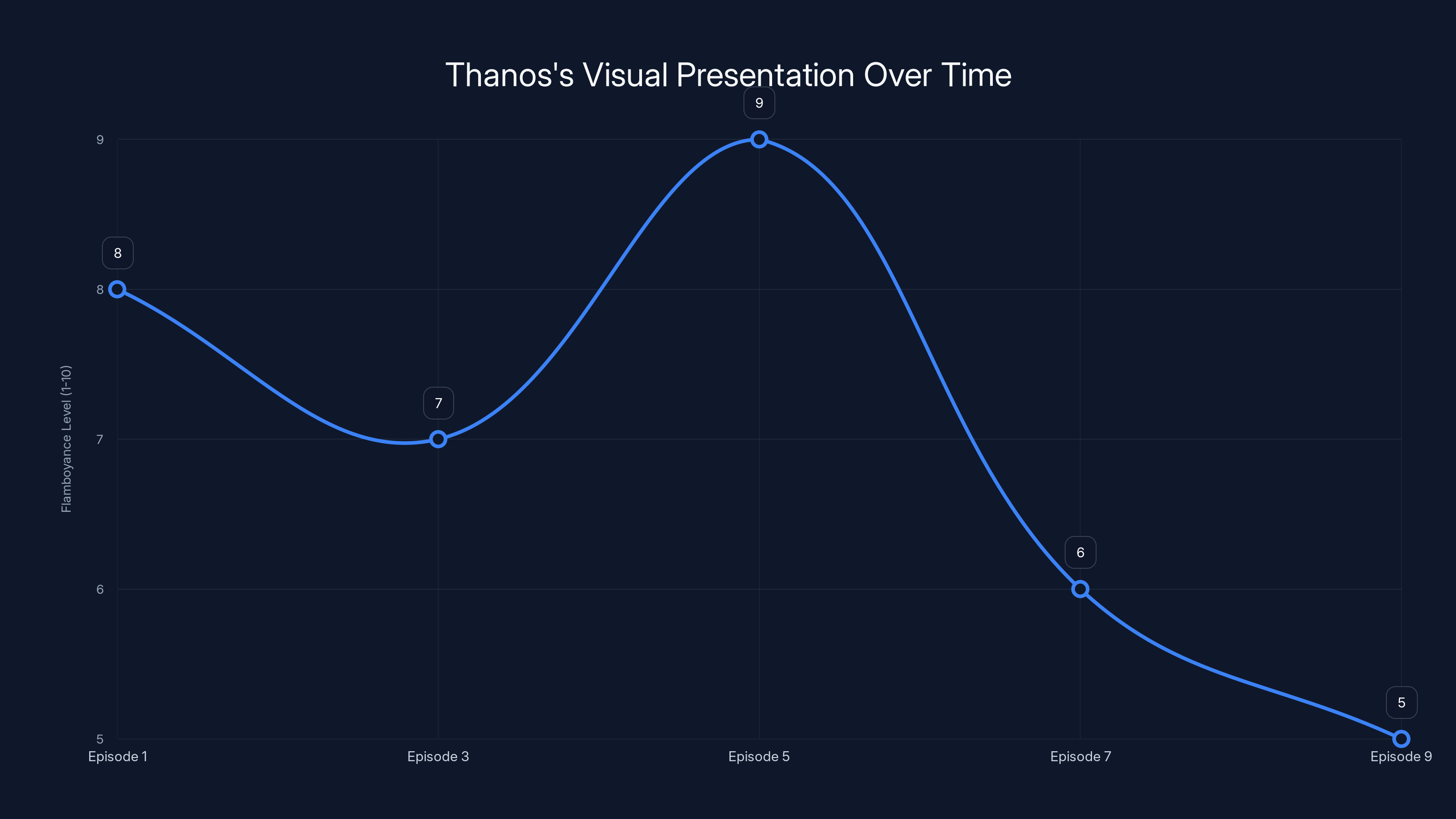
Thanos's visual presentation fluctuates, with peaks in flamboyance around mid-season, indicating changes in his internal state and perceived security. Estimated data.
Thanos and the Hierarchy of Games
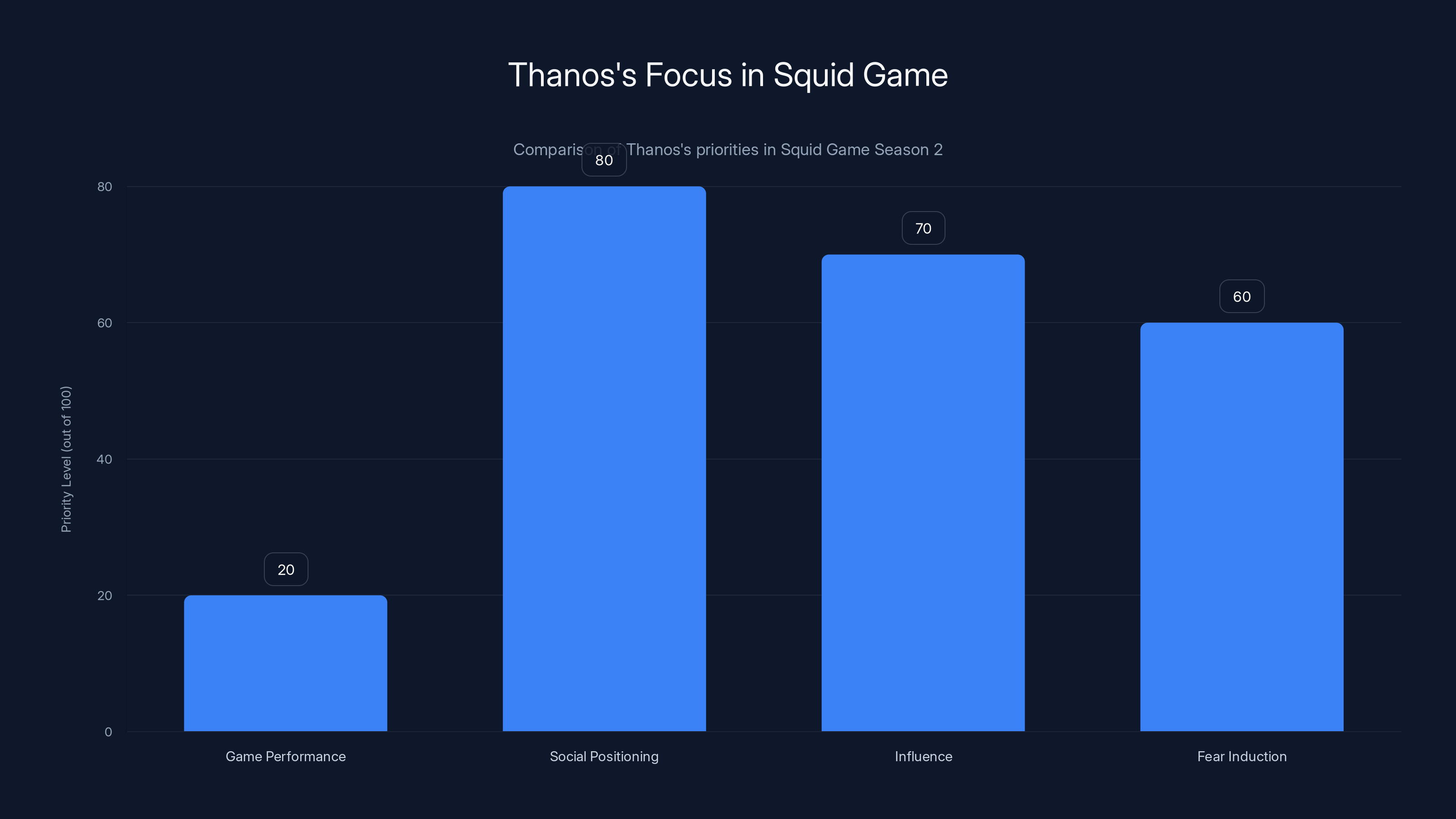
One of the most interesting aspects of Squid Game Season 2 is how Thanos interacts with the specific games being played. Because he's not trying to be the best at the games themselves. He's trying to be the most important player outside the game mechanics.
Consider how he approaches each game. He's not strategizing about winning or losing. He's strategizing about positioning. Where he stands relative to other players matters more than his actual performance in the games themselves.
In some games, he's almost inactive. He's not trying to win. He's not trying to survive. He's just ensuring that his position relative to other players doesn't deteriorate. In other moments, he becomes suddenly aggressive, but not in service of the games. In service of his internal hierarchy.
This is where his character becomes most revealing about human psychology. The games are designed to measure survival and competition based on official rules. But Thanos is competing on completely different metrics. He's measuring success in terms of influence, fear, and social position.
Other characters are confused by this because it's not rational within the context of the games themselves. Why would you spend energy on social positioning when you should be surviving the games? But from Thanos's perspective, surviving the games means nothing if he's weak and dependent when it's all over.
He's playing a longer game. He's thinking about what comes after. And that makes him more dangerous than players who are focused only on the immediate challenge.
The games themselves become almost secondary to what Thanos is doing. They're the context in which the real competition happens. And that's a fundamentally different way of understanding competition than what we've seen in previous seasons.
The Psychology of Charisma as a Weapon
Charisma is one of the most underrated and misunderstood weapons in human interaction. Most people think of charisma as inherent charm or likability. But real charisma is the ability to make people feel like you understand them, that you're seeing them, that you have their interests in mind.
Thanos is a master of this. He uses charisma as a weapon because he's learned that people will do things for someone who makes them feel valued that they wouldn't do for anyone else.
When Thanos raps to someone he finds attractive, he's not just trying to seduce them. He's demonstrating that he sees them. That they matter to him. That they're worthy of his attention. In the context of the games where everyone is disposable, being seen by someone powerful is incredibly seductive.
But here's the psychological trick that makes him dangerous: he's not lying. He does see people. He does find them interesting. His attention is genuine. It's only temporary. He gives his attention generously, and then he withdraws it just as easily.
That creates a dependency. People become addicted to being seen by him because it's the most attention they've received in years. That dependency makes them vulnerable to his manipulation.
The psychology of charisma also connects to his performance of comedy and lack of seriousness. By being funny and light, he disarms people's defenses. They're laughing, they're having a good time, they're not suspecting anything. And then the violence happens. The shift from lightness to darkness is what makes it so effective.
In real organizations and real life, this is exactly how toxic charismatic leaders operate. They're charming, they're fun, they make people feel special. And then they betray them or exploit them, and their followers are confused because they were treated so well.
Thanos is a case study in that dynamic.
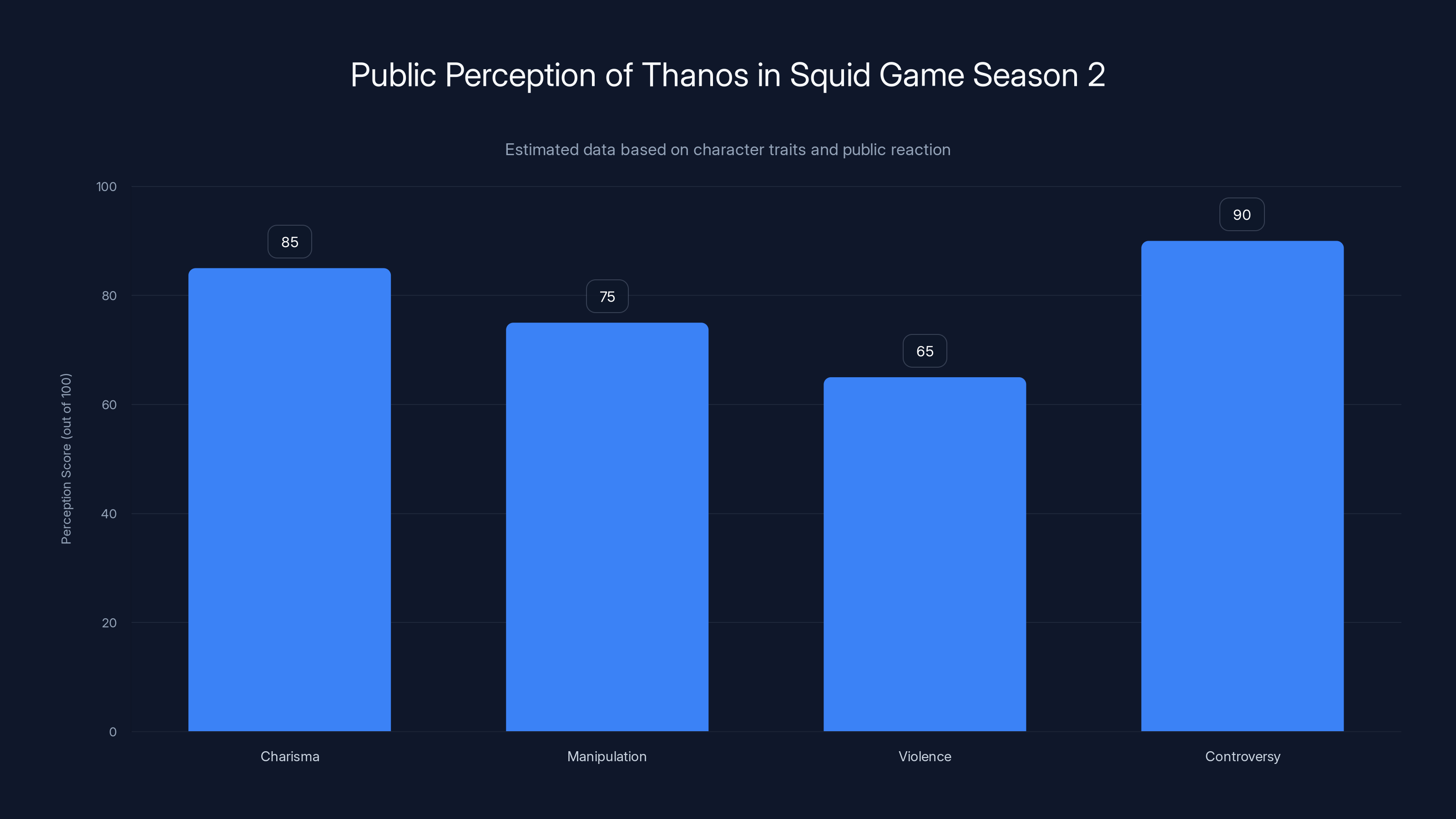
Thanos in Squid Game Season 2 is perceived as highly charismatic yet controversial, with significant manipulation and violence traits. Estimated data.
Comparison to Other Squid Game Antagonists
Squid Game has given us several antagonists across its seasons. The Recruiter from Season 1 operated through efficiency and organization. Il-nam operated through benevolent manipulation and nostalgia. Cho Sang-woo operated through ambition and self-interest. Each of these characters revealed different aspects of what happens when people lose their moral restraints.
Thanos is different in important ways. He's not trying to run the games like Il-nam. He's not trying to win through strategy like Sang-woo. He's trying to reshape the social dynamics within the games without caring about the official rules or objectives.
If Il-nam is the architect of chaos, Thanos is the practitioner of it. If Sang-woo is the ambitious climber, Thanos is the ambitious insurgent. He's not trying to move up within existing hierarchies. He's trying to replace hierarchies.
Where previous antagonists operated from positions of relative power (wealth, information, strategy), Thanos operates from relative weakness. He's a fallen rapper with nothing. And that changes everything about how he moves through the world.
Thanos is also unique in how openly theatrical he is. Other antagonists hide their true natures or operate primarily through subtlety. Thanos broadcasts who he is. He raps about his fallen status. He vapes openly. He's not trying to hide. He's declaring his presence and daring other players to challenge him.
That's a form of dominance that's different from what we've seen before. He's not trying to be liked. He's trying to be feared. But he's using charisma as the tool to generate fear rather than something more obvious.
The Thanos Legacy: What His Character Says About Modern Storytelling
The inclusion of Thanos in Squid Game Season 2 says something important about where prestige television is heading. It's increasingly willing to devote significant screen time and narrative attention to secondary characters who complicate rather than resolve the central conflicts.
Ten years ago, Thanos might have been a minor antagonist who gets eliminated relatively quickly. His scenes might have been played for laughs. His complexity might have been acknowledged but not deeply explored.
Instead, Season 2 commits to him. It takes him seriously while also taking seriously his own lack of seriousness. It gives him scenes and moments and victories. It treats his presence as narratively significant.
That shift reflects changing audience expectations. Modern viewers are sophisticated enough to appreciate characters who exist outside traditional heroic or villainous frameworks. They want characters who are fully human, which means complex, contradictory, and sometimes reprehensible.
Thanos also represents a shift in how antagonists function. The trend in modern storytelling is away from antagonists who oppose the protagonist and toward antagonists who represent alternative philosophies or value systems. Thanos isn't opposing the other players directly. He's offering them an alternative way of understanding survival and power.
That's more interesting narratively because it forces viewers to engage with his logic rather than simply dismissing him.
The character also fits into a larger pattern in recent prestige television of taking marginalized or previously dismissed characters and centering their stories. Thanos is a fallen celebrity, an outsider to the games, someone with a questionable past. And instead of that being a barrier to meaningful storytelling, it becomes the center of the story.
That's part of why the casting of T. O. P is so important. Because his own real-world status as a comeback figure mirrors the character he's playing. The art and the reality inform each other in ways that deepen both.
Thanos prioritizes social positioning and influence over game performance, making him a unique and strategic player. Estimated data.
The Subtext of a K-Pop Star Playing a Fallen Rapper
There's a specific kind of subtext that emerges from casting a real K-pop star as a fictional fallen rapper. It's not quite meta, but it's adjacent to it. It's using an actor's real-world narrative to inform their fictional narrative.
T. O. P was genuinely a major figure in K-pop. Big Bang was genuinely influential. And then his career was derailed. The fact that he's now playing a character whose career was also derailed isn't accidental. It's thematic resonance that operates at a level beyond what the script explicitly states.
For audiences who know T. O. P's history, every scene gains an extra dimension. When Thanos talks about his fallen status, they're hearing T. O. P's own narrative. When Thanos is trying to rebuild and regain power, they're seeing T. O. P's own attempt to reclaim professional relevance.
That's not easy material to work with. It would be easy for the performance to feel self-pitying or salvage. But T. O. P doesn't do that. He commits to the character's self-interest and ruthlessness, which keeps the performance from becoming autobiographical in a way that would undermine the fiction.
This also speaks to something important about casting and diversity in prestige television. When you cast someone outside traditional acting backgrounds, you get performances that can't be replicated by someone who learned their craft through drama school. T. O. P brings lived experience to this character in a way that an actor trained to play fallen celebrities probably couldn't.
The subtext also gives the character arc more weight. If Thanos were played by a traditional actor, his trajectory would be a fictional arc that we follow for the length of the show. But because he's played by T. O. P, his trajectory also represents a potential real-world arc for the actor himself. That double narrative creates pressure and depth.
Thanos as a Mirror for Audience Self-Examination
One of the most interesting things about Thanos as a character is how much he forces audience self-examination. Because viewers consistently find themselves rationalizing his behavior or understanding his motivations in ways they wouldn't for other antagonists.
Why is that? Partly because of T. O. P's performance. But also because Thanos is relatable in ways that other antagonists aren't. He's not operating from a position of wealth or power or established status. He's operating from desperation. He's someone who's lost everything and is trying to claw his way back.
That's a story people understand. That's a motivation people can comprehend even if they wouldn't act on it the same way.
But the show is aware of that sympathy and it uses it against viewers. Just when you're starting to understand Thanos and maybe even root for him, he does something violent or cruel that forces you to reckon with the fact that you've been sympathizing with someone genuinely dangerous.
That recalibration is uncomfortable. But it's also the entire point. Squid Game is fundamentally about how far people will go and what they'll become when the pressure is high enough. Thanos is an extreme version of that, but not an impossible version.
The mirror that Thanos holds up is partly about judgment and partly about self-awareness. Watching him forces viewers to ask: under what circumstances would I do what he's doing? What would have to be true about my situation for me to make the choices he makes?
That's dangerous territory for television to explore. It risks viewers deciding that Thanos is right or justified. But it also treats viewers with respect, assuming they're smart enough to hold multiple truths simultaneously: that Thanos is understandable and wrong, sympathetic and terrible, someone you can relate to and someone you shouldn't want to become.
The Visual Language of Chaos
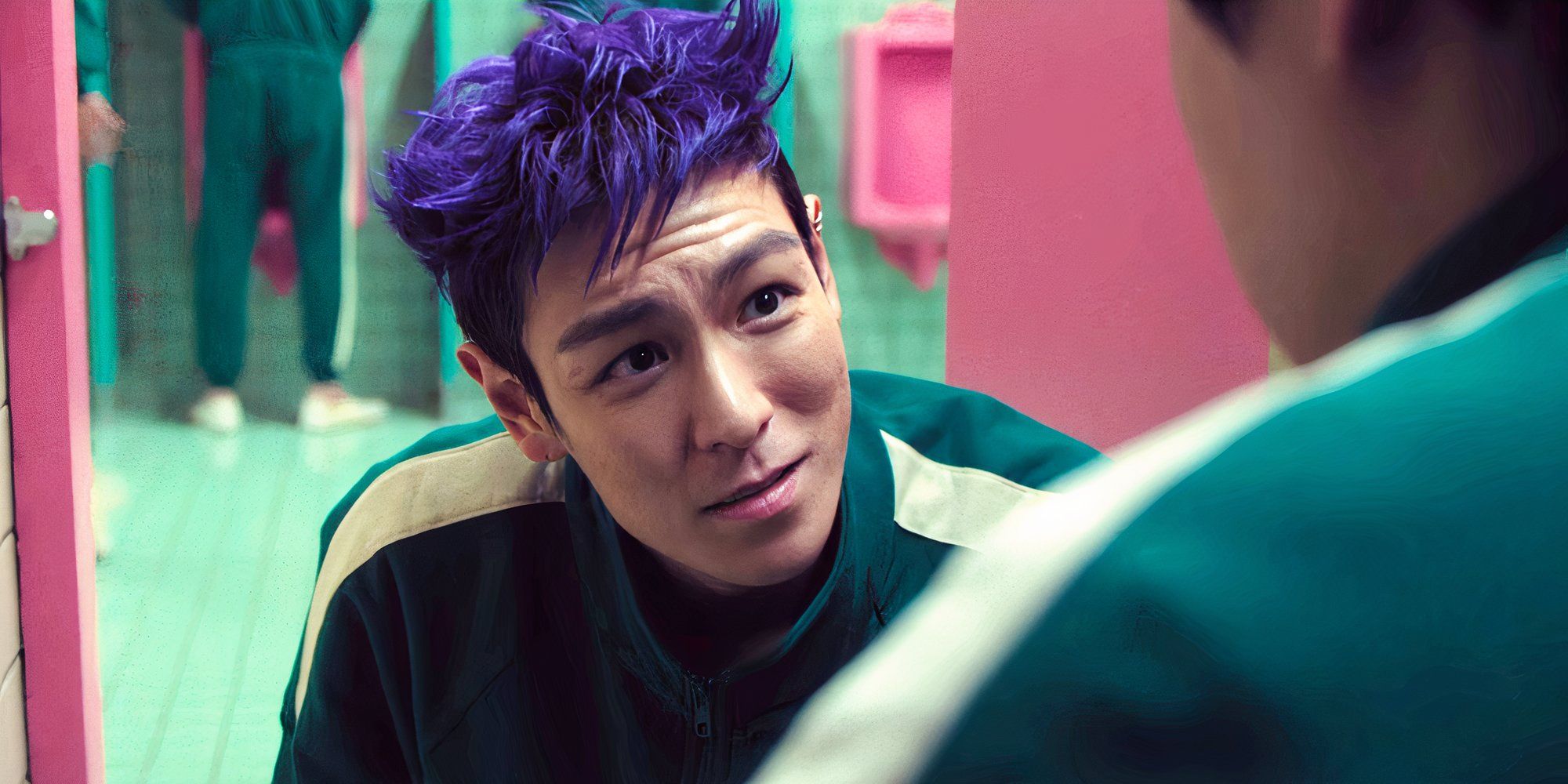
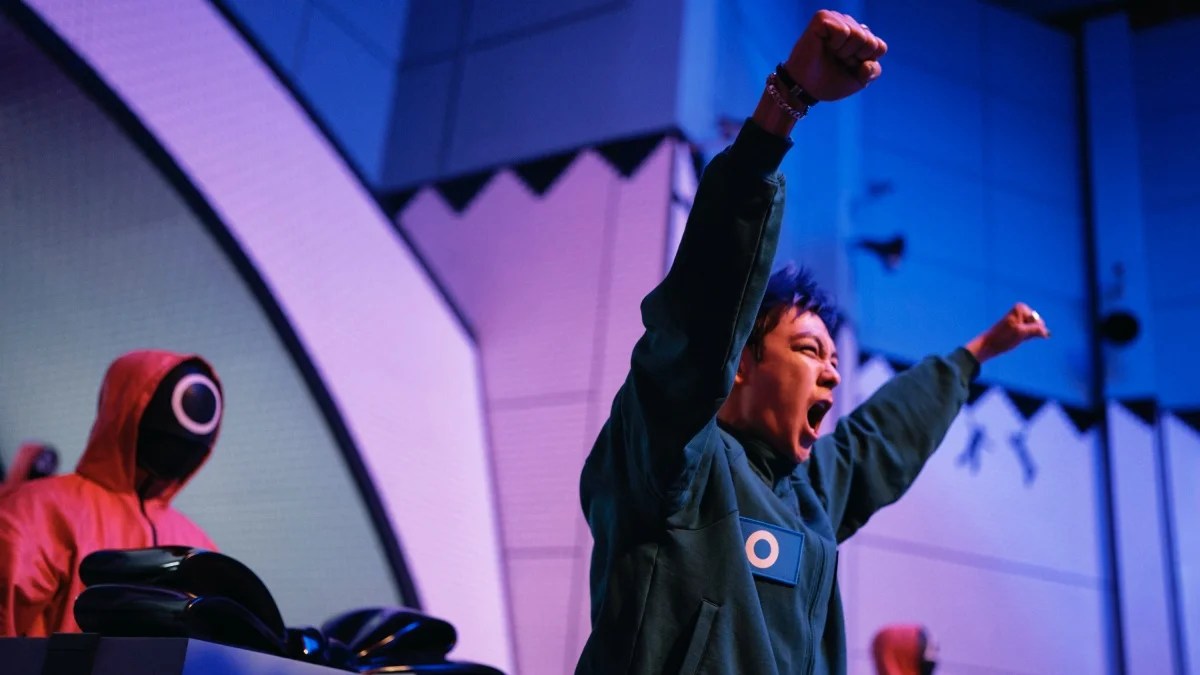
There's something almost cartoonish about Thanos's appearance and presentation. The bright colors. The constant vaping. The rapping. The theatrical energy. It's all somewhat absurd. But that absurdity is the visual language that communicates chaos.
Where other players in the games dress relatively normally, Thanos is almost a performance art piece. He's saying with his entire presentation: I'm not like you. I don't follow the same rules. I'm operating from a different framework.
The costume design and visual presentation of Thanos is crucial to how he functions as a character. Because it makes him instantly identifiable in crowd scenes. It makes him visually distinct. It communicates something about his psyche before he even opens his mouth.
The vaping in particular is a visual motif that recurs throughout his scenes. It's not just character flavor. It's behavioral communication. He's managing anxiety through substance use. He's demonstrating control even as he's potentially losing control. It's a physical expression of his internal state.
The visual language also serves to make certain scenes more effective. When Thanos becomes genuinely dangerous or genuinely emotional, the shift is more striking because his visual presentation has been so consistently chaotic. The moments where the chaos drops are the moments where viewers should pay closest attention.
Thanos's Role in the Overarching Season Arc
Without spoiling specific plot points, Thanos's presence in Season 2 has implications for the overall arc and structure of the season. His actions create consequences that ripple through the narrative and affect how other players navigate the challenges ahead.
He's not a character who exists in isolation. He's a character whose presence destabilizes the entire ecosystem. Every alliance becomes fragile. Every assumption about loyalty becomes questionable. Every moment of apparent safety becomes potentially dangerous.
That creates a tension that's different from the tension created by the games themselves. The games create external pressure. Thanos creates internal pressure. And that internal pressure is arguably more dangerous because it's harder to predict.
His role in the season also speaks to themes about power, morality, and what happens when conventional morality becomes irrelevant. In the real world outside the games, Thanos would likely be marginalized or imprisoned for his behavior. But inside the games, where traditional social structures have collapsed, he becomes powerful.
The character also represents a specific kind of threat that the show hasn't fully explored before. Not the threat of the games themselves or the institutional threat of those running the games, but the threat of other players who've decided that morality is a luxury they can't afford.
FAQ
What is Thanos's character arc in Squid Game Season 2?
Thanos enters the games as a fallen rapper desperate to rebuild his life and status. Throughout the season, he uses charisma, manipulation, and selective violence to position himself as a dominant figure among other players. His arc isn't one of redemption or transformation, but of consolidation of power. He doesn't change fundamentally. Instead, the environment reveals who he already was. By the end of Season 2, Thanos's position and influence are significantly expanded from where he started, though the costs of his approach become increasingly apparent.
Why is Thanos's character name significant?
The name directly references the Marvel villain, creating a layer of irony and thematic resonance. Like Marvel's Thanos, Squid Game's Thanos believes he's bringing balance and improvement to his world, but through methods that are morally questionable and destructive. The character is a "potent force" on a smaller scale, reshaping the social dynamics of the games just as the Marvel character tries to reshape the universe. The name also serves as a commentary on how characters like Thanos view themselves as justified in their actions, seeing themselves as visionaries rather than villains.
How does T. O. P's real-world history inform his performance?
T. O. P's casting as a fallen character attempting a comeback adds subtext to every scene he's in. His real career interruption and the public controversy surrounding him creates a resonance with the character he's playing. The performance gains depth from this alignment between actor and character. For viewers familiar with T. O. P's history, the subtext operates on multiple levels. For others, the performance stands on its own merits. This layering makes the casting a deliberate artistic choice rather than a simple casting decision.
What makes Thanos different from previous Squid Game antagonists?
Thanos doesn't operate from a position of institutional power like the game operators or from established social position like previous antagonists. He operates from weakness and desperation, using charisma and psychological manipulation rather than strategy or authority. He's also theatrical and obvious about who he is, unlike previous antagonists who tried to hide their true natures. His antagonism doesn't come from opposing the protagonist directly but from reshaping the environment in ways that complicate everyone's survival.
Is Thanos a sympathetic character?
Thanos operates in the complex territory between sympathy and judgment. His circumstances are understandable and relatable. His goals are comprehensible. But his methods are brutal and manipulative. The character is designed to create discomfort, forcing viewers to simultaneously understand his motivations and recognize his moral bankruptcy. This complexity is where the character's power lies. He's not designed to be liked but to be understood.
What does the inclusion of Thanos say about prestige television evolution?
Thanos represents the increasing sophistication of secondary character development in prestige television. Rather than being a minor antagonist or comic relief, he's given significant narrative weight and screen time. His presence compliments the overall theme of Squid Game, which explores how people change under pressure. The willingness to invest in his character arc suggests that modern audiences and creators understand the value of complex secondary characters in driving thematic work and narrative complexity.
How does Thanos's use of substances factor into his character?
Thanos's constant vaping and his implied reliance on drugs serves multiple functions. It's behavioral communication about his coping mechanisms. It suggests he manages fear and anxiety through substance use. It also creates ambiguity about whether his decision-making is sharp or impaired. This ambiguity mirrors his entire approach to the games. He's simultaneously in control and potentially losing control, and the audience is never entirely certain which is true at any given moment.
What is the significance of Thanos's interactions with specific players?
Thanos's approach varies dramatically based on who he's interacting with. With weaker players, he's generous and charming. With stronger players, he's competitive and testing. This variation reveals his fundamental pragmatism. He's not operating from consistent principles but from immediate calculations about who is useful and how they can be exploited. These varied interactions serve as case studies in manipulation and show his sophisticated understanding of human psychology.
The Broader Implications: Thanos as a Statement About Modern Villainy
When you step back from the specific details of Thanos's character and Season 2's narrative, his presence makes a larger statement about how villainy and antagonism function in contemporary prestige television.
For decades, traditional storytelling has presented clear antagonists with clear evil motivations. They want power. They want revenge. They want destruction. But modern television increasingly understands that real evil is usually more mundane and more understandable.
Thanos doesn't want to destroy the games. He doesn't want to expose them or save people. He wants what most people want: safety, status, respect. He just prioritizes those things above morality. He's not uniquely evil. He's unusually willing to do evil in service of goals that are completely normal.
That's what makes him more dangerous and more interesting than a character with grandiose evil intentions. He's uncomfortably relatable. He's the kind of person you might become under the right circumstances.
The character also represents a shift in how television treats consequence and accountability. Traditional narratives often punish antagonists for their behavior. Thanos might not receive that punishment. His actions might have consequences for other characters but the show is not obligated to deliver karmic justice to him.
That refusal to provide narrative satisfaction is part of what keeps Squid Game feeling real. Real evil doesn't always get punished. Manipulative people sometimes succeed. Dangerous people sometimes prosper. Life doesn't always deliver the narrative endings we expect.
Thanos is ultimately a character about power in its rawest form. Not power as traditionally understood through wealth or position, but power as the ability to control how other people think and act. He has that power. He exercises it consistently. And the show takes him seriously because of it.
That seriousness is what elevates the entire season. Because if you're taking Thanos seriously as a threat and a character, you're taking the fundamental instability of the human condition seriously. You're acknowledging that civilization and morality are thinner than we'd like to believe.
Conclusion: Why Thanos Matters
Thanos in Squid Game Season 2 works on multiple levels simultaneously. As a character, he's complex and compelling. As a narrative device, he drives change and complication. As a performance, T. O. P delivers something genuinely special. As a cultural statement, he represents the return of someone dismissed by society.
But perhaps most importantly, he works because he forces viewers to engage with difficult questions about morality, power, and humanity. He makes the show uncomfortable in exactly the ways that important art should make audiences uncomfortable.
He's not trying to be liked. He's not trying to be understood. He's just existing, using whatever tools he has at hand to gain power and influence. And in watching him, viewers see reflections of themselves. They see the capacity for manipulation. They see the willingness to compromise morality for advantage. They see what they might become if the circumstances were different.
That's the real power of the character. Not that he's well-written or well-performed, though he is both of those things. But that he's a mirror held up to the audience, and most people don't like what they see reflected there.
Squid Game Season 2 gave us many memorable characters and moments. But in Thanos, it gave us something rare: a secondary character who complicates the entire narrative just by existing. That's not easy to pull off. T. O. P and the creative team behind Squid Game accomplished something significant.
The controversy surrounding the casting, while real, ultimately speaks to the importance of the choice. Safe casting decisions don't generate conversation. They don't force confrontation. They don't matter in the way that this casting matters.
By bringing T. O. P into the show as Thanos, Netflix and director Hwang Dong-hyuk created a space for a fallen figure to reclaim his presence in the cultural conversation. They created a character who is simultaneously funny and terrifying, relatable and reprehensible, human and inhuman.
That's the best addition to Squid Game Season 2. Not because he's the most important character or the one with the most screen time. But because he's the character who changes everything by just being there. He's the chaos agent. He's the wildcard. He's the reminder that survival in these games isn't about playing by the rules. It's about understanding that the rules are irrelevant once the stakes become high enough.
And that's exactly what makes him essential.
For those interested in exploring more about Squid Game's character development, narrative structure, or the cultural impact of South Korean television on the global streaming landscape, Squid Game Season 2 offers rich material for analysis. Thanos is just one entry point into understanding how modern prestige television uses secondary characters to explore themes of power, morality, and human nature.
Key Takeaways
- Thanos functions as a narrative catalyst who destabilizes player hierarchies without caring about game mechanics
- T.O.P's real-world comeback narrative adds thematic weight that elevates the character beyond the script
- The character represents modern television's shift toward complex antagonists who operate from understandable motivations
- Thanos uses charisma and psychological manipulation as his primary weapons, making him dangerous not through physical dominance but social engineering
- The casting controversy in South Korea adds cultural context that deepens both the performance and the character's relevance


