
We recommend mini-LED TVs over OLED TVs if you're looking for a big-screen World Cup upgrade — here's why | Tech Radar
Overview
News, deals, reviews, guides and more on the newest computing gadgets
Start exploring exclusive deals, expert advice and more
Details
Unlock and manage exclusive Techradar member rewards.
Unlock instant access to exclusive member features.
Get full access to premium articles, exclusive features and a growing list of member rewards.
We recommend mini-LED TVs over OLED TVs if you're looking for a big-screen World Cup upgrade — here's why
When you purchase through links on our site, we may earn an affiliate commission. Here’s how it works.
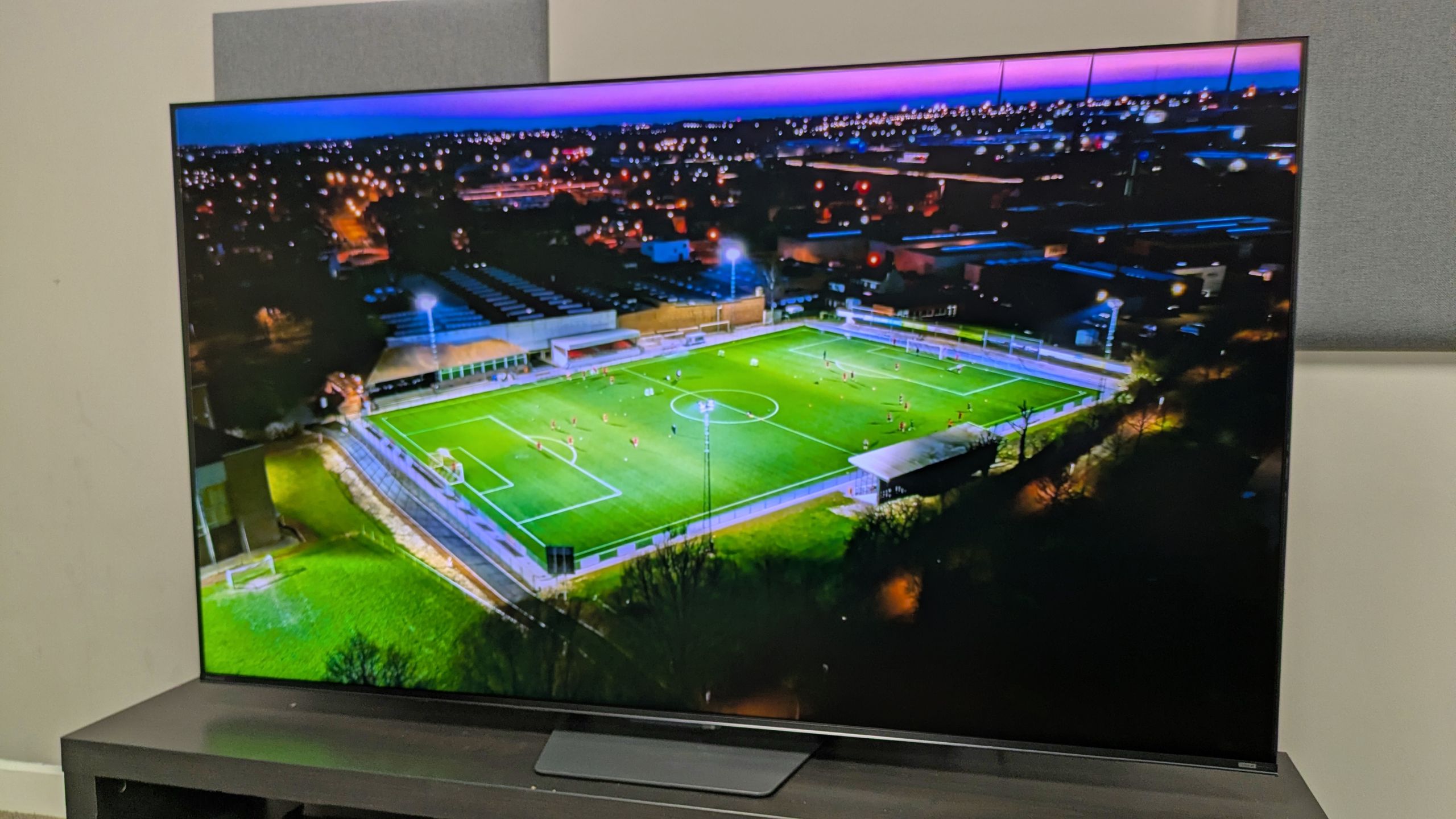
(Image credit: Future / Stock Videos-Copyright Free)
The 2026 World Cup kicks off on June 11, so that still gives you plenty of time to upgrade your TV if you’re looking for a bigger and better view of the tournament.
Over the last few years, bigger screens — 75 inches and over — have become a lot more popular, and they certainly will be for the World Cup. The big question is what kind of TV to get at these size, because the prices can get really expensive.
When it comes to big-screen sports, there’s one type of TV we recommend above the others: mini-LED.
Here are the top 6 big screen TVs I recommend for the World Cup
The 3 OLED TVs I recommend for World Cup viewing, based on my testing
The best mini-LED TVs for all budgets, tested by our experts
Why would I recommend mini-LED over OLED? There are several key reasons, and they're mostly practical concerns about getting the best value, but I’ll get into them properly below. As Tech Radar’s TV tester, I always include sports as part of my testing, so I'm speaking from experience of actually watching sports on every kind of TV.
Engineered for precision light control, the Hisense 65” U7 ensures that every frame is a masterpiece of clarity and depth with brighter highlights and deeper blacks for vibrant, lifelike pictures. Paired with advanced motion technology, the U7 expertly handles gaming, sports, and action at high speeds with no blur, lag, or smeared frames. The U7 illuminates every detail in stunning, razor-sharp precision that is smooth with colors that pop even in bright rooms.
Even mid-range mini-LED TVs have high brightness, with TVs such as the Hisense U (Image credit: Future)
OLED TVs are getting brighter, but mini-LED will always have the advantage in the brightness department. But, where mini-LED has a big advantage is in fullscreen brightness. The same G6 OLED I mentioned earlier hit 387 HDR fullscreen brightness in Standard mode. The same Hisense U75Q mini-LED I mentioned above? 887 nits: bordering on three times the brightness.
Fullscreen brightness is important for sport, as it not only means it can give a large area on the screen more impact, say the field during a soccer game, but it’s crucial for helping with viewing in bright rooms.
The brightest OLED I’ve measured to date is this year’s LG G6, which clocked in at 2,524 nits peak HDR brightness in Standard mode (the picture mode I often recommend for sports viewing). While this is a great result, even mid-range mini-LEDs will dwarf this number. Last year’s Hisense U75QG (the US mid-range mini-LED in Hisense’s lineup) hit 3,372 nits in the same Standard mode.
This peak brightness will make a huge difference when it comes to highlights on screen, such as the sun on the horizon, giving them more impact. This will likely have an effect on the color brightness of a team’s kits during the World Cup, giving them more punch.
While peak brightness is important, fullscreen brightness is a game changer when it comes to bright rooms, often limiting mirror-like reflections compared to OLED — and let's talk about those now.
Mini-LED TVs have good fullscreen brightness for handling reflections and TVs such as the Samsung QN90F (pictured) now have anti-reflection coating (Image credit: Future)
As games during this year’s World Cup are being played at all sorts of times, including during the day, this brightness can make or break your viewing, because you don't want reflections in a bright room to obscure your enjoyment.
5 essential features to look for when buying a new TV for the World Cup
Here are my 4 picks if you're looking for a new TV ready for the World Cup
I’m a trained TV calibrator, and here are the best TVs you can buy today
While OLEDs like the Samsung S95F, with its OLED Glare Free matte screen, and the LG G6, which has effective anti-reflection layer, are getting better at limiting reflections, most OLEDs still struggle. Their glossy screens are often magnets for reflections.
Even budget mini-LED TVs do a pretty good job of limiting reflections, purely thanks to their high fullscreen brightness — reflections being visible is a simple question of whether the light shining through the screen is brighter than what's being reflected, so a super-bright screen is a major advantage.
While they can still be subject to some screen glare, during my testing of TCL’s models last year (called the C-series here in the UK and headlined by the TCL C8K) I found that they more than held up to the scrutiny of the overhead lights in our testing labs. The same couldn’t be said for LG’s mid-range and budget OLEDs.
Samsung introduced the Glare Free matte screen to its Neo QLED (mini-LED) last year in the flagship Samsung QN90F, which was our pick as the best TV for sport and bright rooms in a lot of our best-of lists. Coupled with its high brightness and excellent motion handling, it made for a superb sport for TV, though it's a pricier model, and obviously value is important if you're buying a really big screen — so let's dig into that side of things.
Mini-LED TVs are significantly cheaper than OLED in most sizes. (Image credit: Future)
OLED TVs come at a premium. A mid-range model, such as last year’s LG C5, will set you back
In the UK, the numbers get a bit tighter, but it’s still a similar story. A 65-inch C5 costs around £1,299 right now, whereas a 65-inch TCL C7K (also called the TCL Q7C at some retailers) will cost £849. It's another big price gap that’s tough to justify if you’re on a budget, especially when the C7K boasts a lot of similar features, such as a 144 Hz refresh rate for gaming.
The gap gets bigger as the screen sizes get bigger. A 75-inch Hisense U8Q costs
Looking for a big screen? You can get 100-inch+ mini-LED for much cheaper than OLEDs. (Image credit: Future)
If you’re looking for a big screen for the World Cup, a mini-LED is your best bet. As more people look for cinema-sized screens at home, mini-LED has proved itself to be the better value option.
The largest OLED TV you can currently get is 97-inch, and these models are at the very premium end of the market. A 97-inch LG G5 will set you back
While you may think these 100-inch mini-LEDs will be super-cheap and dodgy models, you’d be wrong. The Hisense U8Q and TCL QM8K (TCL C8K in the UK) are just two of the models available in this 100-inch size, and these are two of the best mini-LED TVs available.
If you're in the UK, you can even pick up a 115-inch Samsung QN90F, our pick for the best TV for sport that I mentioned above, for £7,999, still a fraction of a 97-inch OLED. It’s available in the US too, but at a much higher $24,999 price. So, if you’re after the largest, readily available screens for the best price, mini-LED is your best bet.
RGB TVs are just the latest exciting panel tech that could add another dimension to your World Cup. (Image credit: Future)
RGB TVs made a big splash when they were announced at CES 2025, with the Hisense UX serving as the first model. Since then, brands including Samsung, TCL, Sony and LG have followed suit, announcing their own RGB TVs.
These TVs use RGB LEDs to boast incredible colors with the contrast of premium mini-LEDs. While we worried that it would take years for these screens to become more affordable, smaller screens, it only took a year.
The Hisense UR9, TCL RM9L and Samsung R95H are the headliners for 2026. We’ve tested the UR9, and as well as a staggering 93% BT.2020 HDR color gamut coverage, it has incredible brightness. While the HDR numbers are high, it’s the SDR number that impressed us.
In Standard mode, we measured the UR9’s peak brightness at 2,486 nits, which is the kind of level that elite OLEDs reach in HDR — it's way beyond what they can do in SDR. Considering some sports are broadcast in SDR, this number means watching in daytime sports should be a breeze for RGB TVs, especially because the Hisense UR9 and Samsung R95H both have a matter anti-reflective coating.
You’d think this new tech will cost seriously premium money, but again you might be pleasantly surprised. The UR9 75-inch is available for roughly $3,000 / £3,500: again, that's cheaper than rival OLEDs. We’re waiting on prices for other brands, but we’d expect them to be in a similar region.
We’re still early doors in our testing of RGB TVs, but it’s an exciting tech for sure, and for it to be priced at this level this early is only good news. If these TVs prove to be the real deal, they could become the number one choice for sports.
Wondering what size of TV is right for your space? Use our screen size calculator!
You tell us how far you sit from your TV, we'll tell you what size to buy based on viewing angle advice from image quality experts.
Follow Tech Radar on Google News and add us as a preferred source to get our expert news, reviews, and opinion in your feeds.
James is the TV Hardware Staff Writer at Tech Radar. Before joining the team, he worked at a major UK based AV retailer selling TV and audio equipment, where he was either telling customers the difference between OLED and QLED or being wowed by watching a PS5 run on the LG 65G2. When not writing about the latest TV tech, James can be found gaming, reading, watching rugby or coming up with another idea for a novel.
You must confirm your public display name before commenting
1 Europe races Meta and Japan to launch first Petabit-class submarine cable before 2030 as AI demand explodes
2 How to watch Bayern Munich vs Stuttgart: Live Streams, TV Schedule and Preview for DFB-Pokal final
3 Snap up the powerful and four-star-rated Dell 16 Plus laptop for under $900
4I've looked through all of today's Memorial Day appliance sales, these are the best by far — save up to $1,700 on refrigerators, coffee machines, air fryers, Ninja Slushi
5 How to watch Oleksandr Usyk vs Rico Verhoeven: live stream boxing online, start time, ringwalks, fight card, PPV cost
Tech Radar is part of Future US Inc, an international media group and leading digital publisher. Visit our corporate site.
© Future US, Inc. Full 7th Floor, 130 West 42nd Street, New York, NY 10036.
Key Takeaways
- News, deals, reviews, guides and more on the newest computing gadgets
- Start exploring exclusive deals, expert advice and more
- Unlock and manage exclusive Techradar member rewards
- Unlock instant access to exclusive member features
- Get full access to premium articles, exclusive features and a growing list of member rewards


