
Sony A7R VI review: Sony just perfected mirrorless cameras | Tech Radar
Overview
News, deals, reviews, guides and more on the newest computing gadgets
Start exploring exclusive deals, expert advice and more
Details
Unlock and manage exclusive Techradar member rewards.
I tested the Sony A7R VI and it’s perfect — seriously, Sony can stop making cameras now
Image quality, features and performance — the A7R VI has it all
When you purchase through links on our site, we may earn an affiliate commission. Here’s how it works.
-New battery type, meaning Sony's older battery isn't compatible
New battery type, meaning Sony's older battery isn't compatible
-If you don't need the improved speed, the A7R V is a better-value choice
If you don't need the improved speed, the A7R V is a better-value choice
-Still uses pricey CFXepress Type A cards for optimum performance
Still uses pricey CFXepress Type A cards for optimum performance
The best Sony cameras, ranked according to in-depth testing
The best mirrorless cameras, based on in-depth testing
We spend hours testing every product or service we review, so you can be sure you're buying the best. Find out more about how we test.
Highly-detailed images or blazing-fast performance — historically, you'd have to pick one or the other when choosing a camera. However, Sony has now given us both in one model — the A7R VI — and for me, it's the perfect mirrorless camera.
I've shot everything from detail-rich landscapes to fast-moving wildlife photography while testing the A7R VI, and it hasn't missed a beat. I've really appreciated the huge number of pixels I have to play with, which means that heavily cropping into images is entirely possible.
Its new 66.8MP stacked full-frame sensor resolves more detail than the sensor in the 50MP A1 II — Sony's previous flagship camera for quality and performance — and most of that camera's speed in terms of sensor readout.
I say 'most', because its readout speed is half that of the A1 II, and able to support autofocus up to 60fps, but it has certainly been sufficiently speedy for just about every scenario I've used it in. And rolling shutter distortion is minimized compared to the A7R VI's predecessor, the A7R V — I shot with both cameras at the same time in order to make direct performance comparisons.
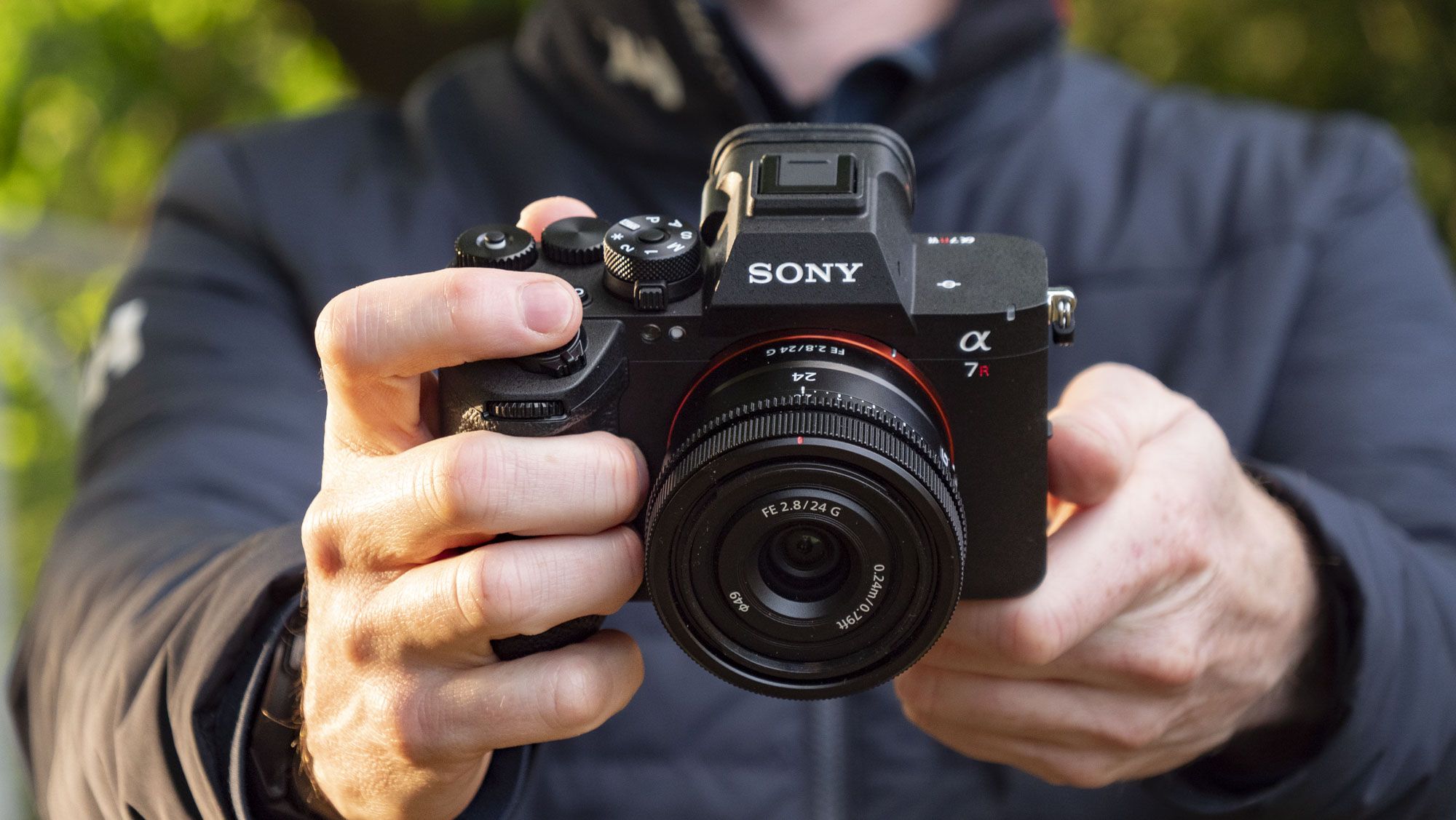
The A7R VI is slightly bigger than its predecessor, with a larger grip housing a new, larger battery (Image credit: Future / Tim Coleman)
Even better, the A7R VI costs £4,500, which seriously undercuts the pricier A1 II. Considering what the A7R VI can do, the A1 II feels somewhat redundant, especially when the speed-specialist A9 III is also on the scene for the likes of pro sports photographers who demand the absolute fastest performance.
Of course, that's still a decent chunk of anyone's money, and the A7R VI costs a lot more than the still-incredible A7R V, which has fallen in price since its launch in 2022, and is probably the better value pick if detail is all that matters to you.
However, given the upgrades here, which also include a new and higher-capacity battery type, the A7R VI's starting price feels justified. I've been reviewing cameras for 15 years, and I think Sony just made the first one that's perfect. I could happily dine out on its skills for many years to come.
However, the A7R VI is still pretty small (Image credit: Future / Tim Coleman)
Yes, the A7R VI'S £4,500 launch price is higher than that of the A7R V, which cost £4,000 on its announcement late in 2022, and which can now be had for around £3,000. That said, the A7R VI is more camera — it's not just a resolution king, but a speed demon too.
When you consider what the A7R VI is capable of versus the Sony A1 II, which costs more than £6,000, it feels like excellent value.
66.8MP full-frame (36 x 24mm) fully stacked BSI CMOS
66.8MP full-frame (36 x 24mm) fully stacked BSI CMOS
Still lightweight and small versus rival high-resolution full-frame cameras
Touchscreen features a 4-way axis, the detailed EVF detail packs 9.44m dots
For recent models, Sony has made great strides in improving how its cameras handle, and how easy the menus and controls are to navigate. It's no longer the case that rival Canon and Nikon cameras are simply easier and more intuitive to use.
For starters, Sony has improved the design of the grip — on the A7R VI it's even bigger and more pronounced than before, no doubt to house the upgraded and physically larger new battery type which debuts here (more on this in the performance section).
The new bulb button on the camera's top plate illuminates key buttons in low light, making them easier to find in the dark, and there's a tally lamp for video recording. Each port sits behind its own rigid door, which when in use sits neatly out of the way. These are all lovely additions to what is otherwise a very similar design to the A7R V.
Like before, we get three control wheels for exposure adjustments (one of which is lockable), four custom buttons (though not one on the front of the camera, sadly), a grippy AF joystick and a four-way control dial which also includes drive mode and ISO shortcuts.
There's a neat 3.2-inch touchscreen with 4-way articulation, meaning the screen can be flipped out to the side and viewed at awkward angles, whether you're shooting in vertical or horizontal format. There's a highly detailed 9.44m-dot EVF, too, but this time it's a HDR DCI PW display which Sony says is 3x brighter than the one in the A7R V.
We get twin card slots again, and each slot accepts either an SD card or one of Sony's CFexpress Type A cards. Per gigabyte, CFexpress Type A cards are among the most expensive, more so than CFexpress Type B used in rival cameras. Of course you can use cheaper SD cards, but you'll want a CFexpress card to get the A7R VI's speediest performance for burst shooting and so on.
Naturally, with this being a pro body, the A7R VI is weather-resistant. I'm not in the habit of wrecking cameras, and certainly not review samples that I have to send back, but you can feel that the A7R VI is rugged too. The back-right control dial has a tiny bit of give, and could be a weak point, but it performed fine during my review.
If I was to have one criticism, it's that the camera body still feels a little cramped — many of the controls are small and tightly packed together. You'll also want a vertical grip when pairing the A7R VI with big lenses for better balance, such is its compact design. But overall, the A7R VI is as good a camera body as Sony has ever made.
The sensor is stacked with rapid readout speed, minimizing rolling shutter distortion
A new higher-capacity NP-SA100 battery makes its debut
Subject tracking autofocus performance further boosted with new chip
While the A7R VI's design is a minor upgrade, its performance reaches new levels thanks to a new 66.8MP stacked sensor, new Bionz XR 2 processor, combined processing and AI chip (as in the Sony A7 V), and an entirely new battery. Let's look at each of these in more detail, starting with the sensor.
Not only is the sensor the highest-resolution for the full-frame format at 66.8MP, it's a stacked sensor, which means a faster readout speeds, and a half-stop boost in image stabilization performance, now up to 8.5 stops.
Stacked sensors power everything from rapid autofocus speed to minimizing rolling shutter distortion. The A7R VI's is faster than the A7R V's regular 61MP sensor, but not quite as quick as the A1 II's 50MP stacked sensor, nor the A9 III's 24MP global shutter.
We also get a next-gen processor, the Bionz XR 2. Top features include 10fps burst shooting (mechanical shutter) for up to 535 frames in compressed RAW, and up to 30fps blackout-free (electronic shutter) for up to 150 shots — the latter is a three-second burst.
One of the buttons can be assigned as a burst-shooting boost, meaning you can tick over at, say, 10fps in using the electronic shutter and up this to 30fps when a key moment occurs.
Burst shooting is also supported by the pre-capture feature, where up to one second of shots can be buffered with the shutter half-pressed, before you fully press the shutter to engage a sequence.
The A7R VI's subject detection autofocus recognised the guinea pigs, including body shape and eyes, for accurate autofocus(Image credit: Future / Tim Coleman)
Same for humans(Image credit: Future / Tim Coleman)
And birds, even when small in the frame(Image credit: Future / Tim Coleman)
Here I've cropped into the image by 1.5x, emulating the APS-C crop (28MP)(Image credit: Future / Tim Coleman)
Like in the A7 V, the A7R V combines the processing chip with the dedicated AI chip — the setup found in previous-generation cameras like the A7R V — into a single chip, for greater efficiency and power conservation, and for smarter autofocus and accurate auto white balance and color rendition.
In addition to a boost in the maximum possible length of burst shooting sequences before the camera slows up, there's an auto subject-detection mode this time around, which is very handy if you regularly switch between subject types, plus dedicated subject-tracking modes for as humans, birds, animals and vehicles, with the camera able to recognize head, eyes and even body shape (human pose), to intelligently understand where exactly to focus on, with a super impressive hit ratio of sharp shots.
I photographed a lot of birdlife, and found the bird detection autofocus super reliable, and even able to pick out subjects when they only took up a small portion of the frame. Those who like to use spot focusing will enjoy seeing the size options expanded, with new XL and XS options for wider or even more precise focusing.
And then there's the new battery, a NP-SA100 unit with 2,670m Ah capacity. For Sony photographers, this one is a big deal — the first new battery for Sony mirrorless cameras in nine years, since the legendary NP-FZ100.
The new battery is physically larger and has a 17% bigger capacity than the NP-FZ100's 2,280m Ah, which already delivered rival-beating power, so that's the good news.
The bad news is that the batteries are not forwards / backwards compatible. You can't use your stock of NP-FZ100 batteries in the A7R VI, nor can you use the new NP-SA100 in an older Sony camera.
Batteries, along with the continued use of Sony's own CFexpress Type A cards, are another potential costly extra, which will no doubt irritate some Sony fans keen on the A7R VI. I certainly enjoyed having two NP-SA100 batteries and a charging dock for long weekends of heavy shooting, and would personally factor that into a purchase. The bottom line, though, is that the new battery's life is better — and who wouldn't want that?
The highest-resolution full-frame sensor in a mirrorless camera, and it's a stacked type
Dynamic range boosted by one stop to a class-leading 16 stops
I've used a range of lenses and autofocus modes, and shot at various ISO values given that I've photographed in good light and low light, and employed severe cropping for some of my favorite bird photos. Throughout, I've been blown away by the A7R VI's quality(Image credit: Future / Tim Coleman)
The 'R' series of A7 cameras have always been about detail — delivering the highest-resolution stills that Sony cameras are capable of. And the A7R VI boosts the series further, from 61MP to 66.8MP, and this is achieved with a substantial boost in performance thanks to the stacked sensor.
There are some who would have preferred an even bigger boost in resolution over a boost in speed — there was a time when the A7R VI was rumored to come with a (regular) 100MP sensor. For me, however, as someone who photographs everything from landscapes to portraits and wildlife, I prefer the versatility of the A7R VI's sensor. It's basically perfect for my needs.
With a stacked sensor, there's a risk of some compromises in image quality, especially in low light. Thankfully, in the case of the A7R VI, the opposite is true, and dynamic range is further boosted from 15 stops to 16 stops.
Some of my favorite bird photos shot with the A7R VI and 400-800mm F6.3-8 lens. The first photo is the full-resolution 66.8MP file(Image credit: Future / Tim Coleman)
And the second is the 1.5x Super 35 (aka APS-C) crop with 28MP resolution(Image credit: Future / Tim Coleman)
I preferred an even tighter crop for the first image, this is how the framing looks with the image cropped down to 14MP. (Image credit: Future / Tim Coleman)
I don't usually need 66.8MP stills, but being able to crop into such large files can be super handy. For example, I took a lot of bird photos, and even with Sony's 400-800mm lens, which is its longest telephoto lens, the tiny, distant subjects at times appeared small in the frame.
No problem: I could crop right in and still enjoy super-sharp detail. To give you an idea, the 1.5x (APS-C) crop mode is still 28MP, which is a huge file size. Employing that crop with the 400-800mm lens is effectively like having a 1200mm lens! This is where high-resolution cameras can be particularly helpful.
Color is also improved, with the subject-detection AI chip analyzing the scene for better auto white balance (AWB). For example, where older AWB systems might look at a lush green woodland scene and compensate with the opposing tone, resulting in an overly magenta hue, the A7R VI knows it's a woodland, or a person in the shade, and will select the right tone for the scene.
Skin tones looks spot on, dynamic range is impressive. There are no weaknesses when it comes to image quality(Image credit: Future / Tim Coleman)
Video recording looks similar to the A7R V's going by the numbers: 8K up to 30fps and 4K up to 120fps, and still no open-gate recording, but the new stacked sensor minimizes rolling shutter distortion, making the A7R VI a better option for video than its predecessor. It's also equipped with more filmic color profiles.
Pricier than its predecessor, but much cheaper than the A1 II, which it outperforms in many ways
Pricier than its predecessor, but much cheaper than the A1 II, which it outperforms in many ways
It inherits Sony's best design from the A7 V / A9 III and adds a few nice features, with superb ergonomics and rugged build
It inherits Sony's best design from the A7 V / A9 III and adds a few nice features, with superb ergonomics and rugged build
The 66.7MP stacked sensor and AI processor chip are a revelation
The 66.7MP stacked sensor and AI processor chip are a revelation
66.8MP stills, 8K video, 16-stops dynamic range — show me a better full-frame camera
66.8MP stills, 8K video, 16-stops dynamic range — show me a better full-frame camera
You want Sony's most complete professional camera yet Yes, the pricier A1 II is a little speedier in some specific ways, and the specialist A9 III quicker still, but the A7R VI takes the speed-plus-resolution crown in Sony's mirrorless camera lineup.
You shoot everything from landscapes to wildlife photography With a 66.8MP stacked sensor, up to 30fps burst shooting, incredible autofocus performance and a rugged build, the A7R VI is a true all rounder.
You specialize in one genre of photography Just shoot sports and action, or major in flash photography? The A9 III is your best bet, or even the A1 II. Highly detailed landscape photography your thing? The A7R V gets you most of the quality of the A7R VI, and it now costs much less.
You like upgrading gear regularly I'm being tongue in cheek here, but I suspect that once you get an A7R VI, your search for the perfect camera will be complete, and you can settle down for a good years to come.
The A7R VI's predecessor is a stellar alternative if highly detailed pictures top your priority list. It packs a 61MP sensor — so just 6MP less than the A7R VI — the same burst-shooting speed, and it now costs much less, as its price has fallen steadily over its four-year life.
Sony loaned me the A7R VI four weeks before it was announced
I had four lenses to use with it, plus twin batteries and a charging dock
I've taken photos and videos of a wide range of subjects to test key feature
I had the chance to test the Sony A7R VI for four weeks ahead of its announcement, and used it with four lenses: a small 24mm f/2.8 prime, the 28-70mm F2 GM, 70-200mm F4 G OSS II Macro and 400-800mm F6.3-8 telephoto zoom. I was also supplied with two batteries and the twin charging dock.
Given the camera's high-resolution stacked sensor and latest processor, which incorporates the previously separate AI chip, I wanted to test the camera's image quality and performance in a wide range of scenarios, which included landscape photography, wildlife photography, portraiture and more.
I also tested its burst-shooting skills, shooting in both the mechanical and electronic shutter modes, and noting how many photos the camera could capture before slowing up.
Sony also loaned me the A7R VI's predecessor, the A7R V, so I was able to make various performance comparisons, especially around high-speed photography.
Tim is the Cameras editor at Tech Radar. He has enjoyed more than 15 years in the photo video industry with most of those in the world of tech journalism. During his time as Deputy Technical Editor with Amateur Photographer, as a freelancer and consequently editor at Tech Radar, Tim has developed a deeply technical knowledge and practical experience with cameras, educating others through news, reviews and features. He’s also worked in video production for Studio 44 with clients including Canon, and volunteers his spare time to consult a non-profit, diverse stories team based in Nairobi. Tim is curious, a keen creative, avid footballer and runner, and moderate flat white drinker who has lived in Kenya and believes we have much to enjoy and learn from each other.
You must confirm your public display name before commenting
1 Rivals season 2 creators reveal Jilly Cooper script notes just days before death
2 The Punisher: One Last Kill draws Marvel fan ire over Disney+ visuals and sound problems
3 Foxconn confirms cyberattack hit some North American factories — hackers say they stole 8TB of data, including Apple and Nvidia files
4 Microsoft's May update for Windows 11 is here boasting 4 key features
5 Canon EOS R6 V vs EOS R6 III and EOS R50 V: here are 5 things you need to know
Tech Radar is part of Future US Inc, an international media group and leading digital publisher. Visit our corporate site.
© Future US, Inc. Full 7th Floor, 130 West 42nd Street, New York, NY 10036.
Key Takeaways
-
News, deals, reviews, guides and more on the newest computing gadgets
-
Start exploring exclusive deals, expert advice and more
-
Unlock and manage exclusive Techradar member rewards
-
I tested the Sony A7R VI and it’s perfect — seriously, Sony can stop making cameras now
-
Image quality, features and performance — the A7R VI has it all


