
Haven-1 Commercial Space Station: Assembly, Launch Timeline & Future Impact [2027]
Introduction: The Dawn of Commercial Space Stations
The landscape of human spaceflight is undergoing one of its most dramatic transformations in decades. For nearly 25 years, the International Space Station (ISS) has served as humanity's primary orbital laboratory, facilitating countless scientific discoveries and becoming a symbol of international cooperation in space exploration. However, this iconic facility is approaching the end of its operational lifespan. NASA has announced that the ISS will be decommissioned sometime before 2031—a deadline that creates an urgent need for replacement infrastructure.
Enter the era of commercial space stations. Rather than developing and operating successor facilities itself, NASA has pivoted to a strategy of contracting with private companies to build, maintain, and operate orbital platforms. This fundamental shift represents a seismic change in how humanity approaches space infrastructure. Instead of government-owned monopolies, we're witnessing the emergence of a competitive commercial space economy where multiple private entities are racing to establish the next generation of orbital facilities.
Among the companies competing in this high-stakes competition, Vast Space has emerged as one of the most aggressive and well-capitalized players. The company is pursuing a two-pronged strategy: first, launch a smaller interim station called Haven-1 to demonstrate technical capability and generate revenue through commercial missions, and second, develop Haven-2 as a larger, longer-duration facility that will eventually become Vast's primary offering.
The recent announcement that Haven-1 will launch in the first quarter of 2027—rather than mid-2026 as previously scheduled—provides valuable insight into the real-world challenges of building space infrastructure at commercial timescales. This timeline slip, while significant, actually underscores how aggressively Vast Space is pursuing its objectives. The company will have designed, manufactured, tested, and prepared to launch the world's first privately-developed commercial space station in just under four years from ground-up conception—a feat that would have seemed impossible in the government-space era.
This article examines Haven-1 in comprehensive detail: the technical architecture that makes it possible, the assembly milestones that demonstrate progress, the competitive dynamics that are accelerating timelines, the crew selection and training processes that will put humans aboard, and the broader implications for the future of space commercialization. We'll also explore how Vast Space fits within the larger ecosystem of commercial space station developers and what this transition means for the future of orbital research and utilization.
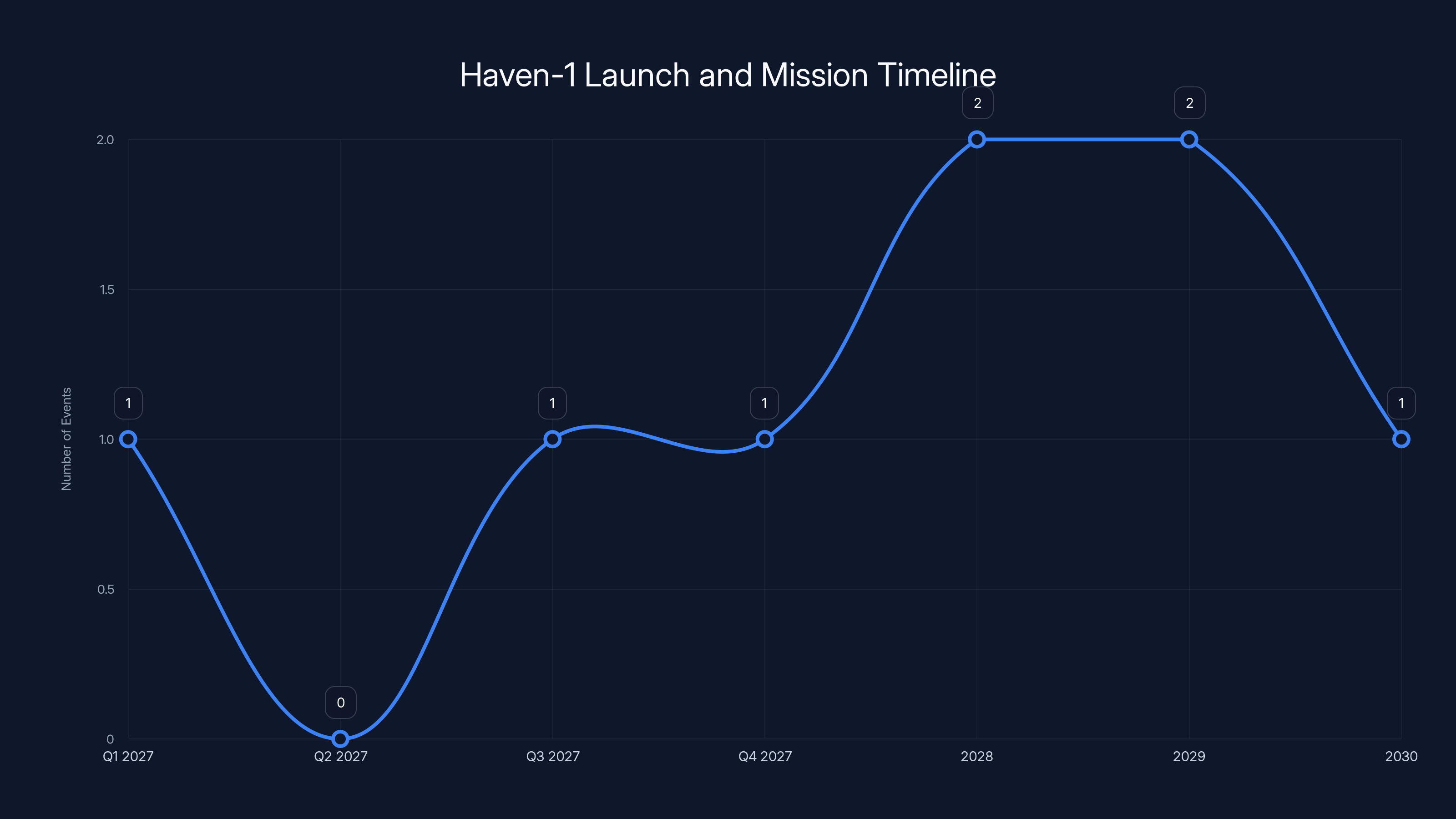
Haven-1 is set to launch in Q1 2027, with the first crewed mission expected between Q2 and Q3 2027. Four crewed missions are planned over its three-year lifespan, occurring approximately every 6-12 months. Estimated data.
Understanding Haven-1: The Interim Commercial Space Station
The Strategic Rationale for a Two-Station Approach
Vast Space's decision to develop Haven-1 as an interim facility before building Haven-2 reflects a sophisticated understanding of market dynamics, technical risk, and revenue generation. Rather than betting everything on a single, larger, more complex station—an approach that would extend development timelines and increase financial risk—Vast has opted for a phased approach.
Haven-1 serves multiple strategic purposes simultaneously. First, it demonstrates technical viability. A successful Haven-1 mission validates Vast's manufacturing processes, systems integration, life support capabilities, and operational procedures. This proof-of-concept reduces the technical risk associated with Haven-2, making it easier to secure additional investment and operational contracts. Second, it generates revenue. Haven-1 will host paying customers—both private individuals and potentially international partners—creating cash flow that can fund Haven-2 development. Third, it establishes operational expertise. The teams that operate Haven-1 will develop real-world experience managing an orbiting facility, handling crew rotations, conducting experiments, and responding to anomalies. This institutional knowledge is invaluable and cannot be acquired any other way.
The Haven-1 design philosophy emphasizes reliability over maximum capability. Rather than attempting to pack in every possible feature or maximize the volume and power available, the designers focused on creating a robust, dependable platform that can support short-duration missions (typically 10-15 days) with small crews. This pragmatic approach reduces complexity, accelerates the development timeline, and minimizes the risk of catastrophic failures that could derail the entire program.
Technical Architecture and Core Systems
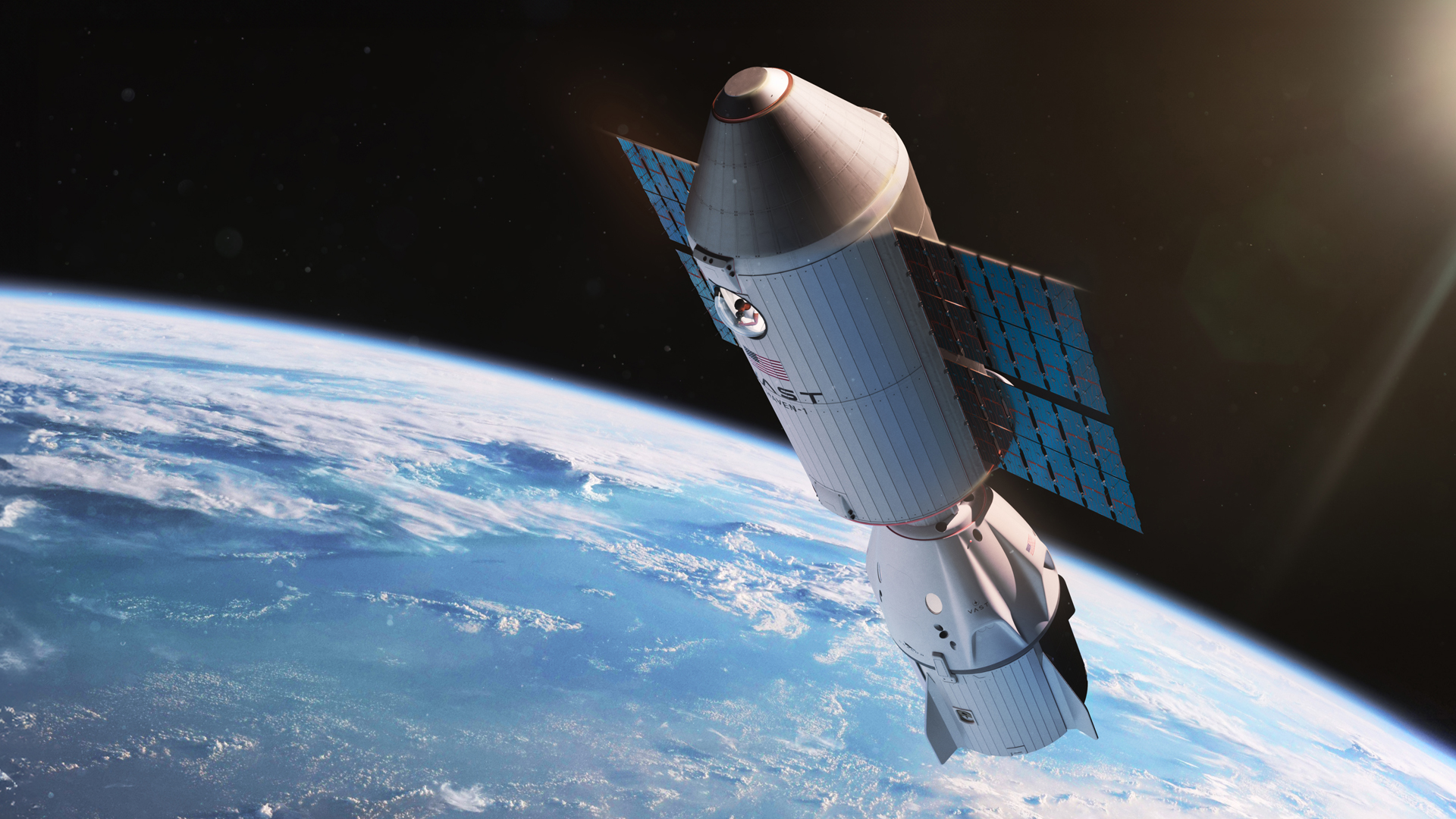
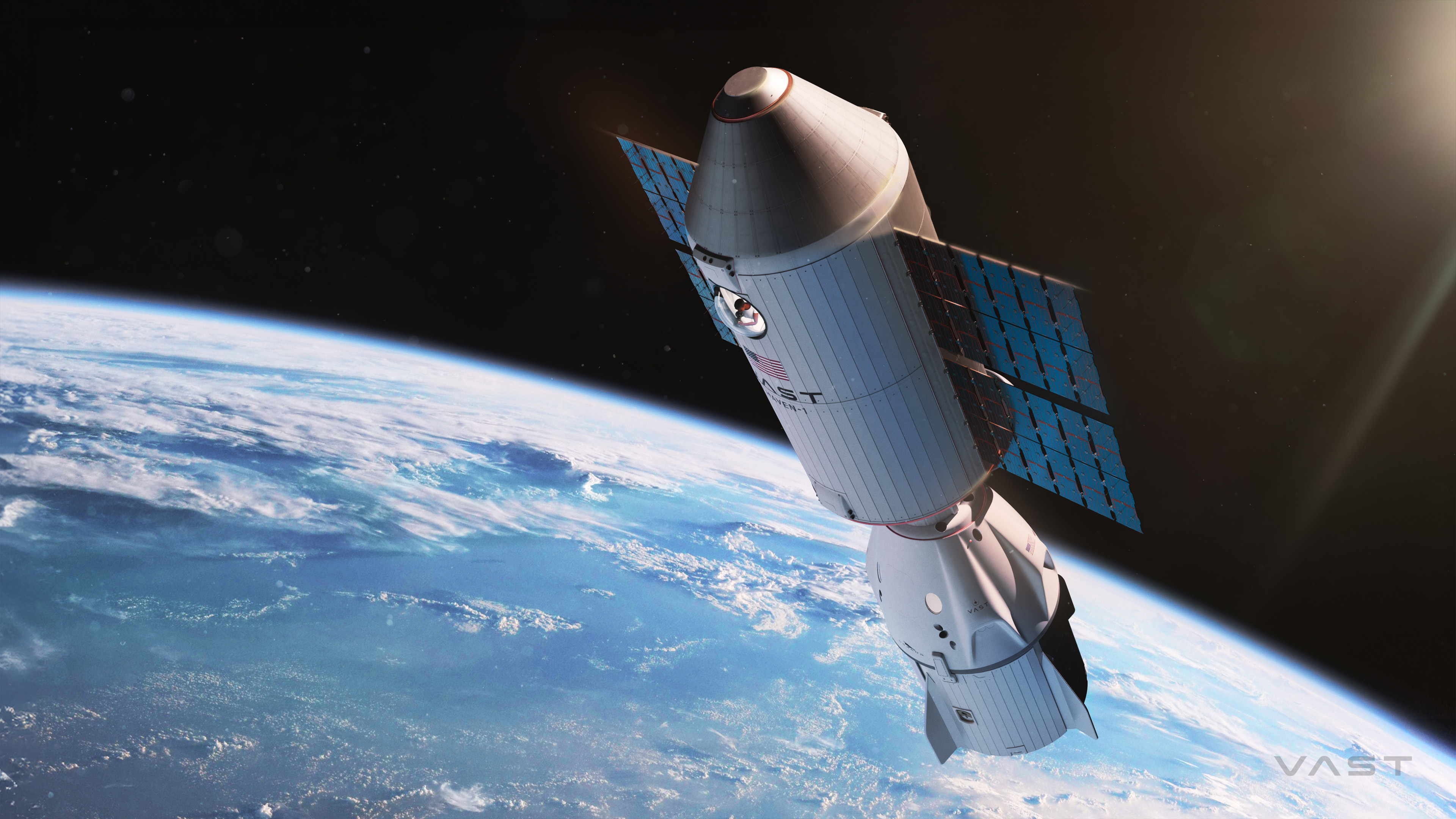
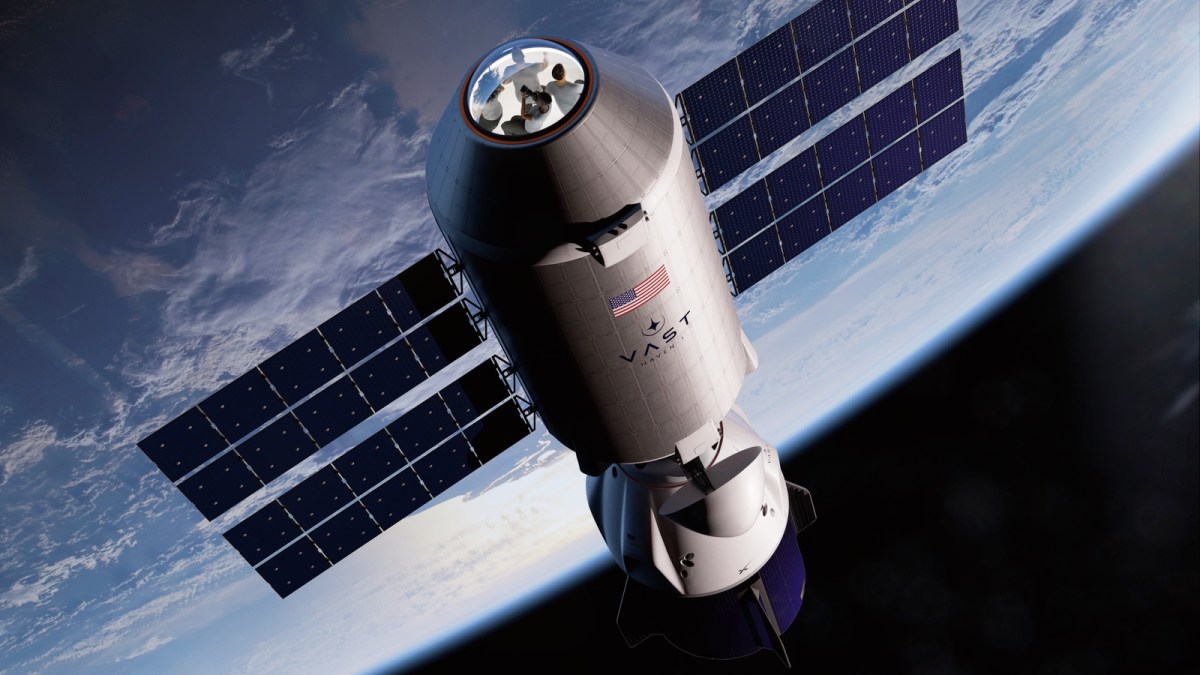
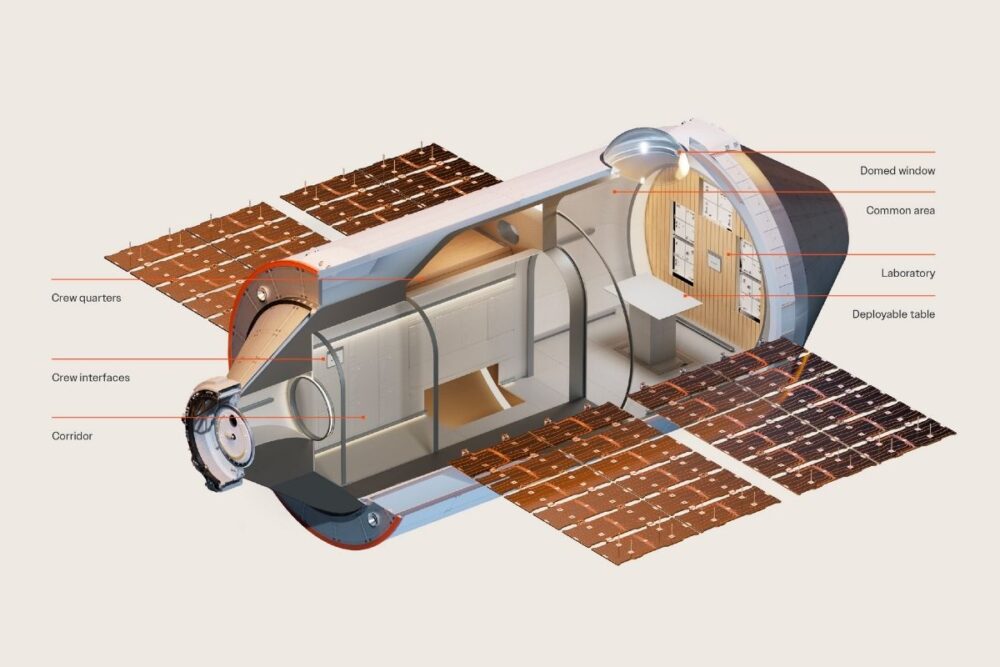
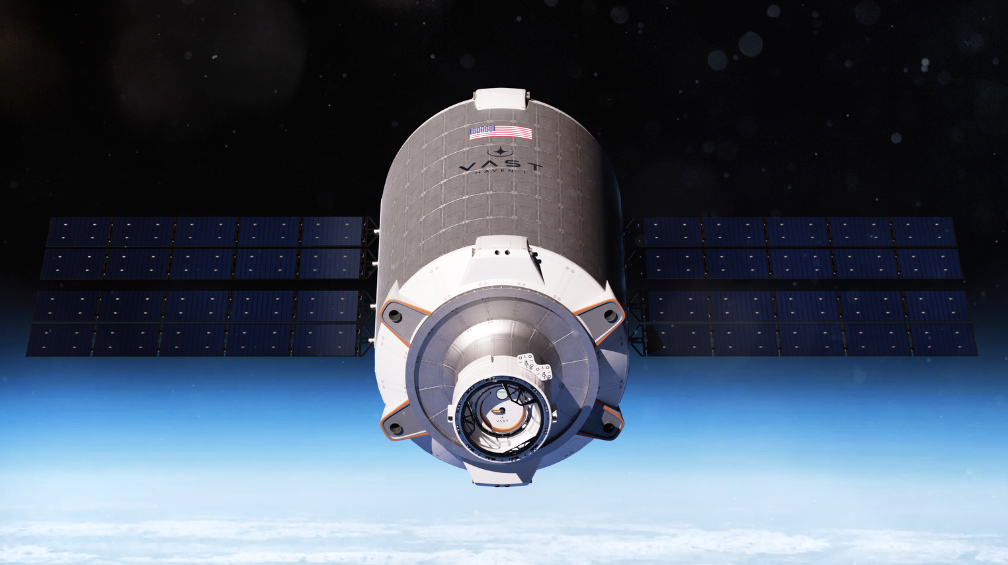
Haven-1 is fundamentally a compressed-volume cylindrical module designed to be launched as a single unit on a Space X Falcon 9 rocket. The station masses approximately 15 metric tons at launch—heavy enough to provide substantial habitable volume and life support capacity, but light enough to be accommodated by a readily-available commercial launch vehicle. This single-launch architecture is a critical advantage: it means Haven-1 doesn't require complex on-orbit assembly, reducing technical complexity and accelerating the path to initial operations.
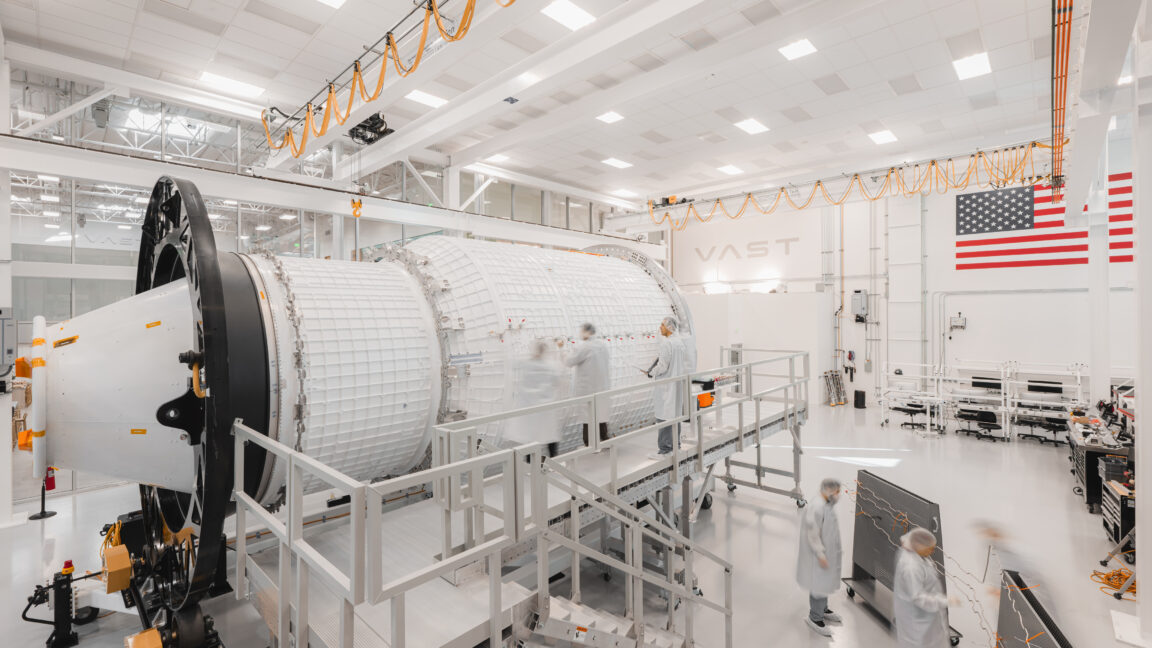
The structural system consists of a primary structure—essentially the main pressure vessel and mechanical load-bearing framework—combined with secondary structures that mount subsystems, provide thermal paths, and support internal equipment. According to recent milestones, Vast completed acceptance testing of the primary structure in November and achieved full structural completion in mid-January. This represents the culmination of months of detailed design, careful manufacturing, rigorous inspection, and systematic testing to ensure the structure can withstand launch loads, thermal cycling, and the mechanical stresses of orbital operations.
The thermal control system (TCS) is one of the first subsystems being integrated in the clean room phase. Space is an extreme environment: one side of a spacecraft exposed to sunlight reaches temperatures exceeding 120°C, while the shaded side drops below -100°C. The TCS must maintain the interior at human-comfortable temperatures despite these extreme gradients. Vast's TCS likely incorporates radiators that reject waste heat to space, insulation blankets to minimize heat loss, and active thermal management using coolant loops. The complexity of thermal management scales with the amount of equipment aboard and the density of operations, so getting this right is critical for mission success.
The propulsion system enables Haven-1 to perform orbital maneuvers: station-keeping burns to overcome atmospheric drag, debris avoidance maneuvers, and controlled deorbit at end-of-life. The propulsion architecture likely uses hypergolic propellants (hydrazine or dinitrogen tetroxide/monomethylhydrazine) in a conventional chemical engine system, providing reliable, proven performance with well-understood operational procedures.
The avionics represent the nervous system of Haven-1. This includes the guidance, navigation, and control systems; the power management and distribution electronics; the communications systems for ground contact and crew coordination; the life support system controls; and the data acquisition and telemetry systems that monitor station health. Modern spacecraft avionics emphasize redundancy—critical systems have backups—and extensive self-checking to detect and respond to failures.
The interior shells and final close-out work represent the culmination of integration efforts. This phase involves installing racks and mounting hardware for experiments and equipment, running wiring and plumbing, integrating crew accommodations and workspace, and conducting final functional testing.
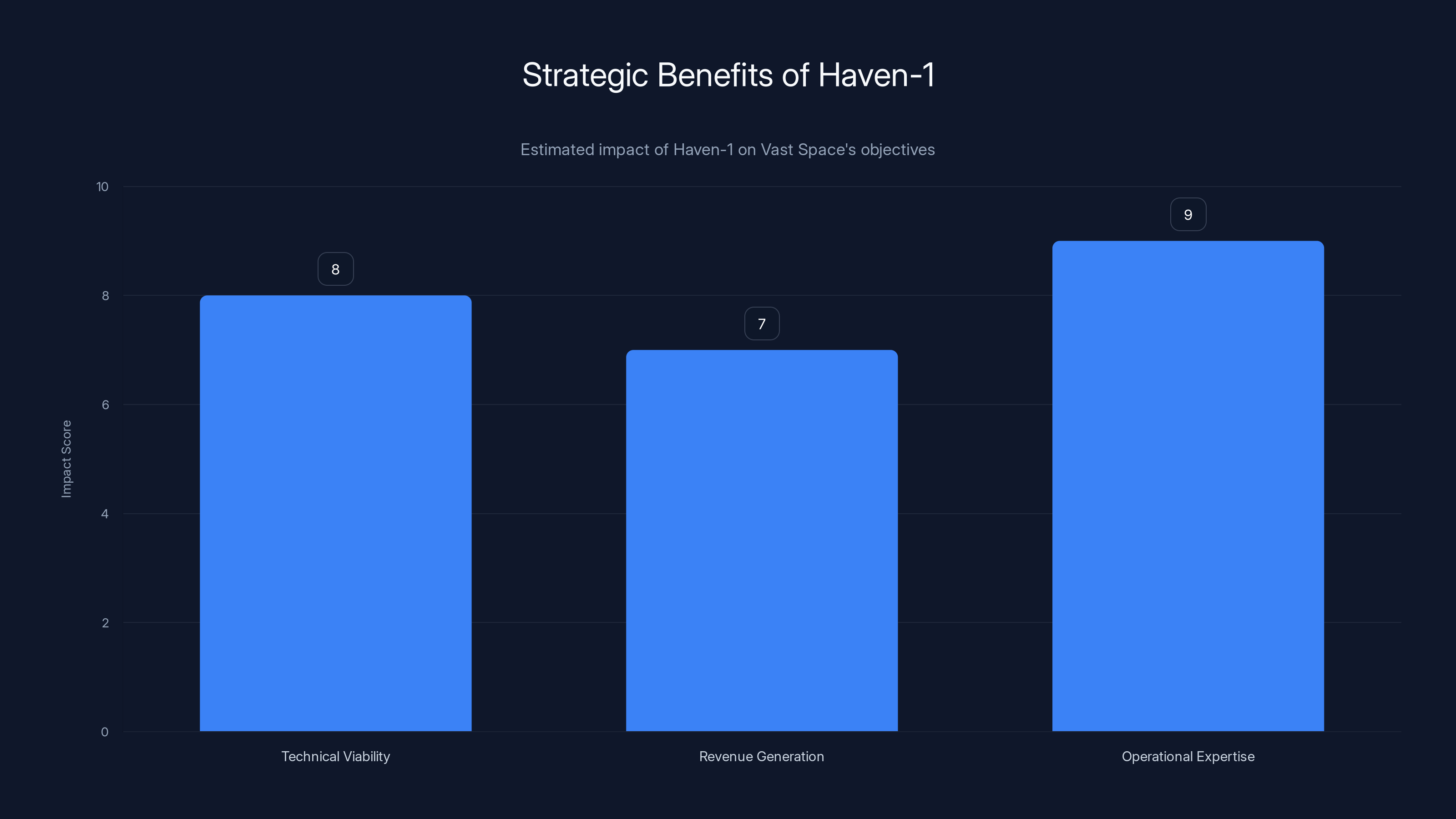
Haven-1 significantly contributes to Vast Space's strategic goals by demonstrating technical viability, generating revenue, and building operational expertise. (Estimated data)
The Assembly and Integration Timeline: From Structure to Orbital Ready
Milestone One: Primary Structure Acceptance (January 2026)
The completion of primary structural acceptance testing in January 2026 represents a critical inflection point in Haven-1's development. This milestone confirms that the fundamental load-bearing structure of the station can withstand all anticipated loads and stresses. The acceptance testing likely involved:
- Static load testing where the structure is subjected to simulated launch loads, microgravity loads, and thermal stresses in controlled laboratory conditions
- Modal analysis and vibration testing to ensure no problematic resonances exist
- Pressure testing to confirm the integrity of pressure seals and tank walls
- Thermal cycling through extreme temperature variations to verify structural stability
- Inspection and documentation to ensure the structure meets all design specifications
Completion of this milestone means Vast has high confidence that the station will survive launch and maintain structural integrity throughout its operational life. From a project management perspective, this is also significant because it represents the transition from the development phase (where design uncertainties exist) to the production/integration phase (where the focus is on assembly and validation).
Milestone Two: Clean Room Integration (January-October 2026)
Following structural completion, Haven-1 moves into a clean room facility where subsystems integration begins. The clean room environment is essential: even microscopic particles of dust or debris can cause failures in spacecraft systems. Particles can lodge in mechanical mechanisms, scratch optical surfaces, degrade thermal coatings, or create electrical short circuits.
The integration sequence follows a logical progression:
- Thermal Control System Installation: Installing radiators, thermal insulation, heaters, thermostats, and coolant loops
- Propulsion System Installation: Mounting thrusters, fuel tanks, and fuel management systems
- Interior Shell Installation: Installing the internal pressure bulkheads and crew compartment structure
- Avionics Rack Installation: Mounting the computer systems, control electronics, and communication equipment
- Utilities Integration: Running electrical harnesses, fluid lines, and data buses throughout the structure
- Testing and Validation: Functional testing of each system and verification of system-to-system interfaces
This phase is scheduled to complete by fall 2026, providing time for final preparations before the crucial pre-launch testing campaign.
Milestone Three: Final Close-out (Fall 2026)
During the close-out phase, all remaining work is completed: installation of crew seating and restraints, emergency equipment and safety systems, scientific equipment brackets and mounting, final wiring and plumbing, protective covers and thermal blankets, and extensive functional testing of all systems.
Close-out is notoriously time-consuming because every system must be verified as functional, and the density of equipment means interference and access problems often emerge that require creative solutions. These issues are typically resolved through careful redesign of mounting arrangements, development of specialized installation tools, or scheduling work in a specific sequence to avoid accessing areas that are already complete.
Milestone Four: Plum Brook Station Testing (December 2026)
Before any spacecraft launches, NASA requires comprehensive environmental testing. Vast has scheduled Haven-1 to undergo testing at Plum Brook Station, NASA's premier spacecraft testing facility in Ohio. Plum Brook includes:
- Thermal vacuum chambers where spacecraft are tested at the temperatures and pressures they'll experience in orbit
- Acoustic test facilities where spacecraft are subjected to the intense noise of launch
- Vibration test equipment where spacecraft are shaken to simulate launch vibrations
- Electromagnetic test chambers where potential radio frequency interference is detected
- Solar simulation facilities where thermal effects of solar radiation are replicated
These tests serve multiple purposes: they validate that the spacecraft will function correctly in the actual space environment, they identify any latent defects or design issues before launch, they gather data to verify engineering models and predictions, and they demonstrate to NASA and Space X that the vehicle is ready for crew transport.
Launch Architecture and Falcon 9 Integration
The Falcon 9 Advantage
Haven-1's launch vehicle—Space X's Falcon 9 rocket—represents a critical enabler for the commercial space station era. The Falcon 9 provides regular, reliable access to orbit at costs that would have seemed impossible just a decade ago. The reusable first stage, where the booster lands itself and flies again, fundamentally changes the economics of spaceflight.
For Haven-1 specifically, the Falcon 9 offers several advantages:
- Proven reliability: The Falcon 9 has conducted hundreds of successful launches, establishing a high track record
- Human-rated certification: Space X invested heavily in qualifying the Falcon 9 and Dragon spacecraft for crew transport, a process that reduces risk for commercial space station payloads
- Payload capacity: The standard Falcon 9 can deliver the 15-ton Haven-1 to the required orbital altitude and inclination
- Schedule predictability: Space X's launch manifest and reusable booster approach provide relative schedule stability
- Cost efficiency: Commercial launch costs are significantly lower than traditional government-provided launch services
Launch Sequence and Orbital Insertion
The Haven-1 launch will likely follow Space X's standard ascent profile. The Falcon 9's first stage burns its nine Merlin engines for approximately 2.5 minutes, accelerating the vehicle to about Mach 2.5 and roughly 70 kilometers altitude. The engines then shut down, and the first stage separates. The second stage, with its single Merlin Vacuum engine, continues the ascent, accelerating to orbital velocity (approximately 7.66 kilometers per second at 400-kilometer altitude).
Haven-1 will be released into a low Earth orbit inclined at approximately 51.6 degrees—the standard inclination for Dragon spacecraft missions to the ISS. This inclination enables future crewed missions (when Haven-1 eventually receives crews via Dragon spacecraft) and aligns with existing spacecraft operations.
The launch profile involves initial deployment into a lower parking orbit, followed by one or two propulsive maneuvers to raise the station to its operational altitude. Haven-1 will likely operate at altitudes between 400-460 kilometers, which balances several competing considerations: lower altitudes experience stronger atmospheric drag (increasing propulsion requirements for station-keeping) but enable crew transport via human-rated vehicles; higher altitudes reduce drag but increase transit time and radiation exposure for crew vehicles.
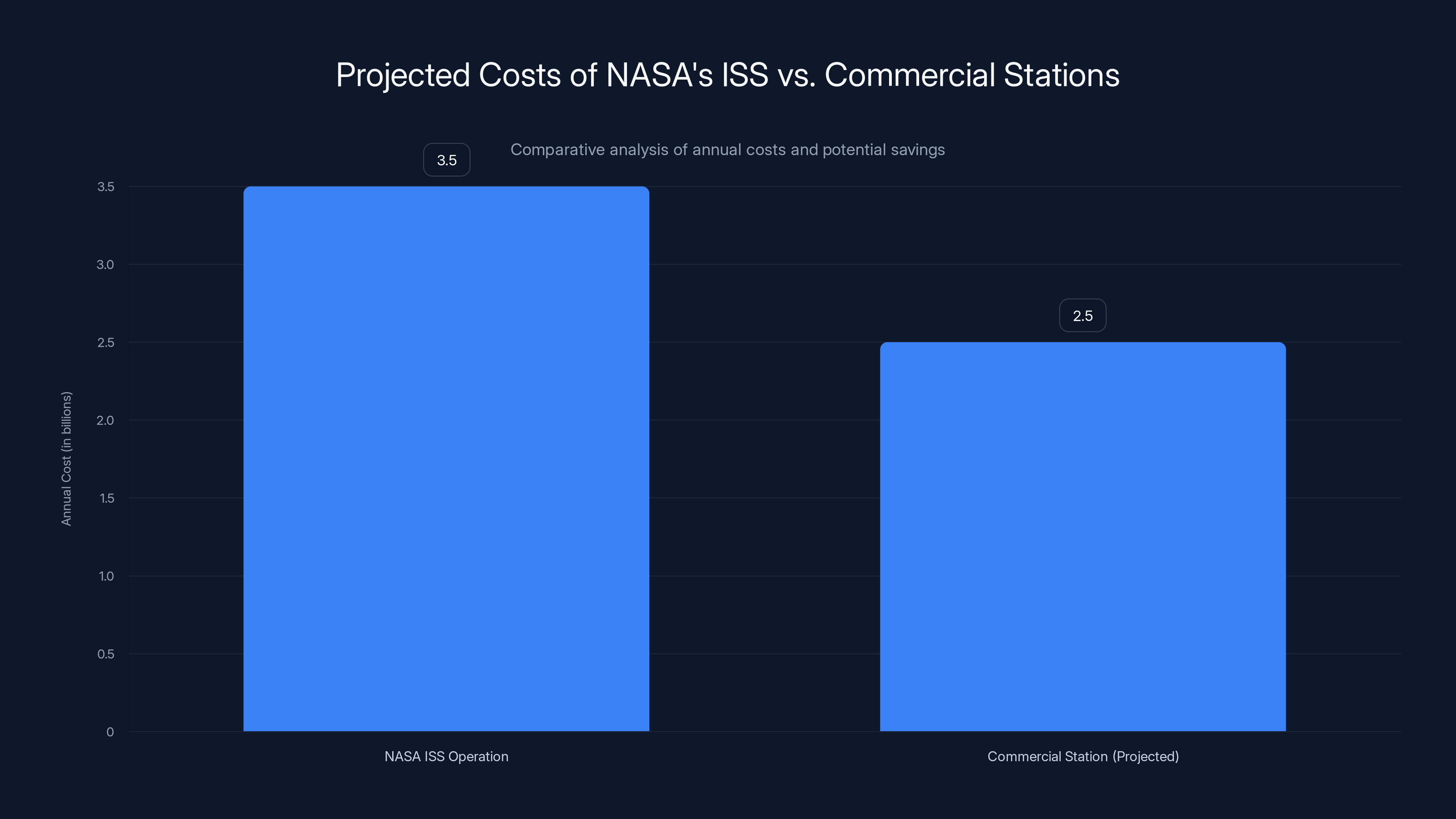
Transitioning to commercial space stations could reduce NASA's annual costs from
Uncrewed Commissioning: The Critical Testing Phase
Why Launch Without Crew?
Haven-1 will launch as an uncrewed satellite—a massive, expensive, fully-equipped space station arriving at orbit with no humans aboard. This design choice, while increasing the temporal gap between launch and the first crewed mission, significantly reduces risk and provides invaluable operational data.
The uncrewed commissioning phase serves several critical purposes:
-
Verification of Vehicle Health: Ground controllers can verify that Haven-1 survived the launch environment and all systems are functioning as designed. This verification happens without time pressure and without crew lives depending on the outcome.
-
Atmospheric Characterization: The station's thermal behavior in the actual space environment can be characterized. Design models are validated against real data, and any discrepancies are understood and accommodated.
-
Structural Verification: Once in orbit, structural engineers can verify that the station maintains structural integrity in the microgravity environment and that thermal stresses behave as predicted.
-
Systems Shakedown: All spacecraft systems can be operated, tested, and validated without the time constraints or safety restrictions that accompany human presence.
-
Contingency Response: If unexpected issues arise, mission controllers can take deliberate time to understand and resolve them without needing to prioritize crew safety.
The Two-Week Checkout Window
Vast Space indicates that Haven-1 commissioning could be completed in as little as two weeks. This aggressive timeline reflects confidence in the design and testing to date. The two-week window would involve:
- Day 1-2: Initial systems check following deployment, verification of power generation, communications, and attitude control
- Day 3-5: Thermal control system operation and verification, power system load testing, life support system activation
- Day 6-10: Propulsion system checks and station-keeping maneuvers, avionics testing, communications system validation
- Day 11-14: Final verification runs, data analysis, and preparation for crew vehicle docking
During this period, Haven-1 is controlled remotely from ground stations. Controllers monitor system telemetry, execute commands, and analyze responses. This is precisely analogous to how space probes are controlled during planetary missions—the difference being that Haven-1 is in near-Earth orbit rather than at Mars.
Space X and NASA Certification Requirements
Before Space X will approve the docking of a crewed Dragon spacecraft to Haven-1, the company must be satisfied that the station is safe and ready to receive crew. This certification involves extensive documentation review, flight data analysis, and potentially additional verification tests.
Space X's requirements likely include:
- Pressure integrity verification: Confirmation that the station can maintain internal pressure for extended periods
- Thermal verification: Confirmation that thermal systems keep the interior at safe temperatures
- Life support validation: Confirmation that atmospheric composition, carbon dioxide removal, and oxygen generation systems function correctly
- Fire suppression capability: Verification that fire detection and suppression systems are operational
- Debris risk assessment: Analysis of the station's collision risk with orbital debris and assessment of avoidance capabilities
- Communication system verification: Confirmation that ground-to-station communications are reliable
This verification process involves both paper documentation (engineering analysis, test reports) and flight data from the uncrewed commissioning phase. The thoroughness of this process directly translates to confidence in crewed operations.
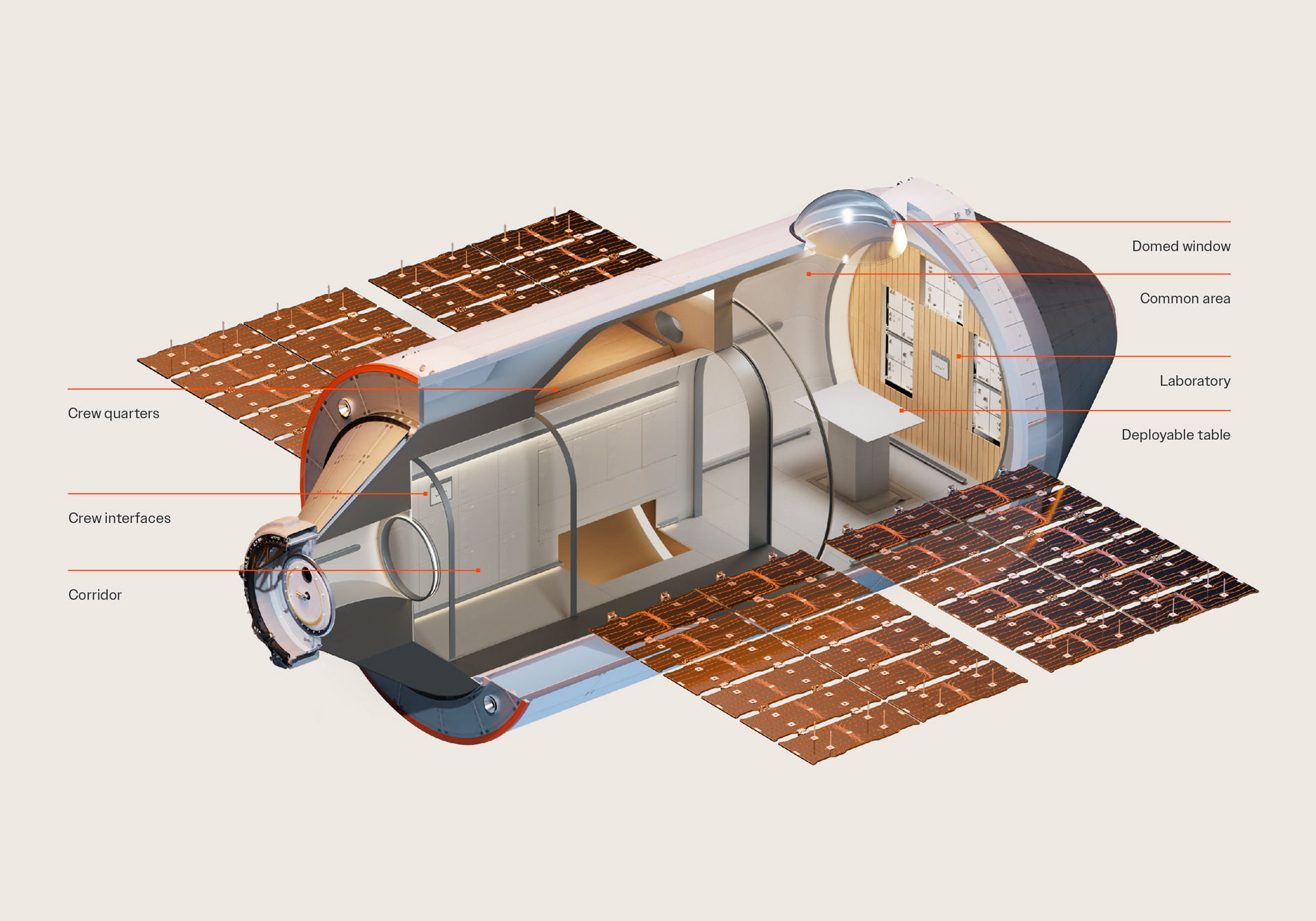
Crew Selection, Training, and First Crewed Mission
The Crew Selection Process
Vast Space has indicated that crew selection is already underway, with negotiations progressing with "both private individuals and nation states." This phrasing provides crucial insight into the business model: Haven-1 will host a mix of private space tourists and potential representatives from international governments or space agencies.
The crew selection process is distinctly different from traditional NASA astronaut selection. Rather than a multi-year, highly selective process evaluating hundreds of applicants for a handful of positions, commercial space station crews are determined through commercial negotiations. Potential crew members are identified, their background and qualifications are assessed, and if deemed acceptable, they contract to fly.
However, this doesn't mean minimal standards. Space X and Vast Space will establish requirements for crew medical fitness, psychological stability, physical capability, and potentially specific technical expertise. These requirements ensure that crew members can safely execute the mission while maximizing the value of their presence aboard the station.
The "nation states" reference suggests that international space agencies or governments may contract to send representatives aboard Haven-1. This could include:
- Space agency personnel seeking experience with commercial platforms
- Government representatives interested in space science or technology assessment
- Commercial researchers from companies conducting space-based experiments
- Private space tourists willing to pay for the privilege of orbital flight
The exact crew composition will reflect commercial demand and Vast Space's revenue optimization. A single mission might include one or two private tourists (at high cost per seat), combined with a space researcher or government official (who might command a different fee structure).
Training Timeline and Requirements
Vast Space has indicated that one year of training is "very comfortable," with the possibility of compressing training to as little as six months for experienced crews. This compressed timeline is possible because:
-
Haven-1 Simplicity: A 15-ton interim station is simpler to operate than the ISS. Crew responsibilities are more focused, and emergency procedures are more straightforward.
-
Falcon Dragon Familiarity: Space X has conducted numerous crewed Dragon missions to the ISS. Training procedures for Dragon are well-established and refined. Crew members without prior spaceflight experience require more training, but crews with previous orbital experience need only Haven-1-specific training.
-
Duration: Haven-1 missions are scheduled as 10-15 day stays, not the 6-month ISS expeditions. Shorter missions require less training in long-duration survival procedures.
-
Scope: The crew's tasks aboard Haven-1 will be circumscribed. Rather than maintaining a complex research facility, supporting dozens of simultaneous experiments, and managing international partnerships, Haven-1 crews will focus on specific objectives: perhaps hosting 2-3 experiments, maintaining basic station systems, and conducting routine operations.
A realistic training timeline for a Haven-1 mission might include:
- Weeks 1-4: Medical and psychological screening, initial classroom instruction on station systems, basic orbital mechanics
- Weeks 5-12: Intensive systems training, emergency procedures, evacuation training, Dragon spacecraft systems and operations
- Weeks 13-16: Neutral buoyancy training in water to simulate microgravity operations, integrated training with mission control
- Weeks 17-24: Mission-specific training, crew compatibility assessments, final evaluations
This 24-week (roughly 6-month) timeline is aggressive but achievable for experienced fliers. Crews without prior spaceflight experience would require the full year or more.
First Crewed Mission Timing
Vast Space has indicated that the first crewed mission could occur "as early as two weeks" after launch commissioning is complete, meaning potentially as early as summer 2027. However, the timeline could extend to "any time within three years," suggesting flexibility if issues emerge or crews require extended training.
The two-week timeline reflects Vast Space's confidence and strong commercial incentive to demonstrate crewed operations quickly. A successful crewed mission generates:
- Proof of capability: Demonstrating that the station is safe and functional with humans aboard
- Revenue: Charging for crew transportation and station hosting
- Media attention: Generating publicity that drives future commercial demand
- Investment confidence: Providing evidence to investors that the Haven-2 program is viable
However, reaching this aggressive timeline requires that the first crew be experienced (likely including at least one astronaut with prior spaceflight experience) and that no significant issues emerge during commissioning. More realistically, the first crewed mission might occur in Q3-Q4 of 2027, several months after launch.
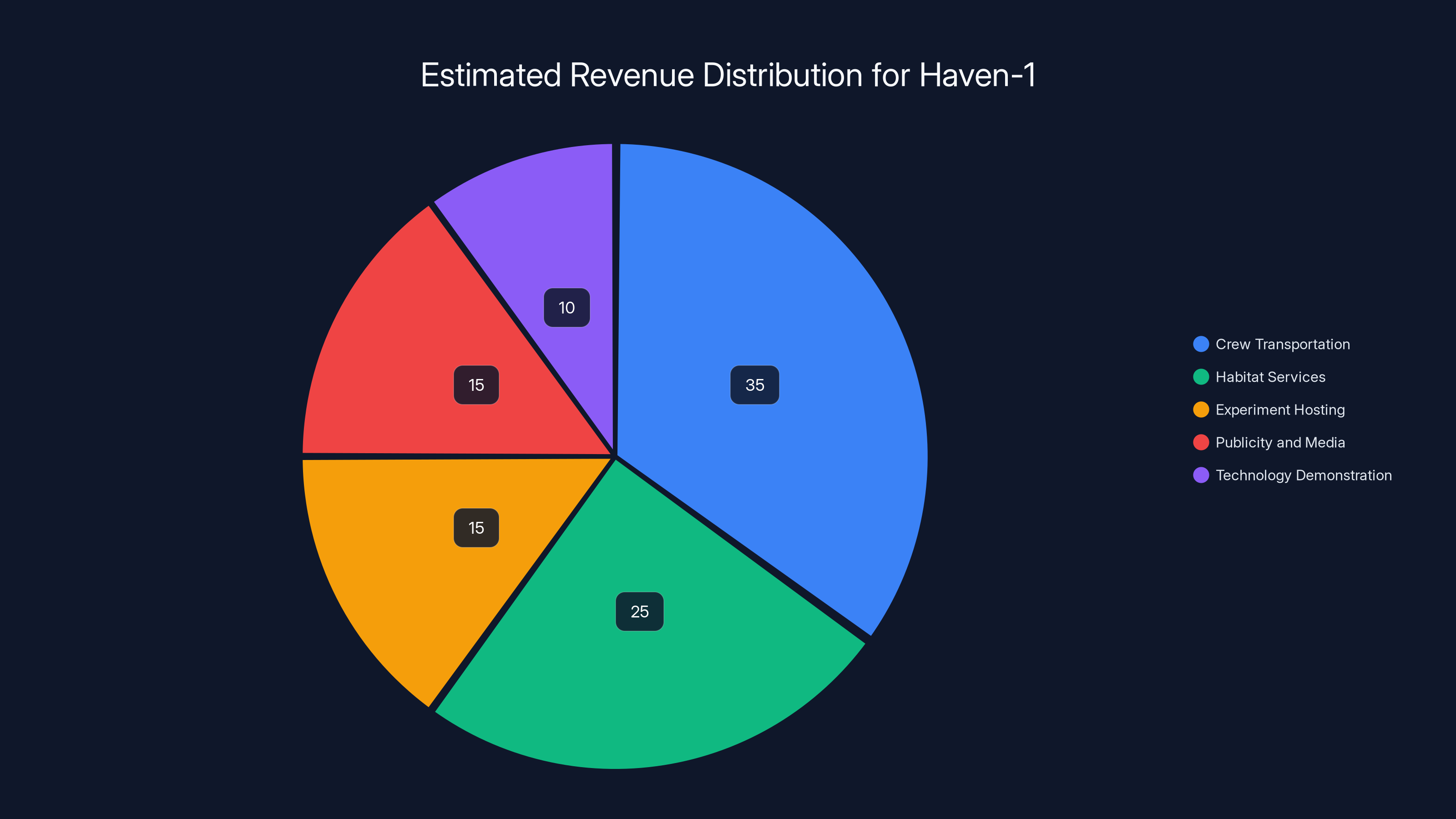
Estimated data suggests crew transportation and habitat services are the largest revenue sources for Haven-1, accounting for 60% of total revenue. Estimated data.
Operational Life and Mission Cadence
The Three-Year Design Life
Haven-1 is designed with a three-year operational lifetime. This doesn't mean the station will cease functioning after three years—it's more accurately understood as the design basis against which Vast Space has engineered the vehicle. Systems are designed and components are selected to reliably operate for three years under anticipated usage. Beyond three years, component degradation and orbital decay (from atmospheric drag) become considerations that might necessitate deorbiting the station.
The three-year timeline provides the window for Vast Space's planned mission cadence:
- Mission 1 (Q2-Q3 2027): First crewed mission, likely with experienced astronauts, demonstrating basic operations
- Mission 2 (Q4 2027-Q1 2028): Second crewed mission, fully contracted with Space X, further validating operational procedures
- Mission 3-4 (2028): Two additional missions from available options, totaling four crewed missions
- Potential Mission 5 (2028-2029): A 30-day extended mission if demand warrants
This cadence generates significant operational experience, provides opportunities for varied crew compositions and scientific objectives, and maximizes revenue during Haven-1's operational life.
Mission Duration and Crew Size
The nominal mission duration is 14 days (10 days on-station plus 2 days for crew transfer to/from Dragon spacecraft). However, Vast Space maintains flexibility to extend missions to 30 days if circumstances warrant. Crew size is likely 2-4 individuals per mission, depending on the mission objectives and available spacecraft capacity.
A 14-day mission duration strikes a balance between several considerations:
- Microgravity Adaptation: Humans require 24-48 hours to adapt to microgravity. A 14-day mission provides roughly 12 days of productive activity after adjustment period
- Crew Physiology: Extended orbital stays (30+ days) result in significant deconditioning—muscle atrophy, bone density loss, cardiovascular deconditioning. A 14-day mission minimizes these effects, reducing post-mission recovery requirements
- Scientific Productivity: 14 days provides sufficient time to conduct meaningful experiments while avoiding the extended timeline and complexity associated with longer missions
- Commercial Viability: Shorter missions enable more frequent crew rotations and higher throughput, maximizing revenue
Haven-2: The Path to Larger, Longer-Duration Operations
Haven-2 Design Philosophy
Vast Space's long-term vision centers on Haven-2, a larger station offering multiple docking ports, increased power generation, and greater volume. While specific specifications haven't been publicly detailed, the company has emphasized that Haven-2 will use the same core components as Haven-1, simply iterated and enhanced.
This component reuse strategy carries significant advantages:
- Development efficiency: Rather than designing new life support systems, power systems, or thermal control systems from scratch, Vast can iterate on proven designs
- Manufacturing learning: The production lines and processes developed for Haven-1 modules can be optimized and refined for Haven-2 and beyond
- Operational familiarity: Crew and mission control teams trained on Haven-1 systems will transition easily to Haven-2
- Cost reduction: Evolutionary improvement typically costs less than revolutionary redesign
Capacity Expansion
The move from Haven-1 (one docking port) to Haven-2 (two or more docking ports) represents a significant increase in operational flexibility. Multiple docking ports enable:
- Simultaneous crew rotation: Two Dragon vehicles can dock simultaneously, enabling crew changeover without leaving the station uncrewed
- Extended stay capability: Multiple visiting vehicles can maintain presence of backup crew and supplies, supporting longer missions
- Modular expansion: Future modules can dock to Haven-2's secondary ports, allowing incremental growth of capabilities
Increased power generation and volume address the constraints that limit Haven-1's mission scope. More power enables operation of additional scientific equipment and life support for larger crews. Greater volume reduces crowding and increases workspace for productive activities.
Production Scale and Economics
Vast Space's statement that it has invested in "facilities to mass produce the follow-on modules" is particularly significant. This indicates the company is not viewing Haven-2 as a one-off research facility but rather as the foundation of a productized, repeatable space station capability.
Mass production of space station modules is genuinely novel. Historically, the ISS was assembled over decades with components built to unique specifications. Vast Space is attempting something different: standardized modules produced in quantity, enabling:
- Economies of scale: Unit costs decrease as production volume increases
- Quality improvement: Manufacturing processes mature and improve with repetition
- Schedule compression: Proven production methods can be executed faster than custom manufacturing
- Global deployment: Multiple stations or expandable systems can be deployed, rather than relying on a single monolithic facility
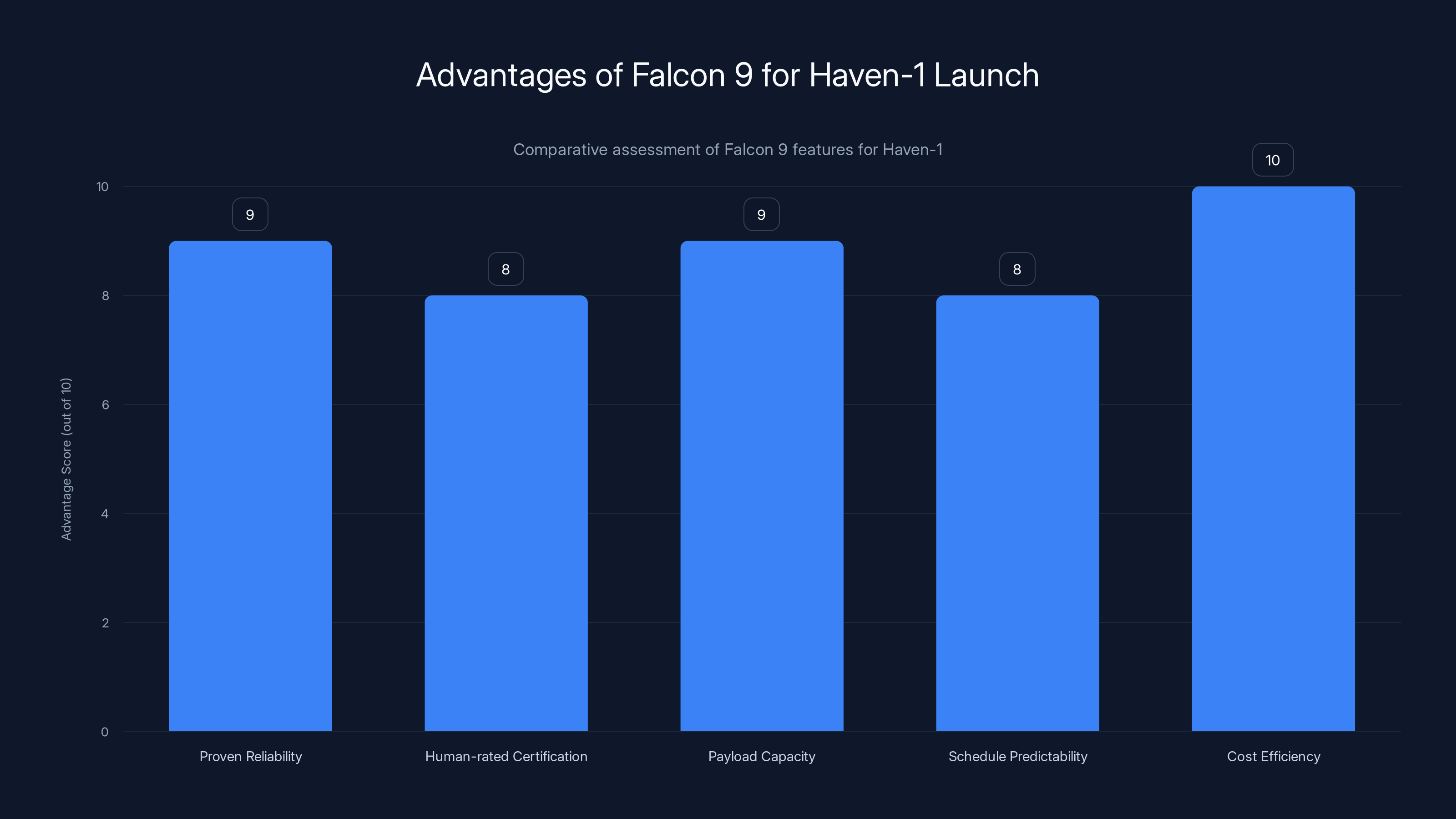
Falcon 9's cost efficiency and payload capacity are its strongest advantages for Haven-1, scoring 10 and 9 respectively. (Estimated data)
The Competitive Landscape: Multiple Paths to Commercial Stations
The Major Competitors
Vast Space faces competition from several well-funded, capable organizations in the commercial space station competition. NASA's Commercial Large Depot (CLD) program is evaluating multiple proposals, and the space agency is expected to select one or more companies for significant funding in the coming months.
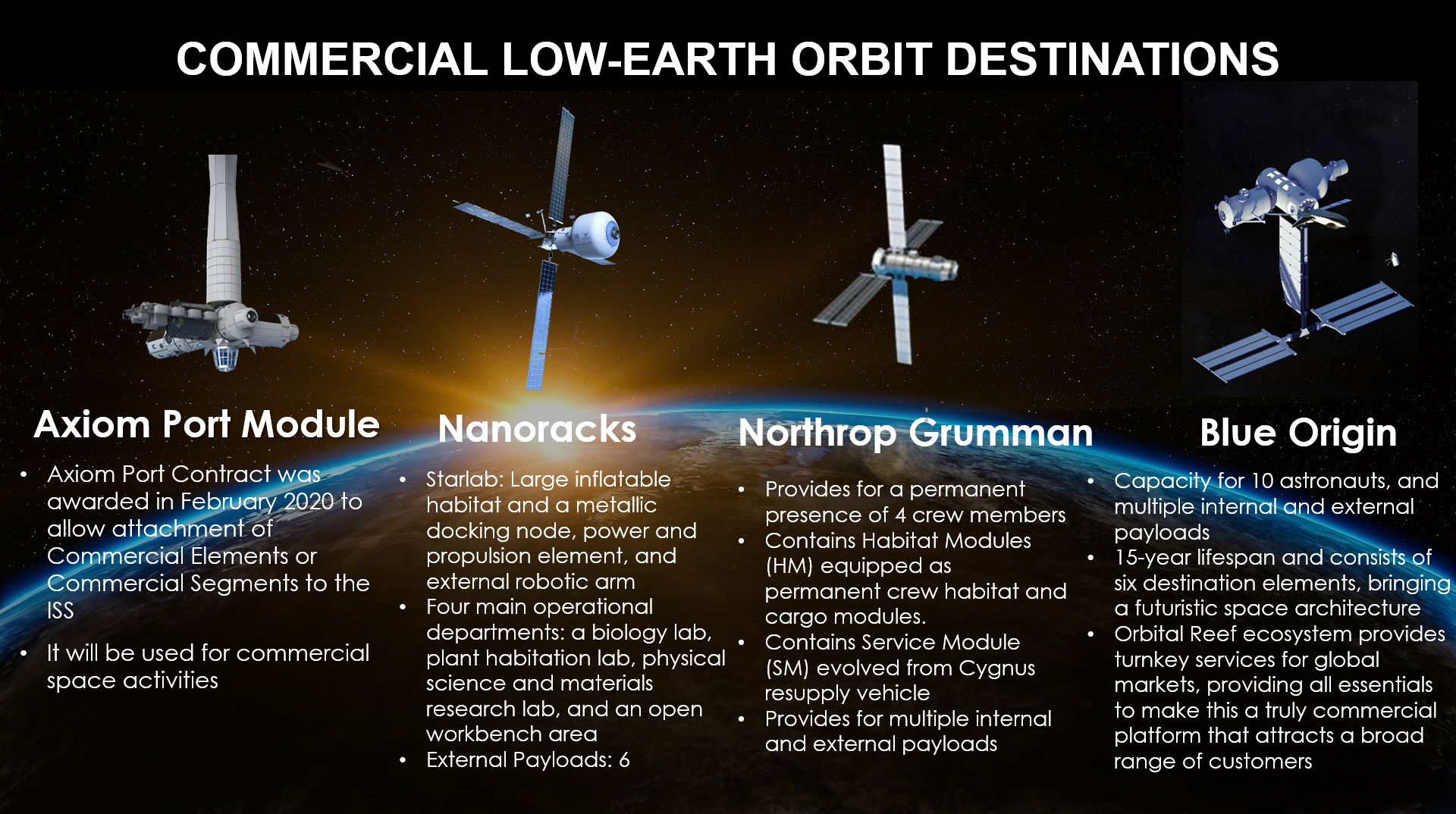
Axiom Space is pursuing a modular approach where the first module docks to the ISS, creating a hybrid commercial-government platform. This approach reduces development risk by leveraging ISS infrastructure and operational procedures. Eventually, when the ISS is decommissioned, Axiom's modules can undock and operate as an independent station.
Blue Origin, leveraging its substantial resources and aerospace heritage, is developing an orbital reef concept—multiple purpose-built modules working in concert. Blue Origin's advantage lies in access to Blue Moon lunar lander development, which could enable logistics resupply, and the company's deep expertise in advanced life support systems from Blue Shepard's suborbital vehicle.
Voyager Technologies is pursuing Starlab, a different modular architecture. Voyager's approach emphasizes reliability and conservative design, potentially enabling faster certification for government operations.
Vast Space's Competitive Advantages
Vast Space's two-pronged strategy (Haven-1 followed by Haven-2) offers several competitive advantages:
-
Demonstrated Performance: Haven-1 will fly and be operated, providing tangible proof of capability that competitors can only promise
-
Early Revenue: Haven-1 missions generate cash flow during Haven-2 development, reducing reliance on external funding
-
Operational Experience: The teams operating Haven-1 gain real-world experience that translates to Haven-2 and beyond
-
Risk Reduction: Proving out core systems in Haven-1 significantly reduces technical risk for Haven-2
-
Established Schedule: Vast has a specific, publicly committed timeline that provides confidence to customers and investors
The company's billion-dollar investment and 1,000-person team provide substantial resources, though they're modest compared to historical government space programs.
NASA's Commercial Space Station Program and Government Procurement
The Strategic Context
NASA's transition from operating the ISS to procuring services from commercial providers represents one of the most significant shifts in the agency's history. Rather than owning and operating space infrastructure, NASA is moving toward a model where the agency is a customer for commercial services.
This transition addresses several concerns:
-
Fiscal Sustainability: Operating the ISS costs roughly $3-4 billion annually. Transitioning this cost to commercial operators (which NASA would support through purchasing agreements) potentially reduces long-term government expenditure.
-
International Complexity: The ISS involves partnership with Russia, which has become problematic geopolitically. Commercial stations could be purely US-based or involve different international partners.
-
Innovation: Commercial operators have financial incentives to reduce costs and improve capabilities. Government operators optimize for safety and reliability, which are important but can lead to expensive, conservative designs.
-
Scalability: Multiple commercial stations could provide more research capacity than a single government-operated facility.
The CLD Program Timeline and Structure
NASA's Commercial Large Depot program is structured in phases:
-
Phase 1: NASA evaluated multiple proposals and selected finalists for initial study contracts (approximately $2-3 million per company)
-
Phase 2: Expected in 2026, NASA will select one or more companies for larger development contracts, likely in the $300-500 million range, to develop and validate specific capabilities
-
Phase 3: Future phases will likely involve firm fixed-price contracts for actual services (crew transportation, cargo, habitat services)
Vast Space is positioned well for Phase 2 selection because Haven-1 will already be flying and operational. This de-risks the government's investment and demonstrates actual capability rather than plans.
NASA's Requirements and Expectations
While formal requirements documents haven't been published, NASA has indicated expectations for:
-
Long-duration habitation: Eventually, NASA expects commercial stations to support continuously inhabited operations similar to the ISS
-
Research capability: Facilities should support scientific research, including experiment racks and dedicated experiment areas
-
Emergency capability: Stations should maintain ability to serve as refuge if visiting crew vehicles experience problems during dock approach
-
Adequate power and thermal control: Systems must support the equipment and crew expected for nominal operations
-
International access: NASA expects access for international partners, though the extent is negotiable
-
Debris management: Commercial stations should be designed for controlled deorbit or high-reliability long-term operation
Vast Space's Haven-2 design is expected to address these requirements, even though Haven-1 will operate in a more limited capacity.
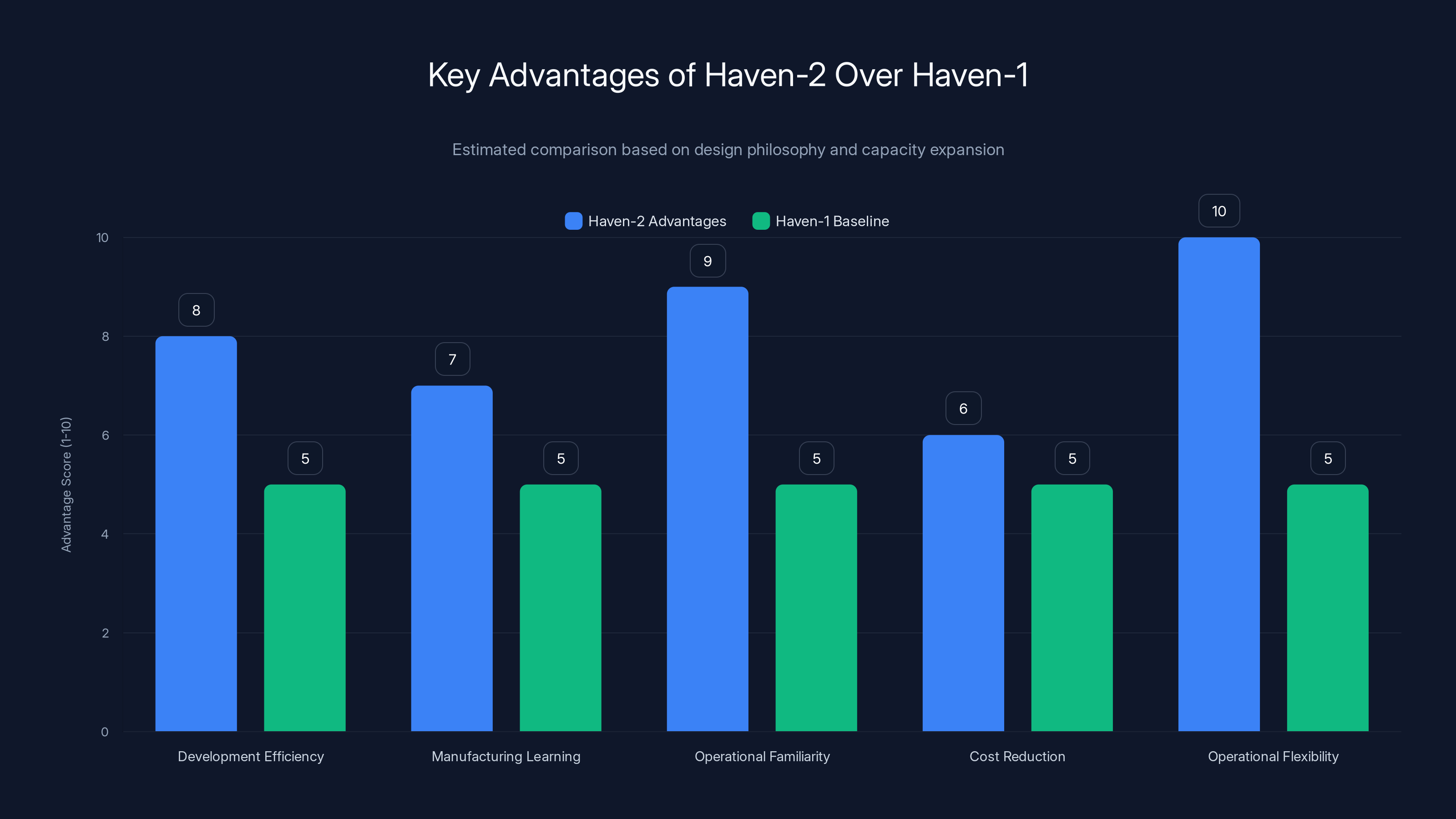
Haven-2 offers significant improvements over Haven-1 in operational flexibility and efficiency, with estimated data highlighting key areas of advancement.
Technical Deep Dive: Life Support and Habitability Systems
The Challenge of Closed-Loop Life Support
Life support represents one of the most technically challenging aspects of any space station. Humans require specific atmospheric conditions to survive: oxygen levels between 16-25%, carbon dioxide below 1%, appropriate pressure, controlled temperature, humidity management, and hygiene water. Meeting these requirements in a sealed spacecraft requires sophisticated systems.
Historically, spacecraft have used open-loop systems where air was vented to space and replaced with fresh supplies from the ground. This works for short missions but becomes unsustainable for longer-duration operations or when orbital resupply is infrequent. Advanced spacecraft use closed-loop life support systems where air and water are recycled.
Haven-1's life support system likely incorporates:
- Oxygen generation: Electrolysis (splitting water into hydrogen and oxygen) powered by solar arrays, or molecular sieve adsorption beds that separate oxygen from the atmosphere
- Carbon dioxide removal: Lithium hydroxide cannisters (proven technology) or regenerable sorbent systems
- Atmospheric composition monitoring: Sensors that continuously measure oxygen, carbon dioxide, humidity, and particulate content
- Humidity and condensation control: Systems to manage moisture and prevent corrosion and mold
- Hygiene water reclamation: Wastewater treatment enabling reuse of water for hygiene and other non-potable purposes
The ISS uses advanced regenerable systems developed over decades, enabling nearly closed-loop operation. Haven-1, as a shorter-duration facility with more limited crew, might employ proven heritage systems (possibly inherited from ISS development) rather than fully novel approaches.
Thermal Management in Vacuum
The space environment presents extremes of temperature. Sunlit surfaces receive approximately 1.4 kilowatts of solar energy per square meter, but this energy cannot be removed through convection (no air to convect). Instead, heat must be rejected through radiation—the electromagnetic emission from hot surfaces to the cold void of space.
Haven-1's thermal control system must balance:
- Internal heat generation: Crew, computers, and experiments generate heat
- Solar heating: Direct solar absorption and radiation from Earth's thermal emission
- Albedo effects: Reflection from Earth of solar radiation
- Eclipse periods: Every 90 minutes, the station enters Earth's shadow, experiencing dramatically reduced solar heating
The TCS likely includes:
- External radiators: Large panels that radiate waste heat to space
- Thermal insulation: Blankets that minimize heat transfer between spacecraft skin and interior
- Active thermal loops: Coolant circulating systems that transport heat from equipment to radiators
- Heaters: Resistive heaters that maintain minimum temperatures during eclipse periods
- Thermostats and controllers: Systems that regulate fluid flow and heating to maintain setpoint temperatures
Safety Systems and Contingency Operations
Pressure Integrity and Emergency Procedures
Pressure integrity is fundamental to survival in space. Haven-1's pressure hull must maintain internal pressure despite micrometeoroid impacts, thermal cycling stress, and material degradation. The design likely includes:
- Primary pressure vessel: The main cylindrical module with redundant pressure seals
- Multiple pressure boundaries: Compartmentalization where possible, so a single puncture doesn't depressurize the entire station
- Micrometeoroid and debris shielding: External protection that absorbs impacts from small particles
- Pressure monitoring: Continuous sensors that detect any pressure loss
- Emergency response procedures: Crew training to respond to pressure losses, including activation of supplemental oxygen systems
If a significant pressure loss occurs during crewed operations, crew procedures would include:
- Identification and isolation of the damaged compartment
- Donning of emergency oxygen kits or spacesuits
- Contact with mission control for situational assessment
- Potential evacuation via Dragon spacecraft if the pressure loss cannot be arrested
Fire Detection and Suppression
Fire in space differs significantly from fire on Earth. In microgravity, fire behaves differently—flames don't rise, smoke doesn't accumulate—and the consequences are more severe because there's nowhere to evacuate. Therefore, Haven-1's fire safety emphasis is on prevention and rapid detection.
The fire safety system likely includes:
- Smoke and heat detectors: Distributed throughout the station to rapidly identify fires
- Fire suppression capability: Portable fire extinguishers for crew use, and possibly automated systems (though these are controversial in microgravity)
- Material selection: Use of low-flammability materials throughout the spacecraft
- Electrical safety: Ground-fault detection and circuit protection to minimize electrical fires
- Crew training: Extensive training on fire response procedures and use of extinguishing equipment
Orbital Debris Risk and Avoidance
Orbital debris—defunct satellites, rocket bodies, and fragmentation from collisions—represents a significant operational hazard. At orbital speeds (approximately 7.6 km/s), even a small particle can damage or destroy spacecraft systems.
Haven-1's debris risk management includes:
- Orbit selection: Operating at an inclination and altitude chosen to minimize debris traffic
- Conjunction assessment: Continuous monitoring of debris trajectories using ground-based radar and optical tracking
- Avoidance capability: Propulsion system capable of executing maneuvers to avoid projected conjunctions
- Shielding: Whipple shields or multilayer protection for critical components
- Conjunction procedures: Established protocols where crew takes shelter (if crewed) or the station executes preprogrammed maneuvers
Economic Model and Commercial Viability
Revenue Sources for Haven-1
Vast Space's business model for Haven-1 likely involves multiple revenue streams:
-
Crew transportation: Charging per-seat fees for flights to/from Haven-1 via Dragon. Historical commercial spaceflight pricing suggests $50-200 million per crewed mission, divided among multiple seats.
-
Habitat services: Charging for the use of Haven-1 itself, perhaps at daily rates for the lease of cabin volume and use of life support systems.
-
Experiment hosting: Charging researchers and companies for the opportunity to conduct experiments in microgravity aboard Haven-1.
-
Publicity and media: Selling exclusive media rights, sponsorships, and naming rights to paying customers.
-
Technology demonstration: Hosting technology demonstrations for companies interested in testing systems in space.
The revenue potential from a four-mission cadence over three years is substantial, potentially $200-800 million depending on pricing and utilization, though expenses (manufacturing, launch, operations, training) are also significant.
Path to Profitability
Vast Space's strategy is to use Haven-1 profits and demonstration of capability to fund Haven-2 development and establish a sustainable long-term business. Haven-1 is essentially a high-confidence, revenue-generating proving ground for Haven-2 technology.
Haven-2, with increased capacity and potential government contracts through NASA's CLD program, offers a path to sustained, higher-margin business.
Broader Implications for the Space Industry
Normalization of Commercial Spaceflight
Haven-1's development and operation will significantly accelerate the normalization of commercial spaceflight. Each successful crewed mission demonstrates that private companies can safely operate space habitats, reducing psychological and regulatory barriers to commercial space activities.
The normalization has several consequences:
- Cost reduction: Increased commercial competition drives costs down
- Capability expansion: More diverse companies entering the space business means more innovation
- Job creation: Space industry employment grows, creating career paths and talent availability
- Science advancement: Increased access to microgravity research capability accelerates scientific progress
- Economic development: Space becomes part of the broader commercial economy rather than a government monopoly
International Partnerships and Geopolitics
The commercial space station era enables partnership models different from the ISS. Rather than mandatory government-to-government agreements, commercial stations can work with willing international partners. This could include:
- ESA partnerships: European countries could utilize Haven-1/2 for research
- Japanese partnerships: JAXA might use Haven-2 as research platform
- Private international partnerships: Companies from multiple countries could invest in or utilize commercial stations
- Competitive models: Rather than a single monolithic station (ISS), multiple competing commercial platforms serve different markets
Long-Term Evolution Toward Orbital Infrastructure
Haven-1 and Haven-2 represent early steps toward a mature orbital infrastructure ecosystem. Over the coming decade, we might expect:
- Multiple competing stations: Haven-2, Axiom Space, Voyager Starlab, Blue Origin facilities—multiple platforms serving different customer bases
- Specialized-purpose facilities: Stations optimized for different missions (manufacturing, tourism, research)
- Orbital refueling stations: Propellant depots enabling deep-space exploration
- Manufacturing in space: Unique properties of microgravity enabling production of materials and pharmaceuticals
- Space tourism maturation: Eventually, space station visits become routine commercial activities like air travel
This evolution is not guaranteed—it depends on continued investment, successful demonstrations, and sustained demand. However, Haven-1's aggressive timeline and public commitment provide momentum toward this future.
The Timeline to Operations: Key Milestones and Dependencies
Q1 2027: Haven-1 Launch
The Q1 2027 launch window (January-March 2027) represents the critical inflection point. Successful launch validates:
- Rocket readiness: Space X's Falcon 9 is operational and certified
- Spacecraft design: Haven-1's design is sound and manufacturing was executed correctly
- Readiness processes: Vast Space's quality assurance and launch preparation procedures work
Delays beyond Q1 2027 would compress the timeline for commissioning and first crewed mission, potentially pushing crewed operations into late 2027.
Q2-Q3 2027: Commissioning and First Crewed Mission
The 2-week commissioning window and rapid transition to crewed operations is aggressive but feasible. Success depends on:
- Flawless commissioning: All systems functioning as designed with no significant anomalies
- Space X certification: Rapid turnaround in Space X's safety review processes
- Crew availability: First crew ready for launch without major delays
A more realistic timeline might push first crewed operations to Q4 2027, providing additional margin for problem resolution and crew training.
2028-2029: Operational Mission Cadence
Following first crewed mission success, the planned four-mission cadence can proceed. Revenue generation during this period funds:
- Haven-2 development: Core module manufacturing and integration
- Operational refinement: Procedures and processes mature based on operational experience
- Facility expansion: Enhanced ground infrastructure for larger crew rotations
2029-2030: Haven-2 Development and Completion
Parallel to Haven-1 operations, Haven-2 development continues. The goal is Haven-2 launch in 2029-2030, providing operational continuity as Haven-1's three-year life expectancy approaches.
2030+: Transition to Haven-2
As Haven-1 approaches end-of-life, Haven-2 becomes the primary platform. If NASA has selected Vast Space for CLD program contracts, government utilization could begin immediately. Concurrently, development of Haven-3 or expansion modules might commence.
Critical Success Factors and Risks
Technical Risks
Designing and manufacturing a space station for the first time is inherently risky. Haven-1's technical risks include:
- Integration complexity: Unforeseen interactions between systems could emerge during on-orbit commissioning
- Manufacturing quality: Despite rigorous testing, orbital environment stresses could reveal defects
- Life support performance: Long-term operation of recycled atmospheres might reveal performance degradation
- Unexpected outgassing: Materials exposed to vacuum can release volatile compounds that contaminate systems
- Thermal surprises: Orbital thermal environment might differ from ground simulations
Mitigation strategies include the uncrewed commissioning phase, extensive ground testing, experienced mission control teams, and established procedures for anomaly resolution.
Schedule Risks
The Q1 2027 launch target is aggressive. Schedule risks include:
- Testing delays: Plum Brook Station or other facilities might not be available when needed
- Component availability: Supply chain disruptions could delay delivery of critical components
- Regulatory approval: NASA or Space X certification processes might reveal issues requiring redesign
- Manufacturing rework: Quality issues during clean-room integration might require rework
Vast Space has built schedule margin (the previous mid-2026 target was already pushed to Q1 2027), suggesting awareness of these risks.
Financial Risks
Vast Space's development and operations depend on:
- Investor confidence: Maintaining venture capital and private investment funding
- Revenue realization: Achieving planned mission cadence and customer pricing
- Cost control: Managing development and operational costs within budget
- Competitive threats: Ensuring Haven-1/2 remains competitive against other commercial stations
The company's stated billion-dollar investment suggests deep financial resources, but competition for private investment in space ventures is intense.
Regulatory and Policy Risks
External factors could impact Haven-1 operations:
- Export control changes: Space technology regulations could restrict international partnerships
- Licensing requirements: New regulatory requirements from FAA could impose additional compliance burdens
- International restrictions: Treaties or agreements could limit operational flexibility
- Government budget changes: NASA's commercial space funding could be reduced if political priorities shift
Learning from ISS Operations: Lessons Applied to Haven-1
What Works Well in Orbital Operations
The ISS has operated for nearly 25 years, generating enormous operational experience. Haven-1's designers have learned from this experience:
- Modular architecture: ISS's modular approach, despite complexity, enabled incremental assembly and capability addition
- Redundancy: Critical ISS systems have backups; Haven-1 will similarly employ redundancy for critical functions
- Proven components: Heritage systems from ISS development are being reused where appropriate
- Operational procedures: Decades of ISS operations have established best practices for crew training, mission planning, and anomaly response
- International coordination: ISS's international partnerships, while complex, demonstrate how to work across organizational and national boundaries
Improvements Over ISS Model
Haven-1 is designed to avoid some of ISS's challenges:
- Commercial operation: Unlike the ISS, which is government-operated, Haven-1 will be operated by a private company with profit incentives to reduce costs and improve efficiency
- Simpler scope: Haven-1's mission (short-duration crew stays) is more constrained than ISS's continuous research complex, potentially reducing complexity
- Modern design: Haven-1 incorporates advanced life support, power, and thermal systems developed since ISS design (1980s-1990s)
- Single-launch architecture: Haven-1 launches complete, unlike ISS which required 40+ launches and decades of on-orbit assembly
- Incremental expansion: Haven-2 can incorporate lessons from Haven-1 before committing to larger infrastructure
The Role of Space X and Commercial Launch Partners
Space X's Enabling Role
Haven-1's development depends critically on Space X's capabilities and cooperation:
- Launch vehicle: Falcon 9's reliability and payload capacity make Haven-1 feasible
- Crew transport: Dragon spacecraft provides safe, reliable crew transportation
- Human rating: Space X's investment in human spaceflight certification reduced regulatory burden for commercial space stations
- Cost efficiency: Reusable Falcon 9 economics make commercial spaceflight economically viable
Space X's willingness to support commercial space stations (as opposed to viewing them as competitors) reflects the company's strategic interest in developing a broad commercial space economy.
Future Launch Vehicle Options
Looking forward, Vast Space might have launch options beyond Falcon 9:
- Falcon Heavy: For larger Haven-2 modules or multiple-vehicle launches
- Starship: Eventually, Space X's Starship vehicle could offer even greater launch capacity at lower cost
- Blue Origin New Glenn: Emerging vehicles like New Glenn will eventually provide additional launch options
- International providers: Arianespace, Chinese launchers, and emerging Indian vehicle options might eventually compete
Competitive launch options provide schedule resilience and potentially drive costs down through market competition.
FAQ
What is Haven-1 and why is it important?
Haven-1 is a 15-ton commercial space station being developed by Vast Space, scheduled to launch in the first quarter of 2027 aboard a Space X Falcon 9 rocket. It's important because it represents the first privately-developed orbital station and demonstrates that companies can build, launch, and operate space habitats at commercial timescales. Haven-1 serves as a revenue-generating proving ground and risk-reduction platform before Vast Space deploys Haven-2, its larger intended successor.
How does Haven-1 differ from the International Space Station?
Haven-1 differs from the ISS in several fundamental ways: it's commercially operated (not government-owned), designed for short-duration 10-15 day crew stays rather than continuous six-month expeditions, launches as a complete unit rather than requiring dozens of assembly missions, utilizes modern life support and power systems rather than ISS heritage designs, and targets commercial revenue generation alongside any research activities. The ISS is a complex international research facility supporting hundreds of simultaneous experiments; Haven-1 is a smaller, more focused platform optimized for specific customer missions.
What is the timeline for Haven-1 launch and first crewed mission?
Haven-1 is scheduled to launch in Q1 2027 (January-March 2027) as an uncrewed spacecraft. Following a commissioning period estimated at 2-14 weeks, the first crewed mission is planned for Q2-Q3 2027, with the possibility of extending to Q4 2027 or beyond if needed. Vast Space plans four crewed missions during Haven-1's three-year design life, with missions occurring roughly every 6-12 months between 2027 and 2030.
How will Haven-1 be crewed and who will fly to it?
Haven-1 will be crewed by Dragon spacecraft carrying 2-4 crew members per mission. Crew selection involves negotiations with private individuals seeking space travel, international space agencies interested in orbital operations, companies conducting space-based research, and government representatives. Training duration is approximately 6-12 months depending on crew experience, with experienced astronauts requiring less training than first-time space flyers. Vast Space has indicated negotiations are underway but has not yet announced the first crew.
What happens if something goes wrong during Haven-1 operations?
Haven-1 is designed with extensive redundancy and safety systems. If a critical failure occurs during uncrewed commissioning, mission controllers can take time to diagnose and resolve issues remotely without time pressure. If a failure occurs during crewed operations, procedures include emergency response steps (depressurization response, fire suppression, medical emergency response) and emergency evacuation via Dragon spacecraft if necessary. The crew also maintains continuous communication with Space X mission control and can abort operations and return to Earth if mission-critical systems fail.
How does Haven-1 relate to NASA's commercial space station competition?
Vast Space is competing in NASA's Commercial Large Depot (CLD) program for funding to develop larger, more capable stations (Haven-2). Haven-1 serves as proof that Vast Space can successfully execute on its plans—demonstrating technical capability, operational excellence, and business viability. A successful Haven-1 program significantly strengthens Vast Space's position for Phase 2 of NASA's CLD selection, expected in 2026. Winning a CLD contract would provide stable government revenue for Haven-2 operations and long-term commercial viability.
What is the cost of Haven-1 development and operations?
Vast Space has invested approximately one billion dollars across the company's entire program (Haven-1, Haven-2, manufacturing facilities, and staffing of 1,000 employees). Individual Haven-1 mission costs for customers are not publicly detailed, but commercial spaceflight pricing suggests seats on crewed Dragon missions cost $50-200 million per mission, with the station operating cost distributed across crew members, researchers, and government contracts. Haven-1's development cost represents a significant investment but is modest compared to historical government space stations.
How does Haven-1's life support system work in the vacuum of space?
Haven-1's life support system is a closed-loop or semi-closed system that recycles atmosphere rather than venting it to space. The system includes oxygen generation (likely via electrolysis splitting water), carbon dioxide removal (likely using lithium hydroxide or regenerable sorbents), atmospheric monitoring (continuous sensors for oxygen, carbon dioxide, humidity, and composition), and humidity control. These systems maintain breathable atmosphere and temperature, enabling crew survival and activity during on-station stays. The system is designed for the 2-week mission duration and tested extensively before orbital operation.
What happens to Haven-1 after its three-year design life expires?
Haven-1 will eventually be deorbited (commanded to reenter Earth's atmosphere and burn up on reentry) after its three-year design life expires or customer demand diminishes. Vast Space plans to transition to Haven-2 as the primary commercial platform, likely launching Haven-2 before Haven-1 is retired. The transition will occur such that customer operations can continue uninterrupted—existing customers transition to Haven-2 missions while Haven-1 is gracefully retired. Haven-1's operational data, lessons learned, and proven systems will inform Haven-2's larger design.
How does Haven-1 represent the future of human spaceflight?
Haven-1 exemplifies a fundamental shift from government-monopoly spaceflight to competitive commercial space operations. Rather than nations building government-owned space stations, private companies increasingly develop and operate orbital infrastructure. This model encourages innovation (companies competing on performance and cost), reduces government costs (contracts for services rather than owning infrastructure), enables rapid iteration (companies can upgrade designs more frequently than government programs), and democratizes access (more organizations can potentially afford commercial space access than could pursue government programs). Haven-1's success would accelerate this transition toward a robust commercial space economy.

Conclusion: Haven-1 as Catalyst for the Commercial Space Era
Haven-1 represents a genuine inflection point in humanity's use of space. For the first time, a commercial company is preparing to launch a fully-functional orbital space station to orbit, establish permanent presence, and conduct human operations in space—all on a compressed timeline and commercial business model. The Q1 2027 launch target is aggressive, the mission cadence is ambitious, and the commercial model is unproven. Yet the fact that Vast Space is executing on this plan, with a billion-dollar investment, 1,000 employees, and publicly committed schedules, demonstrates that commercial spaceflight has matured beyond suborbital tourism or cargo delivery to orbital infrastructure.
The significance of Haven-1 extends far beyond Vast Space or even commercial space stations. Successfully launching and operating Haven-1 will demonstrate that the government monopoly on orbital infrastructure is ending. Other companies—Axiom Space, Blue Origin, Voyager Technologies, and inevitably others not yet prominent—will be inspired and enabled to pursue their own orbital facilities. The result will be not a single monolithic research facility (like the ISS) but rather an ecosystem of competing commercial stations optimized for different missions and customers.
This ecosystem will support human spaceflight at scale and diversity that current government programs cannot achieve. Researchers from universities that cannot secure ISS access will have commercial alternatives. Companies interested in space-based manufacturing will find platforms suited to their needs. Space tourism will mature from suborbital hops to genuine orbital stays. International partners will access space through commercial arrangements rather than government partnerships. The costs of space access will continue declining as competition drives innovation and economies of scale.
The path from Haven-1 to this mature commercial space economy will not be obstacle-free. Technical challenges will emerge during commissioning. Operational procedures will require refinement through experience. Regulatory frameworks will evolve to accommodate commercial operations. Economic models will be tested and adjusted. But the fundamental trajectory is clear: commercial space stations are coming, and Haven-1 is the leading edge of this transition.
For observers of space policy and the aerospace industry, Haven-1's development, launch, and operations will provide a master class in modern commercial space development. For investors and entrepreneurs, Haven-1 validates the commercial opportunity in orbital infrastructure. For researchers and organizations seeking space access, Haven-1 represents an alternative to ISS access limitations. For international space agencies, Haven-1 demonstrates new partnership models beyond traditional government cooperation.
The convergence of multiple factors makes Haven-1 possible today: low-cost launch vehicles (Falcon 9's reusable economics), mature life support technology (inherited from ISS and lunar lander programs), advanced autonomous systems (enabling uncrewed operation and remote control), commercial supply chains (enabling rapid manufacturing), and sustained investor interest in space ventures. None of these factors existed together even a decade ago.
Haven-1's success is not guaranteed. Technical problems could force redesigns and schedule delays. Customer demand might prove weaker than anticipated. Operational challenges could emerge in space that were not anticipated in ground testing. Regulatory changes could impose unexpected constraints. Competition might be more intense than current projections suggest. Any of these outcomes is possible.
Yet the commitment Vast Space has made, the public timeline it has announced, and the resources it has invested suggest serious confidence in the program's viability. If this confidence is justified, and Haven-1 launches, operates successfully with crews, and demonstrates reliable orbital operations, the commercial space era will have truly begun. The implications for science, technology, commerce, and humanity's long-term future in space could be profound.
We are living through the earliest stages of this transition. The launch of Haven-1 in 2027 will mark a turning point—the moment commercial space stations transitioned from concept to operational reality. The success or failure of that mission will reverberate through the space industry for decades to come.
Key Takeaways
- Haven-1 completes primary structural testing in January 2026, achieving critical manufacturing milestone with 2-3 years lead over competitors
- Q1 2027 launch targets uncrewed commissioning within 2-14 weeks, enabling first crewed mission in mid-to-late 2027 via SpaceX Dragon
- Vast Space's two-station strategy (interim Haven-1, then Haven-2) reduces technical risk while generating revenue and operational experience
- Life support, thermal control, and propulsion systems integrate sequentially in cleanroom phase through Q4 2026, followed by NASA's Plum Brook testing
- Four crewed missions planned during Haven-1's three-year design life support commercial customer revenue generation and technical proof-of-concept
- Haven-1's success positions Vast Space competitively for NASA's Commercial Large Depot Phase 2 program expected mid-2026 selection
- Commercial space station era shifts orbital infrastructure from government monopoly to competitive market with multiple operators and business models
- Compressed 4-year development timeline (concept to launch) demonstrates feasibility of rapid iteration in commercial space industry versus multi-decade government programs


