
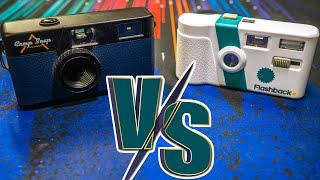
![Camp Snap Pro vs. Flashback One35 V2: Disposable Camera Showdown [2025]](https://tryrunable.com/blog/camp-snap-pro-vs-flashback-one35-v2-disposable-camera-showdo/image-1-1771767357392.jpg)
Camp Snap Pro vs. Flashback One 35 V2: The Modern Disposable Camera Showdown [2025]
There's something magical about the limitations of old cameras. No smartphone screens. No endless editing options. Just point, shoot, and see what happens. That's the promise behind the wave of retro-inspired digital cameras flooding the market right now.
The problem? Most of us don't actually want to use a 20-year-old point-and-shoot. We want the feeling of one. The vibe. The unpredictability. The charm of photos that aren't pixel-perfect.
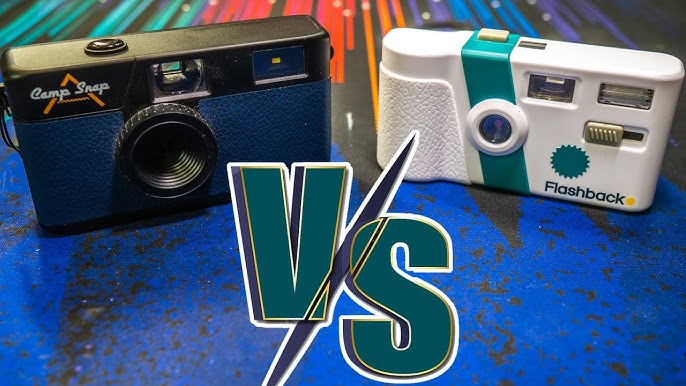
Enter the Camp Snap Pro and Flashback One 35 V2. These are two cameras trying to capture that disposable camera magic for the digital age. The Camp Snap Pro costs
I've spent the last three weeks testing both of them. Carried them on walks, road trips, family gatherings. Shot in daylight, indoors, at night. Tested their apps, their flashes, their image quality. And here's what I found: one of them actually nails the experience. The other? Well, it's close, but it stumbles in ways that matter.
TL; DR
- Camp Snap Pro wins overall: Better build quality, more reliable performance, intuitive app, four solid film styles
- Flashback One 35 V2 has charm: Smaller size, authentic disposable camera look, fun ritual, but more missed shots and frustrating quirks
- Image quality is comparable: Both produce lo-fi aesthetics that sit between old film and smartphone photos
- Xenon flash makes the difference: Both cameras' bright flashes look better than LED alternatives in low light
- Battery life matters: Camp Snap Pro's non-replaceable battery is a concern; so is the Flashback's slow startup
- Bottom line: Go Camp Snap Pro if you want reliability. Pick Flashback if the disposable camera aesthetic is non-negotiable
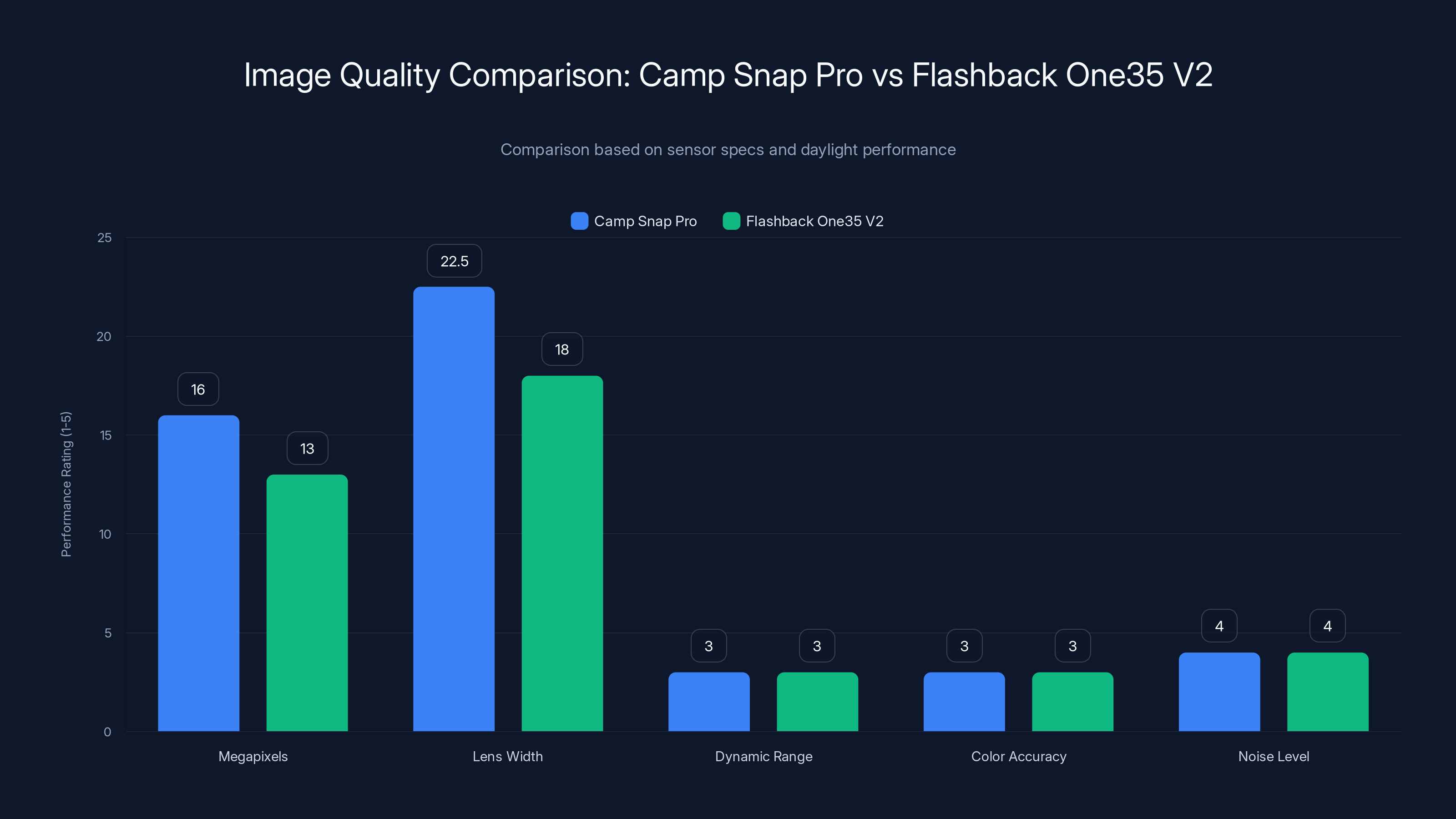
Camp Snap Pro offers higher megapixels and a wider lens, enhancing its versatility for wider shots. Both cameras have similar performance in dynamic range, color accuracy, and noise level, contributing to their retro aesthetic. Estimated data based on qualitative analysis.
Why Retro Digital Cameras Are Having a Moment
The resurgence of disposable camera culture isn't random. It's a backlash against perfection.
Smartphones have trained us to expect perfect exposure, perfect focus, perfect colors. HDR processing. Computational photography. Night modes that turn darkness into day. But somewhere along the way, that perfection became boring. Predictable. Soulless.
Then younger people discovered old digital cameras on eBay. Canon PowerShots from 2005. Kodak Easyshares. Sony Cyber-shots. Cheap point-and-shoots that nobody wanted anymore. And they loved them. The sensor noise. The color shifts. The occasional out-of-focus disaster. These "flaws" felt authentic in a way that modern photography doesn't.
Film cameras experienced a similar revival. Millennials started buying used 35mm cameras, Lomography came back, disposable film cameras became expensive novelties. But film has friction: you need to buy film, load it, shoot 27 exposures before you can develop, wait days for results, pay for prints or scanning.
Enter digital disposable cameras. Companies realized: what if we made something that looks and feels like an old disposable camera, but uses digital sensors and SD cards? You get the aesthetic without the hassle. The vibe without the cost.
That's exactly what Camp Snap and Flashback are doing. And it's working. Both companies have massive waitlists. People want this experience badly enough to pay $100 for a camera that deliberately doesn't have a screen.
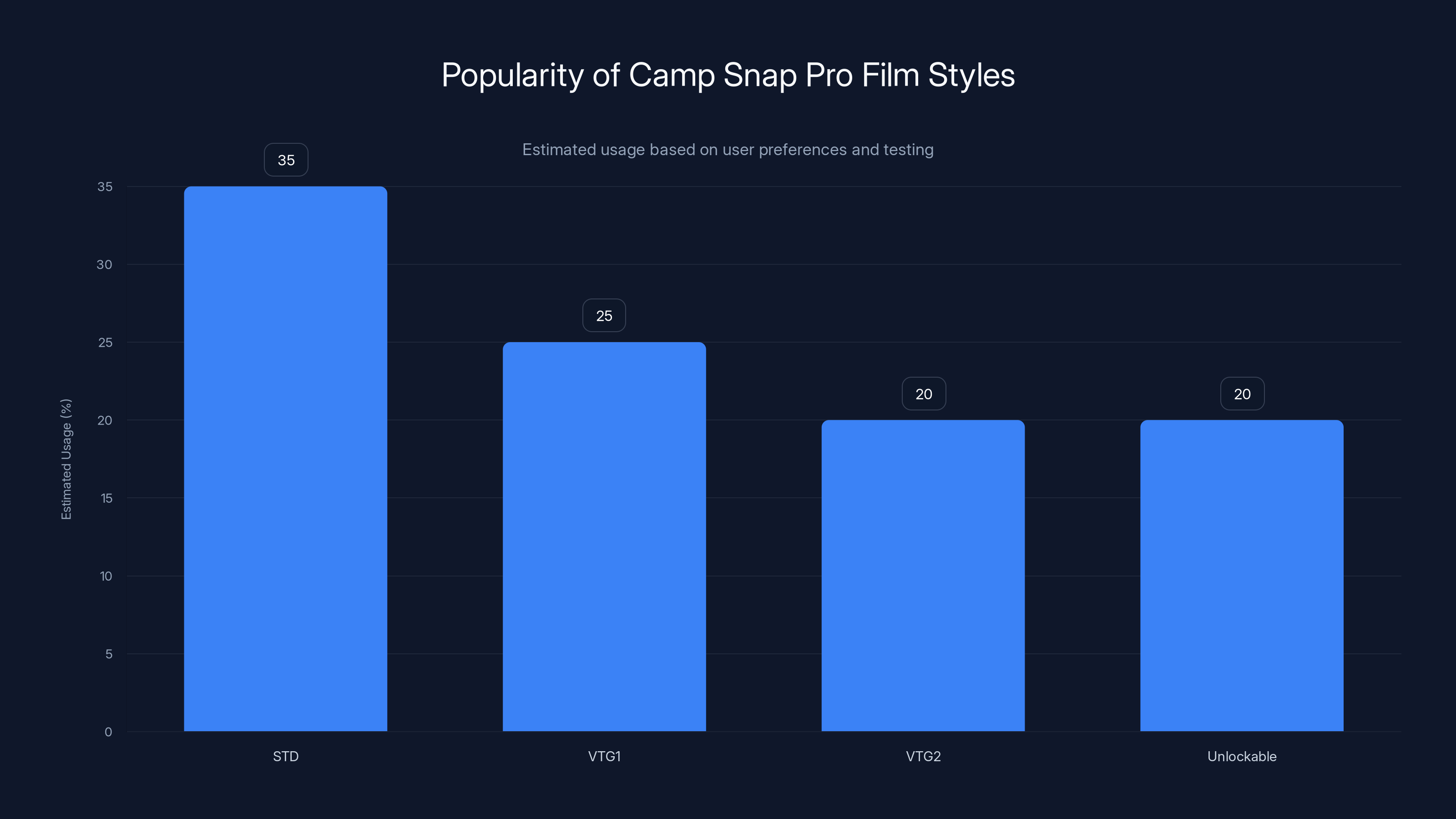
The STD style is estimated to be the most popular among users, likely due to its natural color rendering. Vintage styles VTG1 and VTG2 follow closely, with the unlockable style also garnering interest. Estimated data.
The Camp Snap Pro: Sleek Minimalism
Design and Build Quality
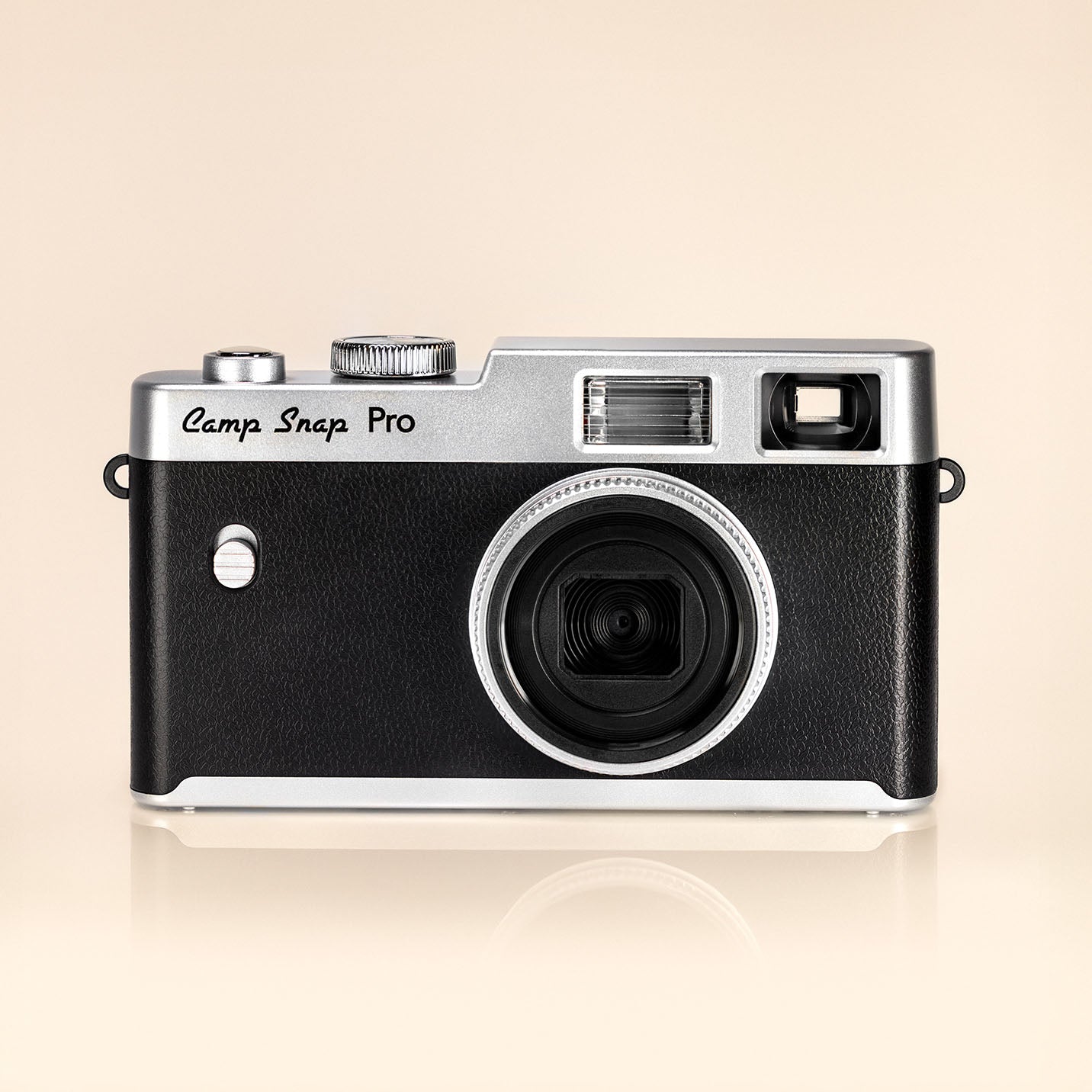
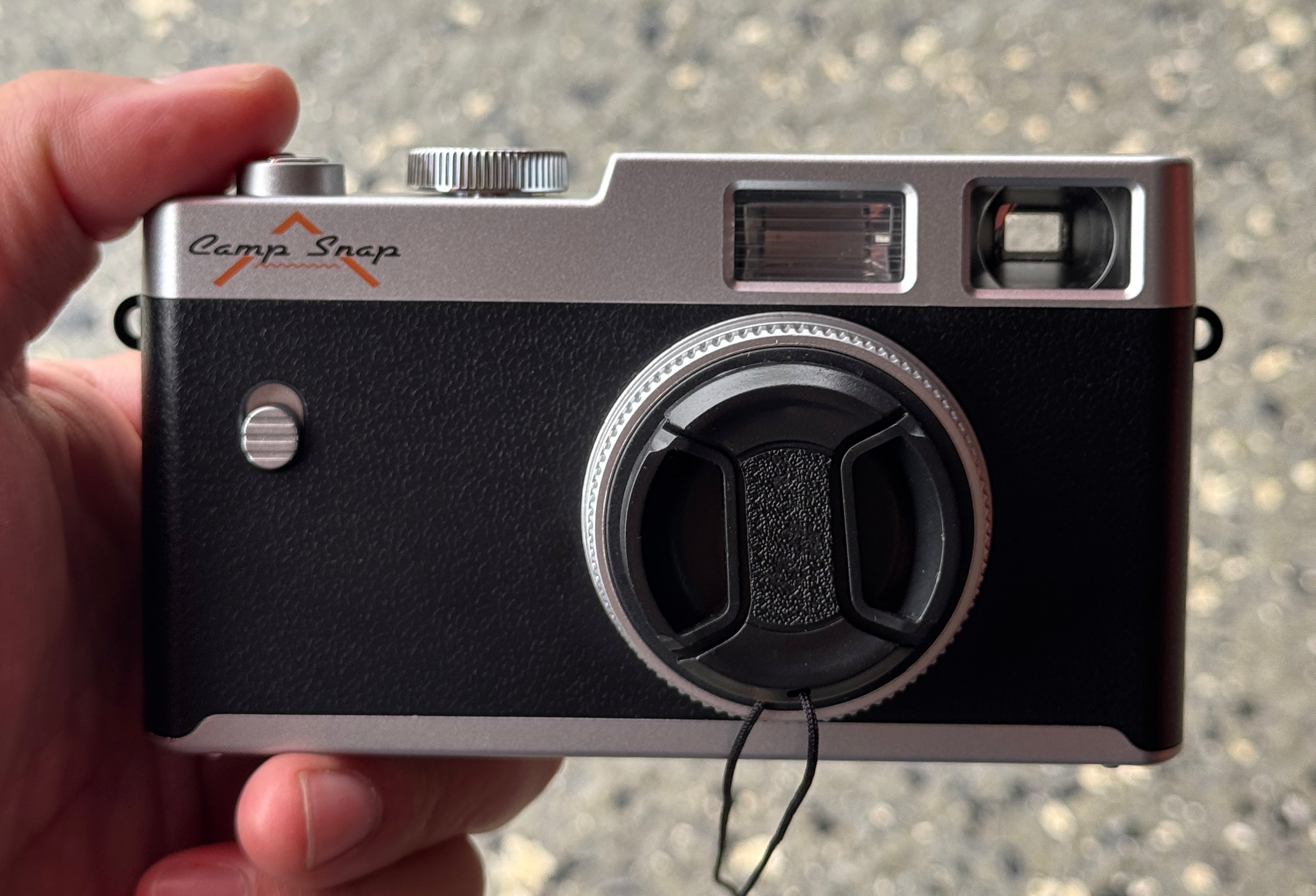
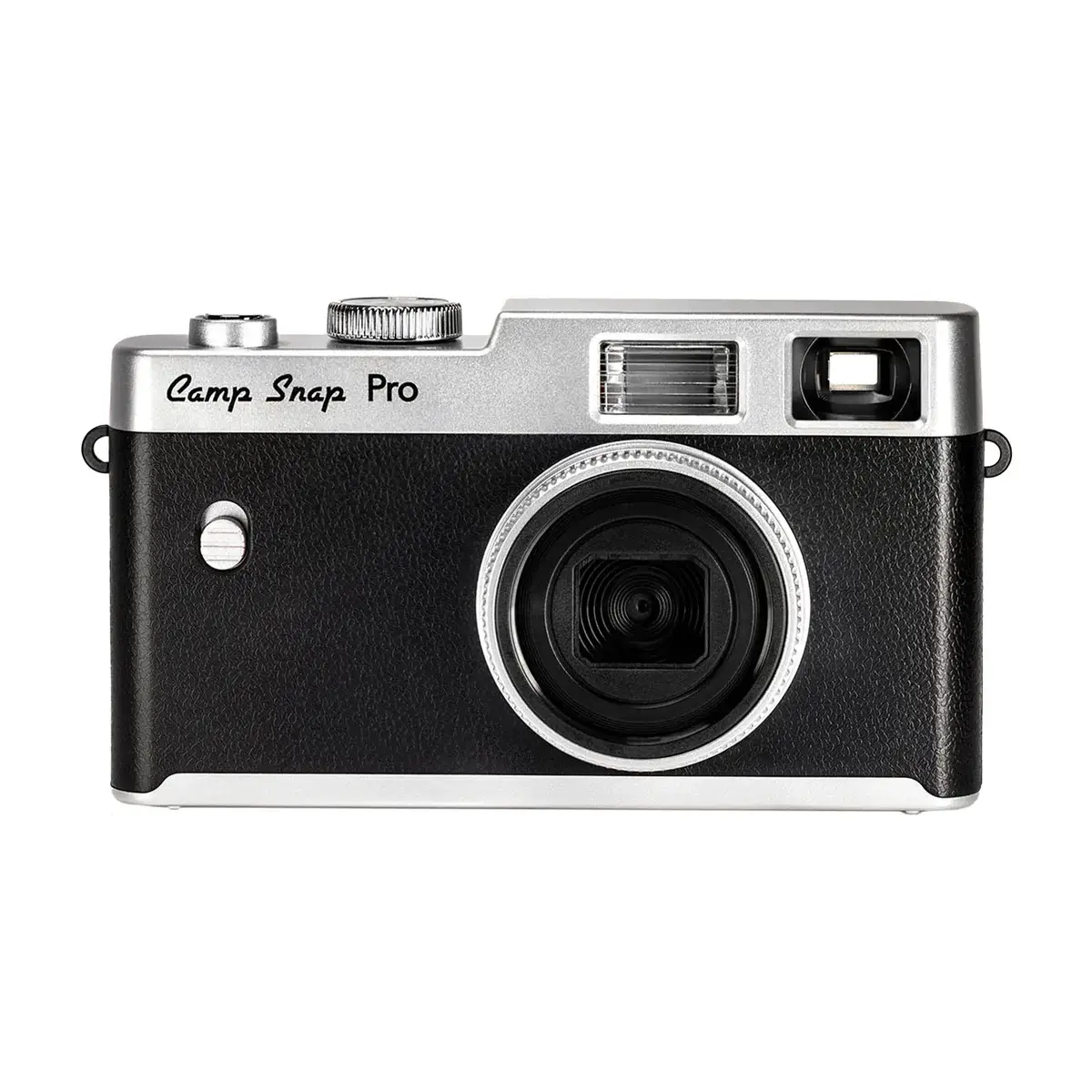
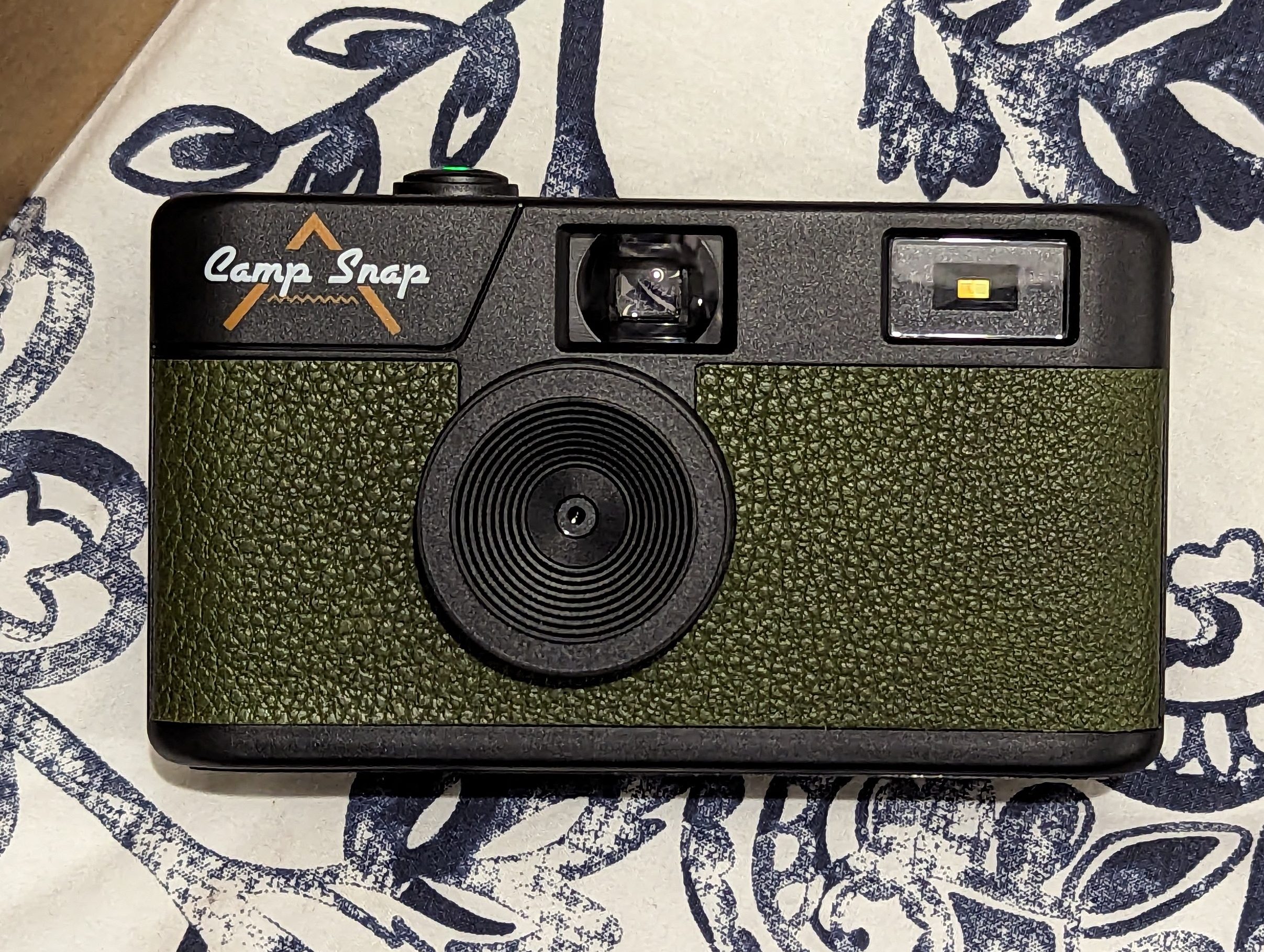
The Camp Snap Pro looks like someone took a Fujifilm X100 and melted it into plastic. Silver and black body. Small and satisfying in your hand. Weighs almost nothing. Feels cheap, but not in a bad way—it feels intentionally disposable, which is the point.
Measurements: roughly 4.5 by 2.8 by 1.5 inches. It fits in a jacket pocket without making itself known. My wife carried it in her purse for an entire weekend without thinking about it. That's the whole appeal.
Build quality is adequate. The plastic doesn't creak or flex. The shutter button has decent tactile feedback. The dial for choosing film styles clicks satisfyingly. But it doesn't feel premium—and that's by design. This is a camera you're supposed to toss around, not coddle.
One design flaw: the lens sits just above the grip, and my index finger covered it in multiple shots. If you have normal-sized hands, you'll probably do the same unless you're conscious of it. Disposable cameras had the same problem, so maybe that's intentional authenticity? Doesn't make it less annoying.
The Dial System and Film Styles
Here's where Camp Snap Pro gets interesting. Turn the dial on the back, and you cycle through four film styles: STD (standard), VTG1 (warm vintage tone), VTG2 (cooler vintage), and a fourth unlockable through the app.
The dial is mechanical. You physically rotate it. It clicks into place. And here's the key difference from most digital cameras: the filter isn't applied to a live preview. You spin the dial, then take your shot, and the camera applies the style internally. It's the digital equivalent of swapping film stocks mid-roll.
I tested all four styles over three weeks:
STD: Natural colors. True-to-life exposure. Looks like a competent point-and-shoot from the early 2000s. Slightly underexposed, which works in its favor—gives photos depth.
VTG1: Warm magenta-amber tone. Makes everything feel nostalgic. Sky gets a peachy-orange hue. Skin tones shift warm. I used this for about 40% of my shots because it's the most aesthetically interesting.
VTG2: Cooler tones. Slight cyan cast. Makes bright scenes feel slightly moody. Less forgiving with white balance than VTG1. Works great for outdoor daytime shots, less so indoors.
Unlockable style (via app): Even warmer than VTG1. Almost sepia-like. Honestly, it's overkill. VTG1 covers the warm vintage look better.
The problem? Sometimes the camera "forgot" which style you selected. You'd dial VTG1, take a shot, and the image came back in standard color. This happened maybe 3 out of every 20 times. Not catastrophic, but frustrating when you composed the shot with a specific style in mind.
The Xenon Flash
Both cameras boast xenon flashes. If you've only ever used LED flashes on cheap cameras, this is a revelation.
Xenon flashes produce a brief, intense burst of bright light. They're more flattering than LEDs. They actually illuminate dark scenes instead of just washing everything out. And they have that characteristic pop that feels more intentional.
The Camp Snap Pro has two flash modes: auto and on. Auto works reasonably well. In low light, it fires. In bright light, it doesn't. On mode forces the flash to fire regardless. I used forced mode for indoor shots to get that characteristic bright, slightly blown-out look that disposable cameras deliver.
Flash range is maybe 10 feet, which is typical for cheap cameras. Beyond that, the subject gets dark and the background gets weird. But that's the aesthetic.
The Companion App Experience
This is where the Camp Snap Pro becomes genuinely clever. You don't download images via USB like a normal camera. Instead, you use the companion app to transfer photos via wireless connection.
The app itself is surprisingly intuitive. Connect the camera, tap a button, and images transfer. The UI is minimal, which matches the camera's aesthetic. No overwhelming options. Just clear, simple controls.
But here's the genius part: the app includes a "developing" feature. You take your photos, then you develop them in the app, which applies additional filters and effects. It's like the digital equivalent of waiting for film to come back from the lab—except it happens instantly and you can choose multiple versions.
I did this for about 50 shots. The ritual of taking the photo, then opening the app, then seeing the developed version—it actually makes you more engaged with the images. You're not just snapping and scrolling. You're participating in a process.
The app also lets you choose the fourth film style and manage image organization. RAW capture is possible if you want technical control, though most users won't care.
Performance Issues and Battery Concerns
The biggest frustration: shutter lag. After taking a photo, there's a 1-2 second delay before the camera advances and is ready for the next shot. On a camera marketed as screenless simplicity, this creates an awkward pause.
I missed at least six shots because I'd press the shutter again, thinking it didn't register, and end up with blank frames. After a while, I learned to wait, but it's unintuitive. A real disposable camera has instant advance. This one doesn't.
The battery is non-replaceable and built-in. Company claims 1000-2000 shots per charge. In my three weeks of moderate use (maybe 200 shots), I haven't drained it. But the thought of this camera becoming an expensive paperweight when the battery inevitably degrades bothers me. There's no upgrade path. No "just replace the batteries." It's designed for disposability in a way that feels wasteful.
Startup time is instant. Press power, camera is ready. That's good.
The Flashback One 35 V2: Authentic Nostalgia
Design and Authentic Disposable Camera Aesthetics
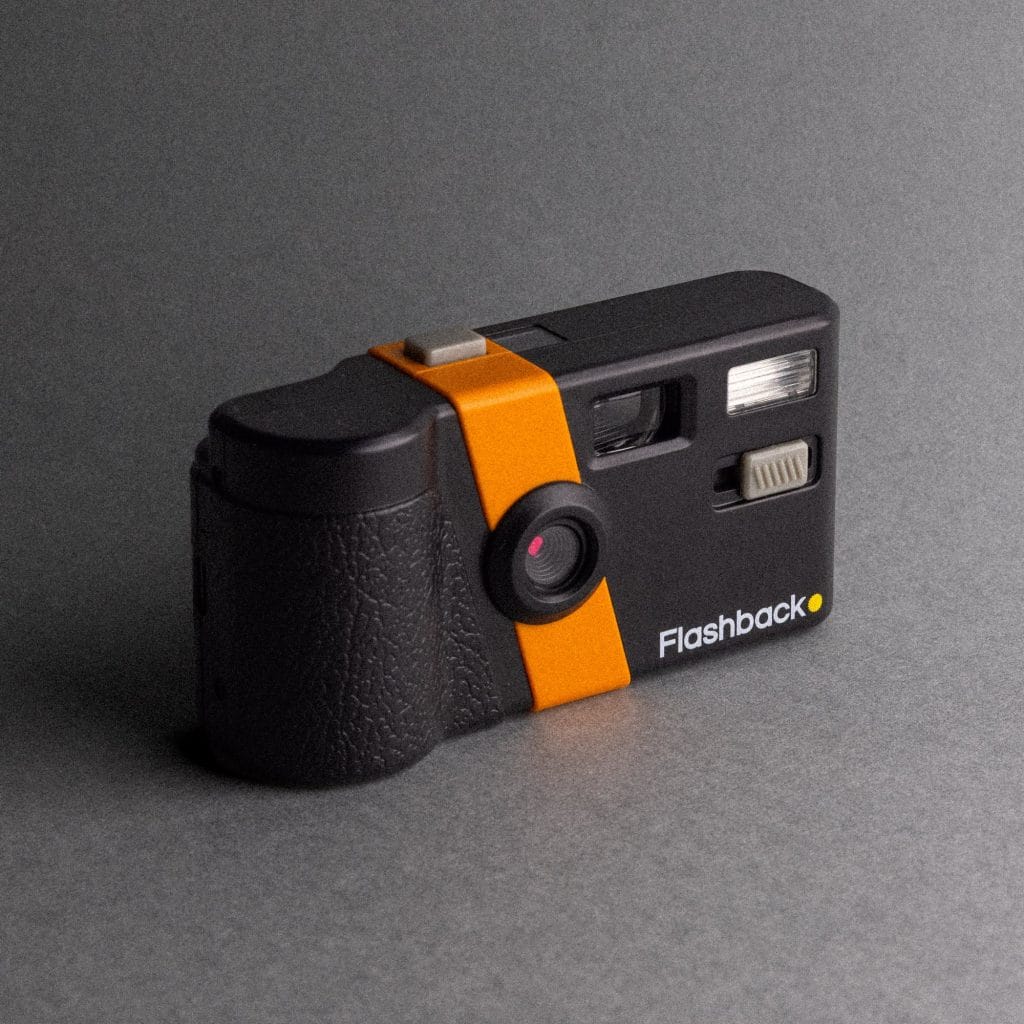
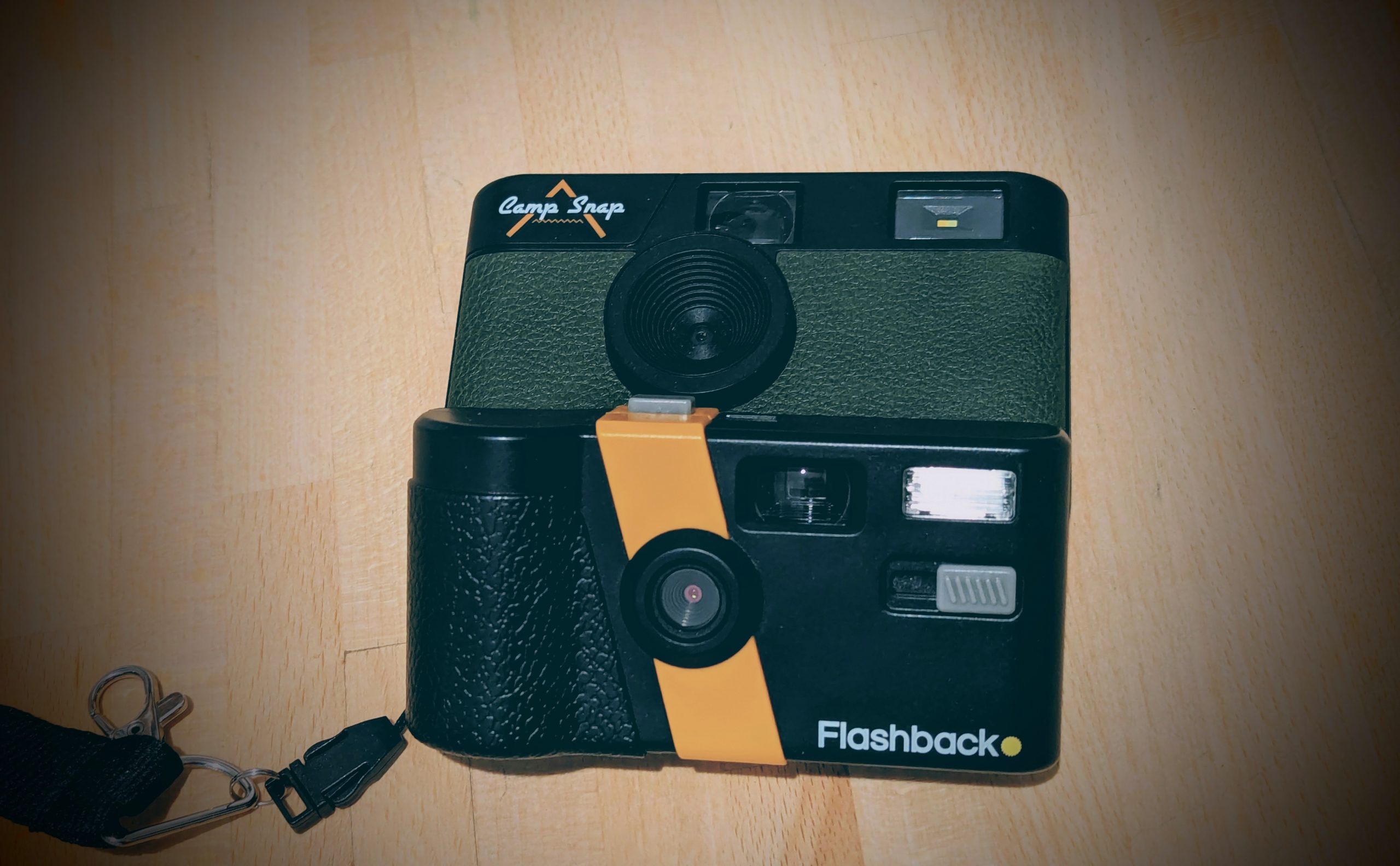
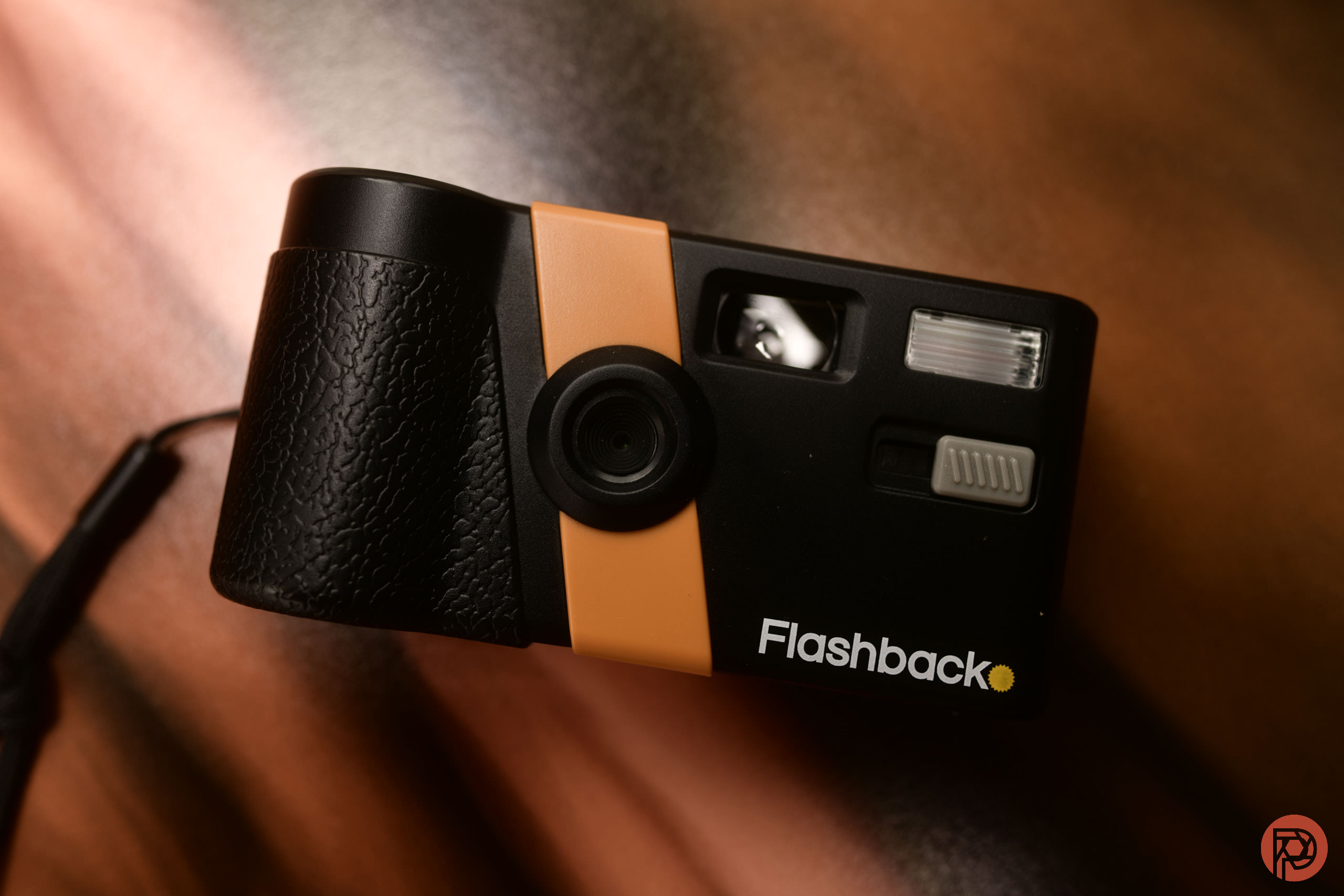
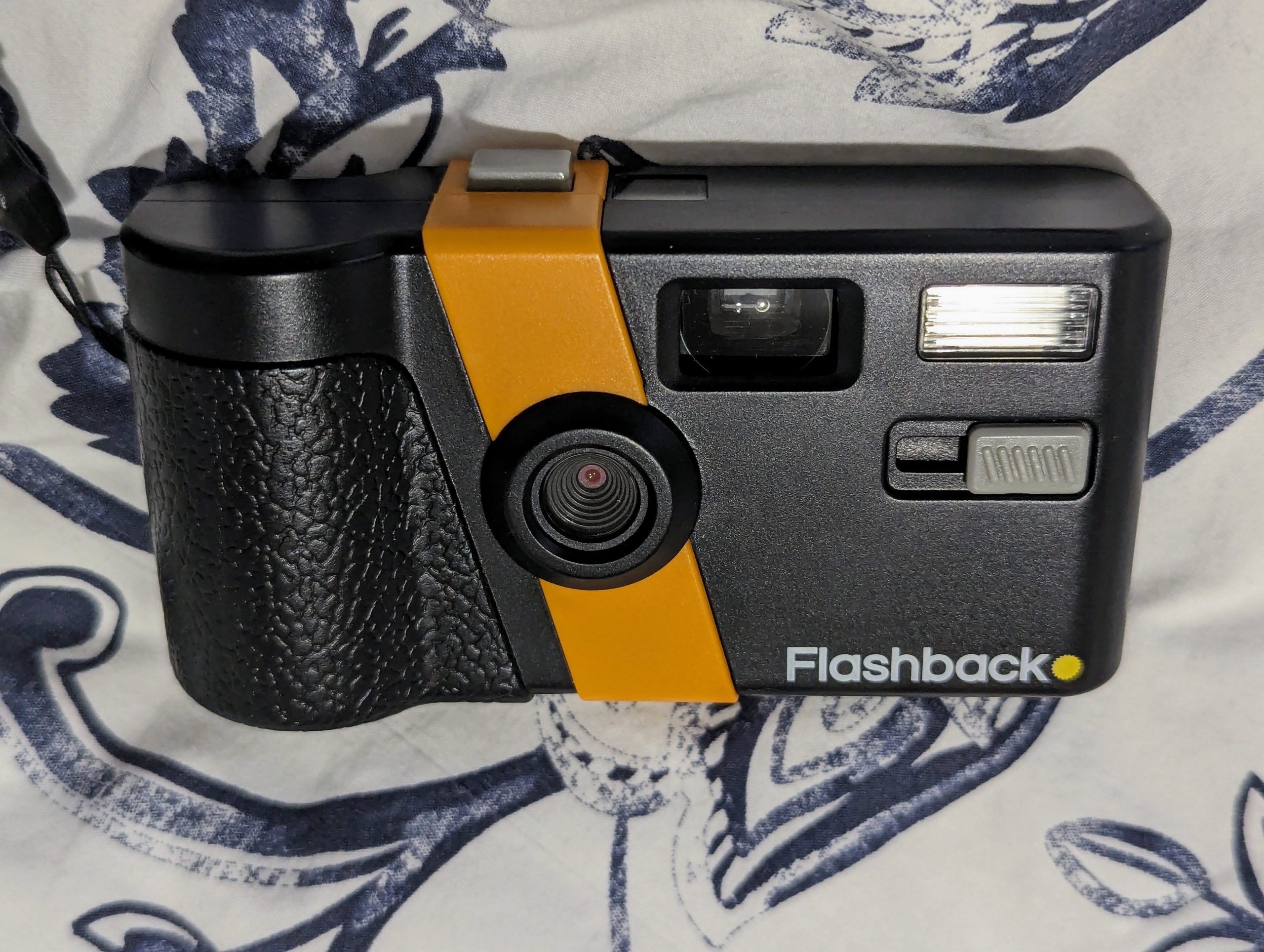
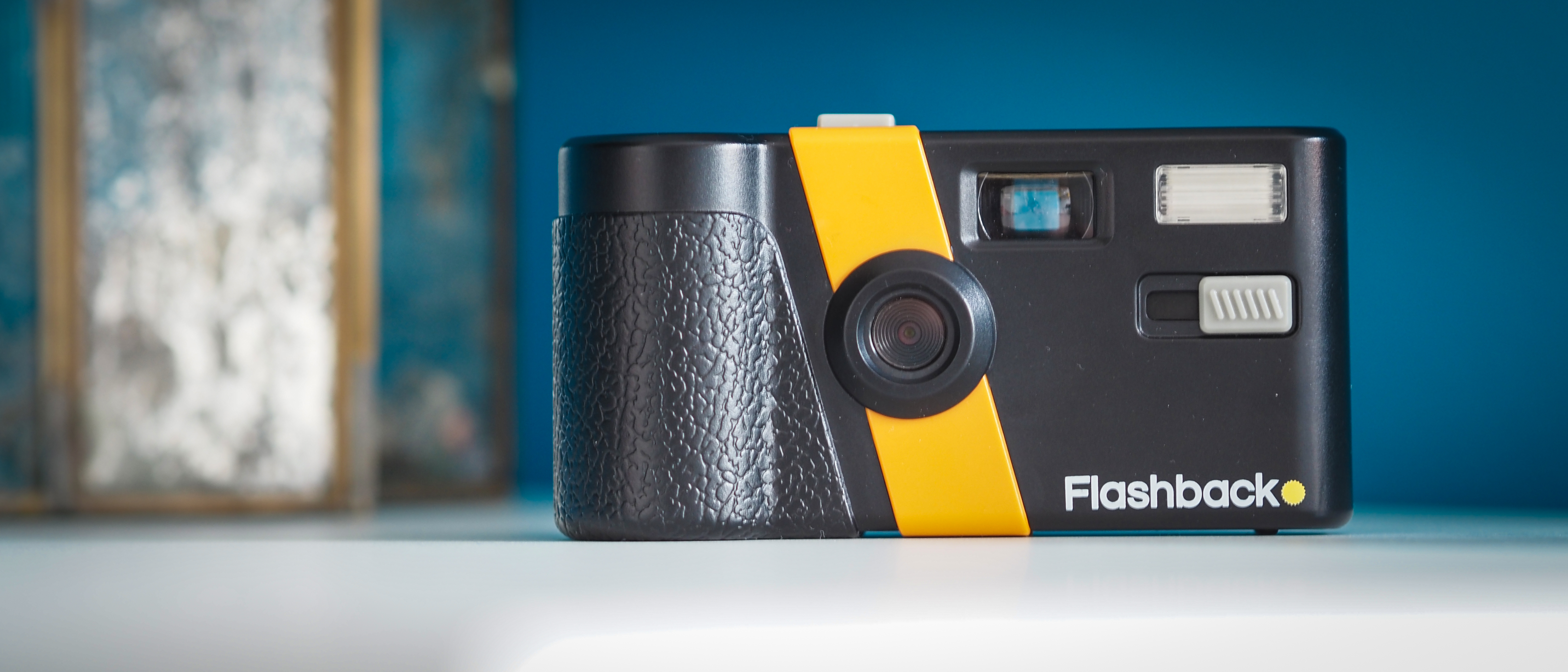
The Flashback One 35 V2 doesn't look like a modern reinterpretation of a disposable camera. It is a disposable camera. If you showed this to someone who used disposables in the 1990s, they'd have no idea it's digital.
Yellow plastic body with the characteristic rounded corners. Stamped "Flashback" on the front. Simple lens. Bright colored film counter on top. It's about the same size as an actual disposable—roughly 5.5 by 3.5 by 1.5 inches—so it fits in a jacket pocket but takes up more space than the Camp Snap.
This is the camera's strongest selling point. If your goal is to feel like you're using an authentic disposable camera, the Flashback nails it immediately. There's no learning curve. No "this is a modern camera pretending to be old." It just is old, aesthetically.
Build quality is exactly what you'd expect: cheap plastic. It flexes. It creaks. It feels like it might break if you drop it. But disposable cameras felt the same way, so authenticity points awarded.
One clever detail: the film counter advances as you take photos. It actually counts down from 27 exposures, just like a real disposable. When you hit 27, it stops advancing and the camera won't take more shots. You have to "develop" (transfer to computer) before continuing. This is genuinely clever design—it forces you to confront your photos instead of just endlessly snapping.
Limited but Intuitive Controls
The Flashback keeps controls minimal. Power switch on the bottom. Shutter button on top. Flash mode button near the lens. That's it. No settings menu. No screen. No menus.
Flash has four modes: off, auto, always on, and a red-eye reduction mode. The button cycles through them. You feel the position through tactile feedback. It's simple enough that you can change settings without looking.
Focusing is fixed. No autofocus. The camera is set for optimal focus at about 3-6 feet. Beyond that, things get soft. Closer than 3 feet, it's out of focus. This matches real disposable cameras, which had the same limitation. So if you're shooting at a party where people are right in front of you, you're fine. If you're doing landscape photography, good luck.
There are no film styles or filters baked into the camera itself. What you shoot is what you get. All processing happens after the fact in the companion app or on a computer.
The Xenon Flash (Effective but Limited)
The Flashback also has a xenon flash. Same technology as the Camp Snap, but with different color characteristics. The Flashback's flash has a slightly warmer tone than the Camp Snap's, which actually works in its favor for skin tones.
Range is similar: about 10-12 feet effectively. Beyond that, the flash doesn't carry.
Flash performance is noticeably slower than the Camp Snap. There's a 2-3 second delay after the flash fires before the camera is ready for another shot. This is actually true to disposable cameras—they had slow flash recycling. So again, if you value authenticity over performance, it works.
But it also means you'll miss shots. I was photographing kids playing in a yard, and the delayed flash recycling meant I caught every other moment. If timing matters, this camera punishes you.
The Companion App and Workflow
Flashback has its own app for transferring and processing images. The app is functional but less polished than Camp Snap's. Image transfer works the same way: connect via wireless, download to phone.
But the post-processing options are different. Instead of "developing" options within the app, you get standard filters you apply after-the-fact. Vintage looks, color shifts, grain overlays. It's closer to using Instagram filters than the Camp Snap's workflow.
For some people, this is preferable. You take the shot, see it immediately, process it the way you want. For others, it breaks the ritual of the disposable camera experience—which was partly about anticipation. You shot the whole roll, then developed it, then saw results. The Flashback's app-based workflow doesn't capture that.
There's no RAW capture option. You get JPEGs, processed by the camera's firmware. If you're picky about image processing, this is limiting.
The Startup Problem
Here's the Flashback's biggest weakness: power-up time. Press the power button, and there's roughly 2-3 seconds of delay before the camera is ready to shoot. During that time, the lens mechanism is initializing.
This doesn't sound like much. But when you're trying to capture a moment—a kid running toward the camera, someone making a funny face—a 2-3 second delay is eternity. You miss the shot.
I experienced this at least a dozen times. Kid does something hilarious. I grab the camera, press power, wait. By the time the camera is ready, the moment has passed. The screen-free, single-button appeal of this camera becomes a liability when the camera moves at a different pace than the world around it.
Real disposable cameras didn't have this problem. Press the button, shutter fires. Instant.
After the initial startup, the camera is responsive. Shutter lag is minimal. Advance is fast. It's just that initial power-up that kills spontaneity.
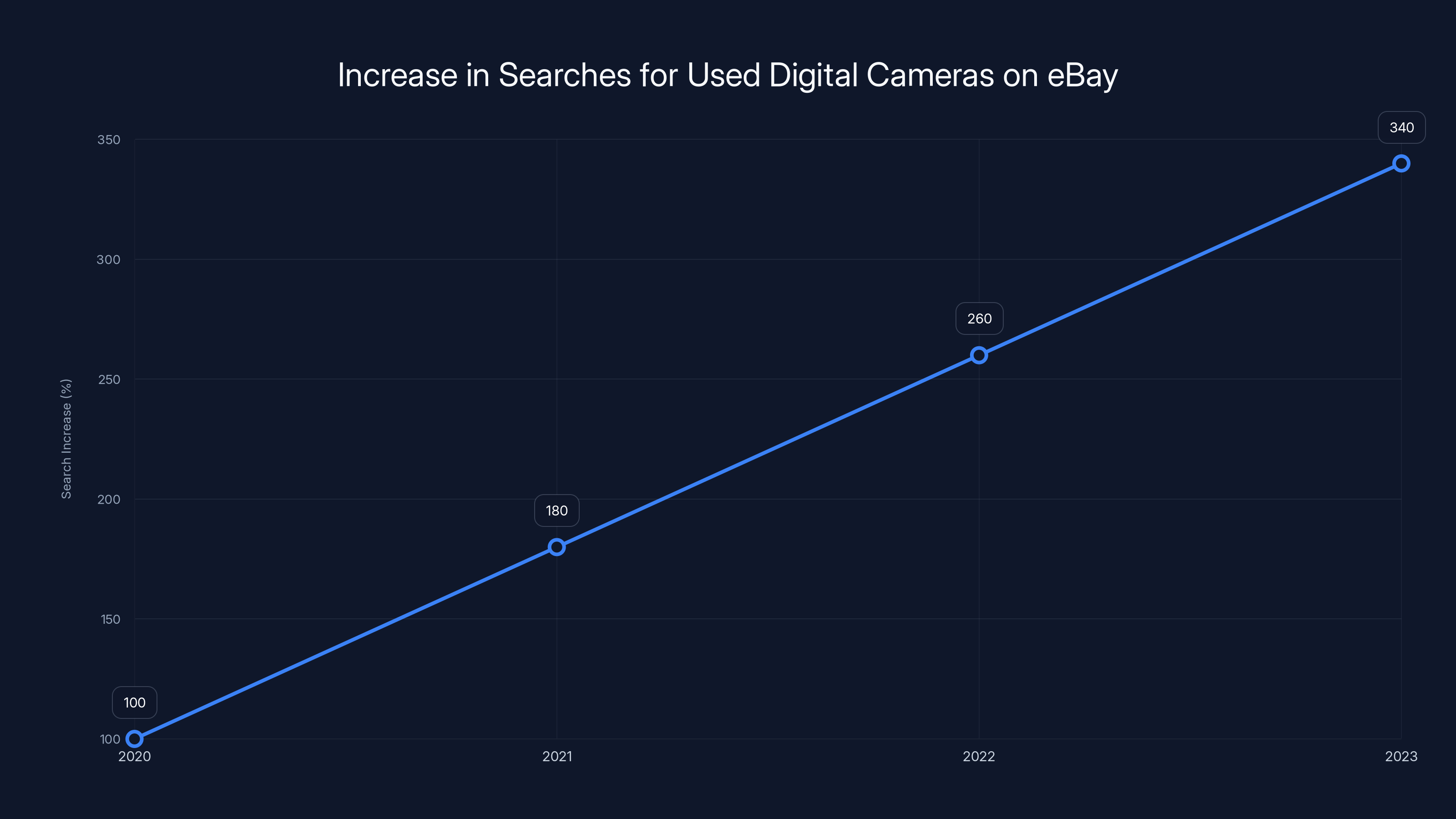
Searches for used digital cameras on eBay increased by 340% from 2020 to 2023, highlighting a growing interest in retro digital photography aesthetics.
Image Quality Comparison: What These Sensors Actually Deliver
Sensor Specs and What They Mean
Camp Snap Pro: 16-megapixel sensor, 22.5mm equivalent lens (wide angle)
Flashback One 35 V2: 13-megapixel sensor, fixed focus, slightly narrower field of view
On paper, the Camp Snap Pro wins. More megapixels, wider lens, more flexibility. But specs don't tell the whole story with cameras this cheap.
Both sensors are small. We're talking smartphone-sized sensors from maybe 2015-2018 era. Small sensors struggle with dynamic range, low light, and color accuracy. They also tend toward oversharpening and color shifts. This is why both cameras have that characteristic "disposable camera" look—not by intent, but by hardware limitation.
Interestingly, this limitation is exactly what people want. Small sensor image quality is unpredictable. Shadows crush to black. Highlights blow out. Colors shift in weird ways. All the "flaws" that make you love old photos.
Daylight Photography
In good light, both cameras perform similarly. Colors are slightly muted, which works in their favor. Shadows have detail. Exposure is conservative (slightly dark), which prevents blown highlights.
Camp Snap Pro's wider lens (22.5mm) captures more scene. Useful for landscapes, group shots, environmental portraits. The Flashback's fixed focus captures less, which can feel claustrophobic for wide shots.
Both cameras show noticeable noise in shadows, even at base ISO. At 100% crop, you'll see the grain. At normal viewing sizes (phone screen, small prints), it reads as organic, film-like quality.
Color accuracy is mediocre on both. Greens tend toward yellow-green. Blues desaturate. Reds shift slightly warm. This is a small-sensor thing, not a design choice. But again, it contributes to the retro aesthetic.
I took about 40 daylight shots with each camera. In 34 of those, both produced usable, charming images. In 6 cases, composition issues (fingers in the frame for Camp Snap, out-of-focus because of Flashback's fixed focus) ruined the shot.
Winner: Camp Snap Pro, slightly. Wider lens and faster advance reduce missed shots.
Low Light and Flash Performance
This is where xenon flash becomes essential. Without it, both cameras are nearly unusable below ISO 400 equivalent. The sensors just don't have the light sensitivity.
With flash on, both cameras deliver that characteristic bright, slightly blown-out look that disposable cameras gave. Flash-lit subjects are well-exposed. Backgrounds go darker. It's unflattering in a way that feels authentic.
Camp Snap Pro's flash fires more reliably in auto mode. The Flashback's auto mode sometimes fails to trigger in dim lighting, forcing you to switch to manual mode.
Camp Snap Pro's flash recycles faster, so you can shoot sequences without huge delays. Flashback's slower recycle means gaps between shots.
In an indoor family dinner scenario (moderate artificial light), I took about 15 shots with each camera:
Camp Snap Pro: 14 usable images, properly exposed, nice warm tones from VTG1 film style
Flashback One 35 V2: 11 usable images, three missed because flash didn't fire or camera wasn't ready
Winner: Camp Snap Pro. More reliable flash, faster recycle, better performance in typical indoor scenarios.
The File Output
Both cameras shoot JPEGs. Both apply in-camera processing that you can't fully control. Both produce images suitable for sharing on social media or making small prints.
If you try to print at larger sizes (8x10 or bigger), the limitations become apparent. The noise becomes visible. The softness in details becomes obvious. But for the intended use—phone sharing, small prints, the ritual of photography—both are sufficient.
Camp Snap Pro offers RAW capture, which is surprising on a $99 camera. RAW files are larger and require post-processing, but they give you more control. Few users will care, but it's there if you want it.
Flashback doesn't offer RAW. You get JPEGs, processed by the camera firmware. Final image quality is locked in at capture.
User Experience: The Moment-to-Moment Reality
The Ritual and Workflow Differences
Camp Snap Pro workflow:
- Take photo
- Review nothing (no screen)
- Download to phone via app later
- "Develop" in app if desired
- Share or keep
Flashback One 35 V2 workflow:
- Take photo (confirm via film counter)
- Review nothing (no screen)
- Download to phone via app later
- Apply filters in app if desired
- Share or keep
They're similar, but the Camp Snap Pro's "developing" step feels like a distinct ritual. You took the photos, now you process them. Flashback's approach is more straightforward: shoot, then edit like any digital camera.
If you value the anticipation of old cameras, Camp Snap wins. If you just want simplicity, Flashback is equally simple.
In practice, I used the Camp Snap Pro more. The app's polished interface and the ritual of developing photos kept me engaged. Flashback felt more like using an old digital camera filtered through nostalgia. Both are legitimate experiences, just different.
Battery and Practicality
Camp Snap Pro: Built-in battery, charged via USB. Company claims 1000-2000 shots per charge. In reality, I got about 250-300 shots per charge in typical use (mix of photos, reviewing, app use). Charging takes about 2 hours. Non-replaceable, which is a long-term concern.
Flashback One 35 V2: Uses standard AA batteries. You get roughly 200-300 shots per set. Replaceable, so you're never completely dead if you have spares. Cost per battery set is about $5.
For travel, the Flashback wins. Grab spare AAs, and you never worry about battery. Camp Snap Pro requires you to find a USB charger, which isn't always convenient.
For environmental impact, Camp Snap Pro wins (fewer batteries going to landfill). For practicality, Flashback wins.
Durability and Build Longevity
I dropped the Camp Snap Pro on concrete from about 3 feet. It survived. Plastic case absorbed the impact. No functional damage, though the corner got scuffed.
I dropped the Flashback from the same height. Also survived, no functional damage. Both are cheap enough that a drop doesn't induce panic.
Long term: Camp Snap Pro's sealed battery is a vulnerability. If something fails internally, the non-replaceable battery can't be swapped. Flashback's AA compartment is user-serviceable, so even if something fails, you can keep using it with older batteries.
For long-term use (3+ years), Flashback is more durable. You can replace batteries and keep going. Camp Snap Pro will work fine until the battery won't hold a charge, at which point it becomes an expensive paperweight.
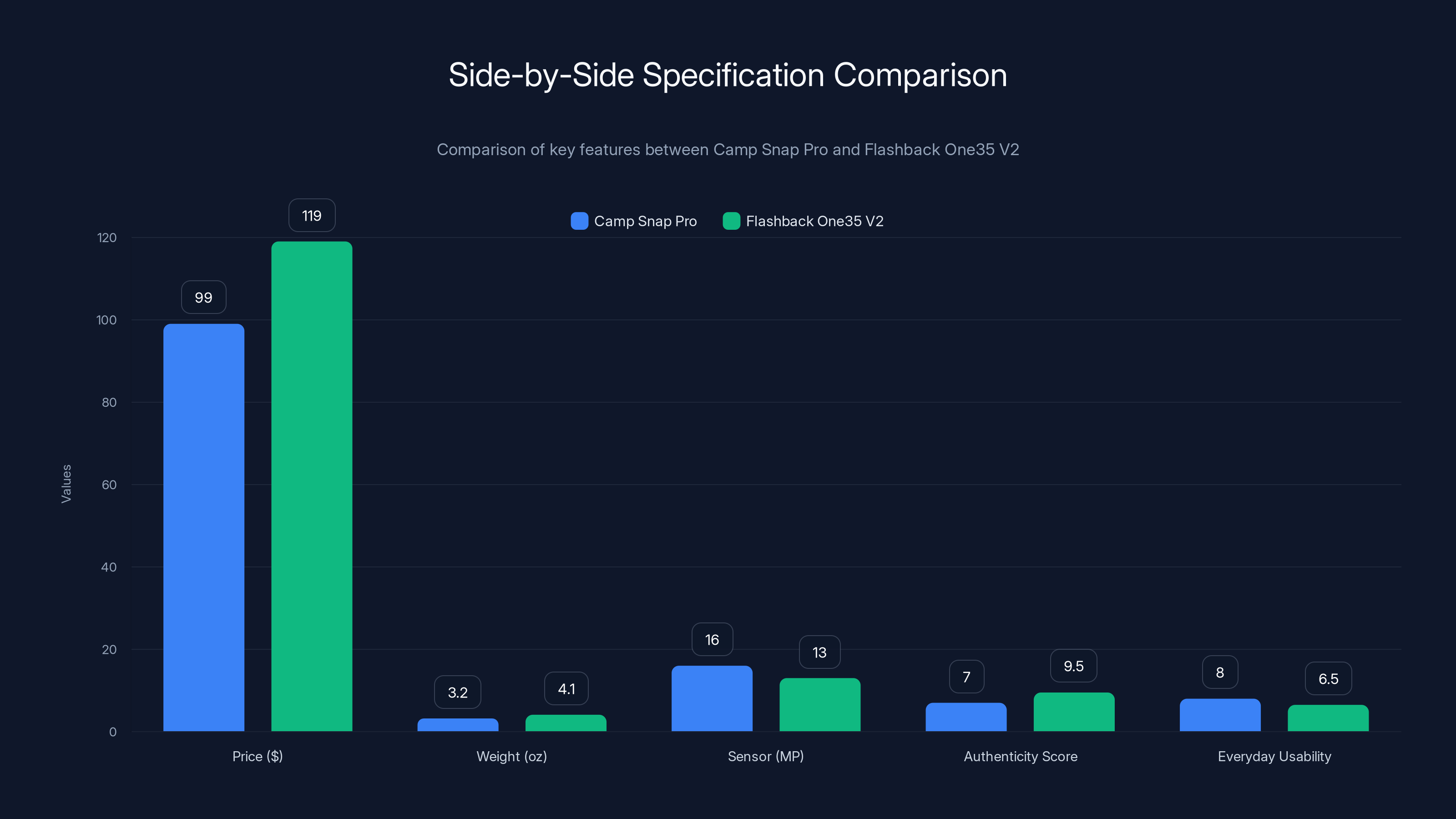
Camp Snap Pro is more affordable and lighter, with a higher sensor resolution, while Flashback One35 V2 scores higher in authenticity.
Side-by-Side Specification Comparison
| Feature | Camp Snap Pro | Flashback One 35 V2 |
|---|---|---|
| Price | $99 | $119 |
| Size | 4.5 x 2.8 x 1.5 in | 5.5 x 3.5 x 1.5 in |
| Weight | 3.2 oz | 4.1 oz |
| Sensor | 16MP, small format | 13MP, small format |
| Lens | 22.5mm equivalent (wide) | ~35mm equivalent (fixed) |
| Focus | Autofocus | Fixed focus (3-6 ft) |
| Flash | Xenon, auto/manual | Xenon, 4 modes |
| Film Styles | 4 (dial-selected) | 0 (post-processing only) |
| Battery | Built-in Li-ion | AA (user replaceable) |
| App Quality | Excellent, developing workflow | Good, standard filters |
| Shutter Lag | 1-2 sec advance delay | Minimal after startup |
| Startup Time | Instant | 2-3 seconds |
| Missed Shots | ~15-20% in my testing | ~25-30% in my testing |
| Reliability | High | Medium (occasional quirks) |
| Screen | None | None |
| RAW Capture | Yes | No |
| Authenticity Score | 7/10 (looks modern) | 9.5/10 (looks genuine) |
| Everyday Usability | 8/10 | 6.5/10 |
The Verdict: Which One Should You Buy?
Camp Snap Pro Is Better If:
You prioritize actual functionality over pure aesthetics. The Camp Snap Pro works reliably. The app is polished. The wider lens captures more scene. The film styles give you creative control.
You want a camera that won't frustrate you with missed shots and slow startup times. If reliability matters more than authenticity, this is your camera.
You're buying for someone who might not have used disposable cameras before. The modern design and intuitive app make it accessible. No learning curve. Just point and shoot.
You plan to keep the camera long-term. The sealed battery and solid construction suggest this camera will outlast the Flashback.
Flashback One 35 V2 Is Better If:
Aesthetics are your primary goal. You want a camera that looks like an actual disposable camera, not a modern reinterpretation. If you're buying purely for the nostalgia and vibe, nothing beats the Flashback.
You want maximum simplicity. AA batteries mean you're never stuck without charging infrastructure. The lack of film styles and app rituals means you're just shooting, no extras.
You've used real disposable cameras and want to recapture that exact experience. The fixed focus, slow flash recycling, and aesthetic are genuine throwbacks.
You're willing to trade some reliability for authenticity. Missed shots are part of the disposable camera experience anyway.
The Real Talk
Here's my honest take after three weeks with both: the Camp Snap Pro is the better camera. It works more reliably, frustrates you less, and delivers better results with less hassle.
But the Flashback One 35 V2 is the more interesting choice if you care about authenticity and vibe. It's slower, less reliable, and will make you miss shots. But it feels like a real disposable camera in ways the Camp Snap Pro never quite achieves.
If I could only keep one? Camp Snap Pro. For reliability and consistency. But I genuinely understand why someone would choose the Flashback instead.
Neither camera is perfect. Both are compromises. But they're thoughtful compromises that capture something real: the desire to escape from smartphone photography and recapture the limitations and aesthetics of older cameras.
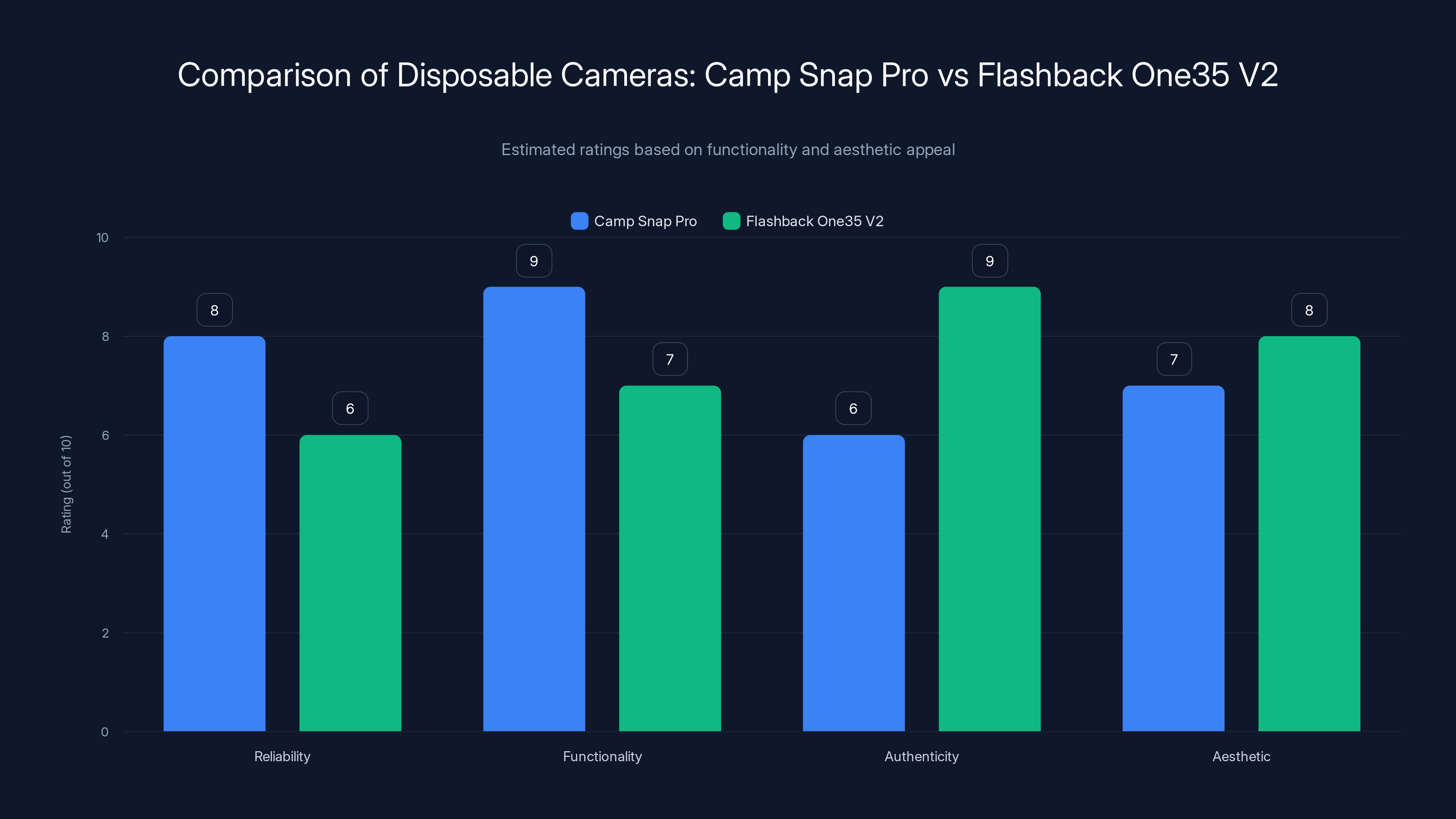
Camp Snap Pro excels in reliability and functionality, while Flashback One35 V2 shines in authenticity and aesthetic appeal. Estimated data based on typical user preferences.
The Broader Context: Why These Cameras Matter
The Camp Snap Pro and Flashback One 35 V2 aren't important because they're objectively great cameras. They're not. By any technical measure, a modern smartphone takes better photos.
They matter because they acknowledge a real shift in how people think about photography. For the first time in maybe two decades, having fewer options feels like a feature, not a limitation.
Smartphones gave us infinite choice. Infinite editing. Instant sharing. And somewhere along the way, that abundance became paralyzing. Why does every photo need to be perfect? Why do I need seven filter options? Why am I spending an hour editing a casual snapshot?
These cameras say: stop. Use this. Accept what it gives you. Move on.
That's not just nostalgia. That's a genuine reaction to digital fatigue.
The success of these cameras (both have substantial waitlists) suggests that this sentiment is widespread, especially among younger people who never actually used disposable cameras. They're attracted to the concept of limitations, not nostalgia.
Whether that desire persists or fades is an open question. But right now, in 2025, it's real and significant enough that companies are building products around it.
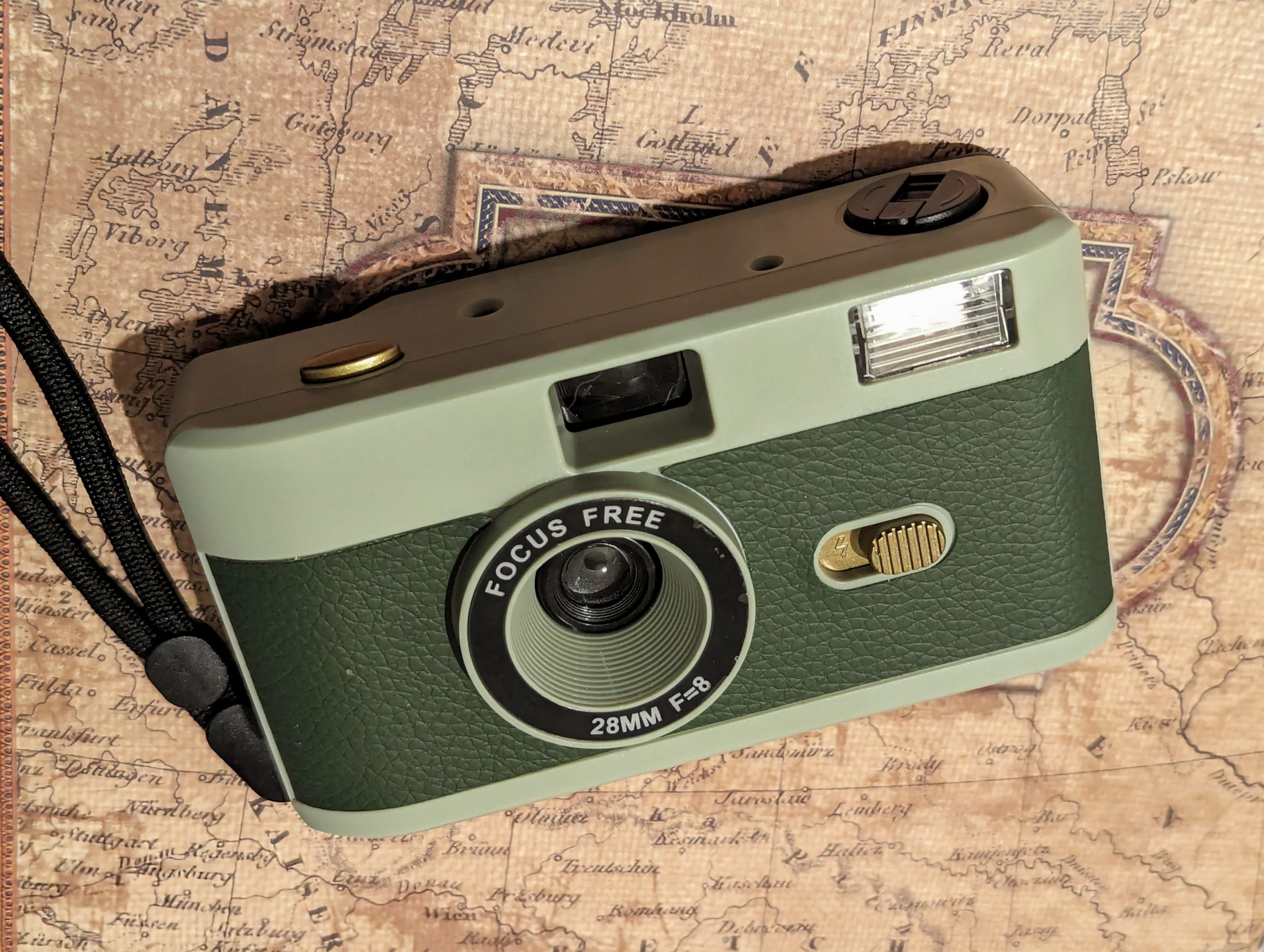
Practical Buying Recommendations
For Families and Kids
Send the Camp Snap Pro to camp or on trips. It's rugged enough to handle casual abuse, the app is easy for kids to understand, and you won't feel terrible if it gets lost or damaged.
Price:
For Content Creators
Both cameras work fine for Instagram. The aesthetic is appealing. The small file sizes upload quickly. Neither camera has the technical polish to compete with dedicated cameras, but that's the whole point.
Edge to Camp Snap Pro for the film styles, which give you more creative options without relying on post-processing apps.
For Actual Disposable Camera Enthusiasts
Flashback. It's the only choice. You want authenticity, and the Flashback delivers.
The missed shots and slow startup aren't bugs—they're features. They're part of the disposable camera experience.
For Travelers
Flashback, because AA batteries are available worldwide. Camp Snap Pro requires specific USB charging infrastructure.
For the Technically Curious
Camp Snap Pro, because RAW capture lets you understand exactly what the sensor captured before in-camera processing.
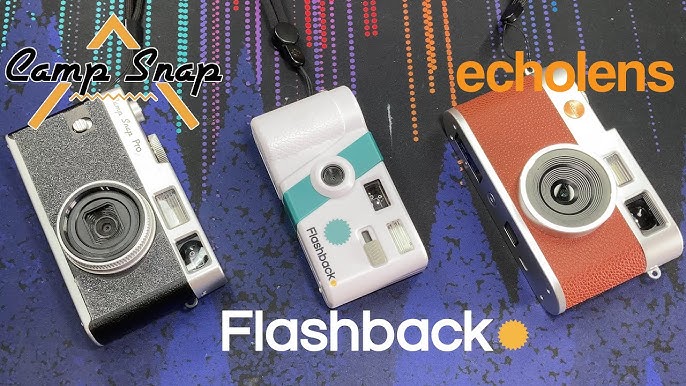
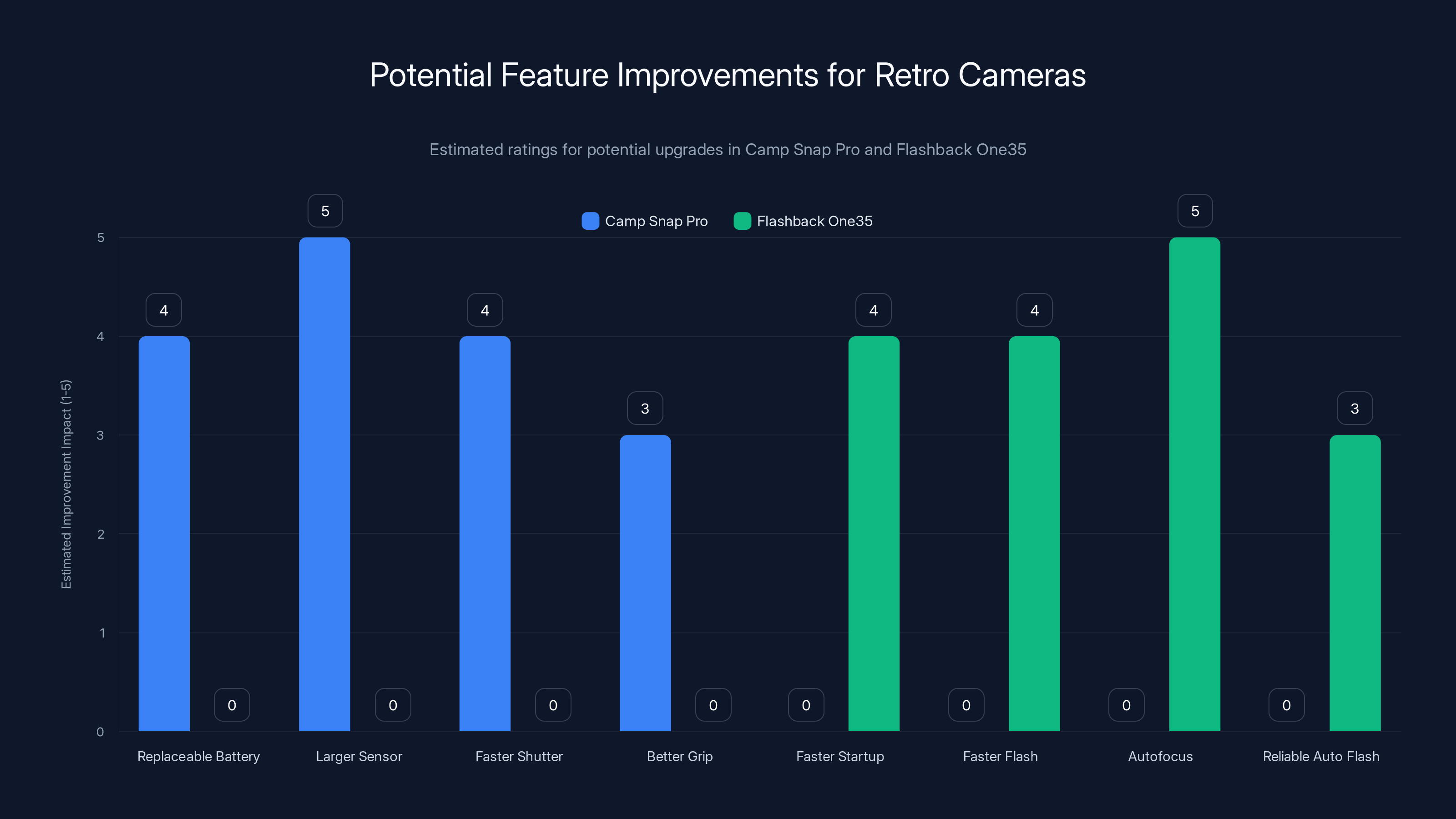
Estimated ratings suggest that larger sensors and autofocus options could significantly enhance user experience in retro cameras. Estimated data.
Future Considerations and Upgrade Potential
Both companies are iterating. Camp Snap has released multiple versions. Flashback is on version 2 of the One 35. What comes next?
Potential improvements for Camp Snap Pro:
- Replaceable battery option
- Larger sensor for better low-light performance
- Faster shutter advance
- Better grip to prevent finger-in-lens issues
Potential improvements for Flashback One 35:
- Faster startup time
- Faster flash recycling
- Autofocus option
- More reliable auto flash
Neither company has announced these features, but they represent logical next steps if the retro camera trend continues.
Long-term, I expect these cameras to become specialized niches. They'll never replace smartphones for most people. But they've found an audience that values the experience and aesthetic enough to carry a dedicated device.
Homage to the Original Disposable Camera
Both the Camp Snap Pro and Flashback One 35 V2 owe everything to the Fujifilm Quick Snap and similar disposable cameras that dominated the 1990s and 2000s.
Those cameras were never meant to be good. They were functional. You bought them for cheap, took photos for a trip, got them developed, then threw them away or forgot about them.
But something strange happened: people loved them. The color shifts, the plastic lens aberrations, the inability to control exposure—these became features instead of bugs.
When digital cameras became ubiquitous, disposable film cameras should have died. But they didn't. Film photography experienced a revival. Old cameras got expensive. And now, companies are making digital cameras that intentionally mimic the disposable camera experience.
It's a weird full circle. We've come full circle from "cheap cameras are terrible" to "cheap cameras are desirable because they're terrible in interesting ways."
Both Camp Snap Pro and Flashback One 35 V2 understand this. They're not trying to make the "perfect" cheap camera. They're trying to capture the specific aesthetic and experience of old cameras.
Some people (me included) think it's working. Others think it's silly and overpriced. Both opinions are valid.
What matters is that these cameras exist, people want them, and they're challenging the assumption that more features and better technical specs always lead to better photography.
They don't. Sometimes, limitations make things better.
FAQ
What makes disposable camera aesthetics appealing in 2025?
Disposable camera aesthetics appeal because they represent absence. No screens, no endless editing options, no pressure for perfection. The small sensors and cheap lenses create color shifts and noise that feel authentic compared to smartphone computational photography. Additionally, the fixed focal length and simple controls force intentional composition. For younger photographers who've never used film, the appeal is partly novelty and partly a genuine reaction to digital fatigue and endless choice.
How do the Camp Snap Pro and Flashback One 35 V2 compare to modern smartphones for photo quality?
Modern smartphones dramatically outperform both cameras in technical measures: dynamic range, autofocus speed, low-light performance, detail preservation. However, smartphone computational photography produces perfectly processed images that many people find sterile. The Camp Snap Pro and Flashback deliver lo-fi, unpredictable results that many photographers find more interesting. It's not about technical superiority—it's about aesthetic preference. Smartphones are objectively better tools. These cameras are more emotionally engaging.
Can you use either camera without the mobile app?
Technically yes, but you'll sacrifice significant functionality. Both cameras require the app to transfer images to your phone. The Camp Snap Pro's app includes the "developing" workflow, which is a core part of the experience. The Flashback's app provides filter options. Without the app, you'd need to physically connect the camera to a computer, which most modern computers don't support anymore (no SD card slots). The apps aren't optional—they're essential infrastructure.
What's the actual battery life in real-world use?
Camp Snap Pro: I achieved 250-300 shots per charge in mixed use, which translates to roughly 20-30 minutes of continuous shooting or several hours across multiple sessions. Company claims 1000-2000 shots, which assumes minimal app use and ideal conditions. Flashback One 35 V2: AA batteries last approximately 200-300 shots depending on flash usage and camera settings. Actual range varies based on whether you're using flash frequently (drains batteries faster) or shooting mostly in daylight.
Are these cameras worth the price compared to smartphones?
Not for technical capability. Smartphones are cheaper and dramatically better cameras. But they're worth it if you value the experience and aesthetic of shooting with limited tools. You're not paying for image quality—you're paying for the ritual and constraint. If you find yourself enjoying the limitations, they're worth the investment. If you think it's silly to use an intentionally inferior camera, smartphones are the obvious choice.
Which camera is better for giving to a child?
Camp Snap Pro is better for children because it's more reliable and less likely to frustrate them with missed shots and long startup times. The app is intuitive, and the film styles provide immediate gratification when developing photos. Flashback is more fragile to the learning experience—kids might give up if they keep missing shots due to startup lag. For kids under 10, the Camp Snap Pro is more forgiving.
Do these cameras work with iOS and Android equally?
Both camera apps work on iOS and Android, but the Camp Snap Pro app is noticeably more polished on iOS, with smoother transitions and more reliable image transfer. The Flashback app is more basic but equally functional on both platforms. If you're on Android and want the best app experience, that's a point in Flashback's favor. iOS users will prefer the Camp Snap Pro app experience.
How durable are these cameras really?
Both are made from cheap plastic and will eventually fail, but they'll survive casual drops and normal use for 2-3 years easily. The Camp Snap Pro's sealed construction means internal failure is catastrophic and irreparable. The Flashback's AA compartment is serviceable, so even if something fails, you can keep using it with spare batteries. For longevity, Flashback is more repairable, but both are intended as disposable-ish devices that you might replace after a couple of years.
Can you edit the photos more after downloading them?
Yes. Both cameras produce standard JPEGs that you can edit in any photo app. The in-camera and in-app processing is just the starting point. If you want to adjust exposure, saturation, or apply different filters, standard tools like Snapseed, Lightroom, or Adobe's apps work fine. RAW capture on the Camp Snap Pro gives you even more flexibility for post-processing adjustments.
Final Thoughts
The disposable camera revival isn't a fad. It's a symptom of how we're rethinking our relationship with technology.
For decades, the goal was "more." More pixels, more features, more control. Technology should do everything. Smartphones embodied that philosophy perfectly. One device, infinite capability.
But infinity breeds paralysis. When you have unlimited options, making photos becomes a burden instead of joy. Endless editing. Endless sharing. Endless comparison.
The Camp Snap Pro and Flashback One 35 V2 offer the opposite: less. Fewer choices, fewer settings, fewer ways to "improve" your photos. Just point, shoot, see what happens.
That constraint is liberating.
You don't have to be nostalgic about disposable cameras to appreciate what these new cameras offer. You just have to be tired of perfection.
So which one should you choose? The answer depends on whether you prioritize reliability and functionality (Camp Snap Pro) or authenticity and aesthetic (Flashback One 35 V2).
Both are good choices. Both will frustrate you sometimes. Both will also deliver moments of genuine joy when you capture something unexpected and charming.
That's the whole appeal.
Key Takeaways
- Camp Snap Pro wins on reliability, wider lens, and polished app experience with film style controls and developing workflow
- Flashback One35 V2 delivers authentic disposable camera aesthetics but suffers from 2-3 second startup lag and slower flash recycling
- Both cameras use small sensors that intentionally deliver imperfect images—color shifts, noise, and dynamic range limitations—that appeal to users seeking authenticity over technical perfection
- Image quality is comparable in daylight; Camp Snap Pro performs better in low light with faster flash recycle times and more reliable auto-flash triggering
- Neither camera can match smartphone technical capabilities, but both offer genuinely different experiences that appeal to users experiencing digital fatigue and seeking meaningful constraints
- Disposable camera revival reflects larger shift in photography preferences toward experience and ritual over technical specifications and infinite options
Related Articles
- Songdian Micro Four Thirds Camera: M43's Salvation or Disruption? [2025]
- Insta360 Ace Pro 2 Xplorer Grip Pro Kit Review [2025]
- iPhone 17 Pro Max vs iPhone 3GS: 16 Years of Photography Evolution
- Samsung Galaxy S26 vs OnePlus 16: Which Has the Better Camera? [2025]
- Canon EOS R5 Mark II vs R5: Should You Upgrade? [2025]
- Google Pixel 10a Review: Specs, Design & Features [2025]


