
‘Breathtakingly awesome’ — it doesn't quite rival Artemis II, but after spending a month with the Seestar S30 Pro smart telescope I’m shocked by its stunning views of galaxies, nebulae and — yes — the moon | Tech Radar
Overview
News, deals, reviews, guides and more on the newest smartphones
News, deals, reviews, guides and more on the newest computing gadgets
Details
Start exploring exclusive deals, expert advice and more
Unlock and manage exclusive Techradar member rewards.
‘Breathtakingly awesome’ — it doesn't quite rival Artemis II, but after spending a month with the Seestar S30 Pro smart telescope I’m shocked by its stunning views of galaxies, nebulae and — yes — the moon
The Seestar S30 Pro might be the closest you can come to the stars without being an astronaut
When you purchase through links on our site, we may earn an affiliate commission. Here’s how it works.
Unlock instant access to exclusive member features.
Get full access to premium articles, exclusive features and a growing list of member rewards.
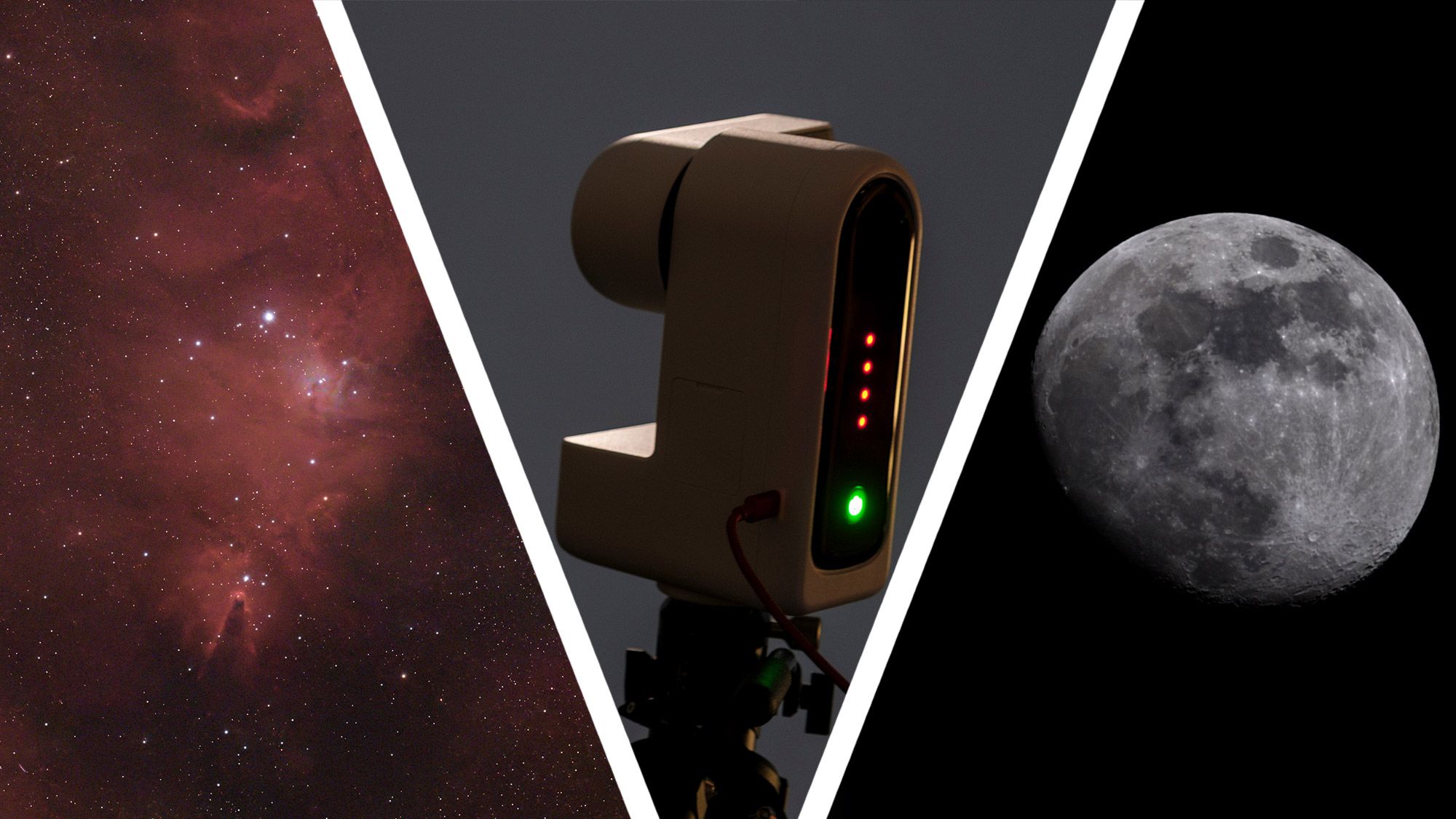
The Cone Nebula is an immense pillar of gas and dust some seven light-years tall. It’s located in the constellation Monoceros 2,700 light-years from Earth, and is bathed in ultraviolet radiation from nearby stars, which it re-emits as brilliant red light. And right now, it’s in my living room.
Or rather, it’s on my phone, in my hand, as I sit in my living room staring in wonder at the majesty of our galaxy. Anyone could look at photos of the Cone Nebula at any time, of course, but this isn’t just a photo of the Cone Nebula — it’s a live feed* of it taken by the smart telescope quietly doing its thing in my back yard. That smart telescope is the ZWO Seestar S30 Pro, and it’s truly, breathtakingly awesome.
- Well, not really live of course — because the light it’s capturing left the nebula 2,700 years ago. But as close as we can get
NASA's stunning new 'Earthset' photo was shot on an ancient Nikon DSLR — here's why
I compared Artemis II mission's historic dark side of the moon photo with my Sony Alpha A6000
Canon’s RF 14mm F1.4L VCM Is an astrophotographer’s dream — at a premium
The Seestar S30 Pro is one of a new breed of smart telescopes (Image credit: Future/Tech Radar)
Smart telescopes have been around for a few years and have been a total game-changer for amateur astrophotographers such as myself. That's partly because they cost a fraction of what you'd need to shell out for a dedicated astrophotography rig with separate tracking mount, telescope, camera, and filters, but also because they're so simple to use.
And this last point is key, because taking photos of extremely dim objects trillions of miles away has, until recently, been a very hard thing to do (understandably so).
I speak from experience here, because I began my astro journey more than a decade ago by hooking up a mirrorless camera to a telescope on a tracking mount. It worked, and I captured some great images, but it was a real time-, money- and effort-sink, with arcane software to navigate, heavy gear to lug around, and a seemingly never-ending shopping list of new kit to shell out for.
The Seestar S30 Pro is about as far away from that as you could imagine; it's small, light, super-simple to set up, and just does its thing efficiently, leaving you free to enjoy the results. It's a revolution — like we jumped from developing film in a darkroom to snapping a photo on your i Phone in just a couple of years.
This is the fourth smart telescope I've used, following ZWO's original Seestar S50, the superb Dwarflab Dwarf 3, and the Dwarf Mini; I'm in the process of testing the latter right now and will be writing about that very soon.
All have their strong points, but if I could only own one, it would be the S30 Pro. And no, the views don't quite rival being on the Artemis II mission and gazing at the dark side of the Moon, but they're good enough for me.
The S30 Pro comes with a carrying case and a small tripod (Image credit: Future/Tech Radar)
At launch, the Seestar S30 Pro costs
Artemis II astronaut snaps stunning Moon photo with an i Phone 17 Pro Max
The first i Phone 17 Pro Max photos sent from the Artemis II mission
For that price, you get a lot — essentially everything you need to take photos of galaxies, nebulae, star clusters, the moon, the sun, and even daytime targets such as birds.
The only thing you won't easily be able to capture with it is a planet, as most are far too small (relatively speaking) to show up as more than a dot. That's true of most smart telescopes, though, particularly at this price.
The S30 Pro has a dual-camera setup, with one telephoto and one wide lens. The 160mm telephoto is a high-quality 4-element apochromatic with a high-resolution 4K Sony IMX585 sensor, while the 6mm wide camera is also 4K and has an impressive 63-degree field of view.
Most of your shooting will be done with the tele, which is itself a pretty wide-angle affair; it captures a much larger section of the sky than the S50 or Dwarf Mini and a fair bit more than the Dwarf 3.
This is great, as it makes it much easier — and faster — to shoot large targets such as the Andromeda galaxy or Heart Nebula without needing to mess around with mosaics (which involves shooting different bits of the image separately, then stitching them together).
The downside is that smaller targets will be, well, smaller in the frame. But you can get around this to an extent by cropping — which in turn is made easier by the fact that the images are 4K. Do note, though, that the Seestar's sensor is vertical rather than horizontal — so it's better for 'tall' targets than wide ones. You can rotate it, but doing so will increase the time taken to get the full image.
The wide-angle camera, meanwhile, serves a dual purpose: it helps the S30 Pro's tele lens find its target, and can be used for widefield shots of the Milky Way.
UV / IR cut, dual-band (OIII 30nm / Ha 20nm), Dark Field Filter, Solar (external)
UV / IR cut, dual-band (OIII 30nm / Ha 20nm), Dark Field Filter, Solar (external)
The S30 Pro comes with several built-in filters, including a dual-band filter that brings out color and detail in nebulae, plus an external solar filter that clips on magnetically. You also get a rather nice carrying case, plus a mini tripod and USB-C cable for charging it up.
Speaking of charging, the S30 Pro has a 6,000m Ah battery, which ZWO says is good for about 6hrs of shooting. If anything, I'd say that's a little conservative, and it definitely seems to drain battery more slowly than the bigger S50. Not that it matters too much either way, because you can simply plug in a portable power pack to give it enough juice to last through the night.
The 128GB of storage is twice the amount you get with the S50 or Mini, and the same as that in the Dwarf 3. This provides enough space to shoot multiple targets for multiple nights — each exposure, or 'sub', takes up 16.6MB, meaning you could fit many thousands on there before needing to delete some.
The S30 Pro (left) is much smaller than the earlier S50 (Image credit: Future/Tech Radar)
Size-wise, it's much more manageable than the rather hefty S50, which is itself a tiny little thing compared to a dedicated astro mount and telescope. The S30 Pro weighs just over 1.5kg — half a kilo less than the Mac Book Pro I'm typing this on — and could easily fit in a backpack for a trip out to a dark-sky spot.
It's also really, really nicely built: solid, quiet in use, and with an attractive matt white finish. It's obvious from the moment that you unpack it that this is a quality product through and through.
None of that would matter if the image quality was lacking, though, so how does the S30 Pro fare in that regard? Well, I'm happy to report that it's not just good — it's incredible.
The Seestar S30 Pro is beautifully built (Image credit: Future/Tech Radar)
Smart telescopes work by rotating in time with the skies, so your target stays centered, then taking lots of relatively short photos and 'stacking' them to bring out the detail.
This stacking is something that is needed for all astrophotography, because most subjects are so far away that sensors only capture a very small amount of their light, but a lot of unwanted noise. Stacking increases the signal-to-noise ratio to turn a dim, fuzzy blob into a glorious image of, say, the majestic Rosette Nebula.
You can see it in action below; this is a sped-up version, because in total I shot the Rosette for 2hrs using 1-minute exposures, so captured 120 frames in total — whereas this GIF is created from only 13 images. But you get the idea.
This timelapse shows the Rosette Nebula gradually becoming more detailed as exposures are added (but heavily sped up compared to reality) (Image credit: Future/Tech Radar)
One of the key advantages of smart telescopes is that this stacking is done automatically as the telescope captures the data; you can see the target emerging from the noise and getting brighter and more detailed on your screen, the longer you snap away. There's an app for Android or i OS, and it works particularly well on i Pad, where the larger display makes it easier to see what's happening.
Of course, you can also download the images — either the finished stack, or individual exposures — after you've finished, then process them separately in the likes of Photoshop or Lightroom, or using specialist astrophotography software such as Pixinsight or Siril.
The results when you do that can be incredible. Take the Rosette Nebula again: on the left of the image below, you can see the finished stack as it came out of the Seestar S30 Pro, complete with a trail from either a satellite or plane; on the right, there's the clean version created from individual frames I stacked in Siril and then processed in Pixinsight.
Don't have a laptop or desktop computer? No problem — because you can process images within the Seestar app instead. The results won't be quite as good as if you've done it yourself in specialist software, but as an example, here's the Rosette Nebula again, processed by the Seestar's Deep Sky Stack feature and compared to my Pixinsight version.
I wasn't able to use the Seestar S30 Pro for the first month I had it, because the UK was being subjected to some kind of atmospheric torture game involving endless banks of clouds and rain.
A confession: this may actually have been my fault, because all astronomers know that a new telescope always comes with a free gift of cloudy skies, and I'd just taken possession of two, with the Dwarf Mini having been delivered soon after the Seestar. Sorry, everyone!
Eventually, the weather improved, and I got shooting — and quickly learned what this smart 'scope can do.
My first target was the obvious one for late spring: M42, the Orion Nebula. This is one of the brightest nebulae and can even be seen with the naked eye; look up at the night sky and you might glimpse it, just below the three stars that comprise Orion's Belt.
It only took a few minutes for it to start forming on my phone's screen, and an hour was long enough to bring out the wonderful red and violet hues of the nebula's central core. The image below is actually a composite of three nights' worth of shots, totalling 2hrs 40 mins, and with that level of integration, you can also easily make out the little 'Running Man' nebula above it.
The Orion and Running Man Nebula (M42 and NGC 1977) are well suited to the S30 Pro's FOV(Image credit: Future/Tech Radar)
The S30 Pro did a great job of bringing out the Cone Nebula's rich red colors; this was taken with 4hrs of exposures of either 30 or 60-second length(Image credit: Future/Tech Radar)
The iconic Horsehead Nebula, with the Flame Nebula above it(Image credit: Future/Tech Radar)
The Rosette Nebula is an almost-perfect fit for the S30 Pro (Image credit: Future/Tech Radar)
Even with only 90 minutes of shooting the Monkey's Head Nebula stands out clearly. Whether you think it actually resembles a monkey's head is a different matter(Image credit: Future/Tech Radar)
The Jellyfish Nebula is the remains of a supernova. It's a tough target for a smart scope, and I'd probably have needed more than the 70 minutes of exposures I took here (Image credit: Future/Tech Radar)
Other targets at this time included the aforementioned Cone and Rosette nebulae, and one of my favorites — the Horsehead Nebula. The S30 Pro did a fantastic job with each of these, with the IMX585 sensor and quality glass combining to really bring out the bold colors, particularly once I'd processed them fully.
By mid-to-late March, we were in the midst of galaxy season, with the Milky Way and its colorful nebulae mostly out of sight and the targets consisting instead of the spiral arms and glowing centers of the likes of M51, the Whirlpool Galaxy.
These are not really the S30 Pro's forte; as I said above, they're generally too small to be well suited to the telescope's FOV. But they can still make for striking images, with the combination of a small galaxy against a vast backdrop of stars really bringing the enormity of the universe into sharp relief; I'm particularly pleased with how my shot of the lovely Needle Galaxy came out, for instance.
M51, the Whirlpool Galaxy, is small in the S30 Pro's wide FOV — but still looks wonderful(Image credit: Future/Tech Radar)
The Needle Galaxy looks fittingly sharp thanks to the S30 Pro's excellent image quality(Image credit: Future/Tech Radar)
The M100 galaxy is part of the galaxy-rich Virgo Cluster; several others are visible in the shot (Image credit: Future/Tech Radar)
The famous Leo Triplet features three galaxies(Image credit: Future/Tech Radar)
Star clusters make a great target — though comparatively small in the S30 Pro's FOV, they stand out clearly and the smart 'scope does a great job of isolating individual stars(Image credit: Future/Tech Radar)
I also took photos of multiple star clusters, which the S30 Pro handled smoothly. The 'scope's high-quality glass really helps to pull out the individual stars — there are several hundred thousand in the M13 Great Hercules Cluster, and though my photo above can't resolve them all, it does a great job of capturing the dense cores.
And of course I took some photos of the moon and sun. My lunar shot is not quite up there with the image taken by the Artemis II astronauts, but it's mine, and I still love it. As with galaxies, the S30 Pro isn't ideally suited to the moon — the S50 provides a much closer view — but it sure beats a smartphone.
The sun, meanwhile, can be photographed via the included external solar filter. This snaps on magnetically, and after that, you simply select it in the app, wait for the 'scope to move to its target, then snap away.
The moon, obviously. The S30 Pro can't capture the detail you'd get from the Seestar S50, but it's never a dull target(Image credit: Future/Tech Radar)
The S30 Pro comes with a solar filter for shooting the sun; you can make out a decent amount of detail in the lower right-hand side of the image(Image credit: Future/Tech Radar)
Finally, to really put the Seestar S30 Pro through its paces, I turned it towards the Virgo Cluster. This is a galaxy-rich area of the heavens containing some 1,300-2,000 of the structures. Many are too small (or rather, too far away) to be captured by the Seestar S30 Pro, but I was astounded at just how many it did pick up.
For the shot below, I used the S30 Pro's mosaic mode, which increases the size of the shot by up to 2x. This isn't generally something you'll need to use, because the S30 Pro has such a wide field of view that most targets don't require it, but it can add some further drama to your imaging.
I've also included an annotated version that demonstrates just how many targets the S30 Pro was able to pick up here — more than 100 of them, though most are no more than dim, fuzzy blobs.
A widefield mosaic shot of the Virgo cluster and its many galaxies…(Image credit: Future/Tech Radar)
…and an annotated version of the same shot. Just imagine how many stars and planets lurk within it!(Image credit: Future/Tech Radar)
There are, of course, many thousands of subjects you could photograph in the night sky, with the best targets changing with the seasons.
Pretty soon, for instance, the Milky Way will be back in view for me — which will bring into play the beautiful Eagle Nebula and the colorful Veil Nebula, and the massive Heart and Soul Nebula. And whatever I end up shooting, it'll be the S30 Pro that I turn to first.
Marc is Tech Radar’s Global Editor in Chief, the latest in a long line of senior editorial roles he’s held in a career that started the week that Google launched (nice of them to mark the occasion). Prior to joining TR, he was UK Editor in Chief on Tom’s Guide, where he oversaw all gaming, streaming, audio, TV, entertainment, how-to and cameras coverage. He's also a former editor of the tech website Stuff and spent five years at the music magazine NME, where his duties mainly involved spoiling other people’s fun. He’s based in London, and has tested and written about phones, tablets, wearables, streaming boxes, smart home devices, Bluetooth speakers, headphones, games, TVs, cameras and pretty much every other type of gadget you can think of. An avid photographer, Marc likes nothing better than taking pictures of very small things (bugs, his daughters) or very big things (distant galaxies). He also enjoys live music, gaming, cycling, and beating Wordle (he authors the daily Wordle today page).
You must confirm your public display name before commenting
1‘Breathtakingly awesome’ — it doesn't quite rival Artemis II, but after spending a month with the Seestar S30 Pro smart telescope I’m shocked by its stunning views of galaxies, nebulae and — yes — the moon
2 Own a Kindle from 2012 or earlier? It could be time to upgrade as Amazon's officially ending support for very old models
3 Daredevil: Born Again season 2 episode 4 ending explained — is [spoiler] really dead in the Disney+ show?
4 Microsoft flags China-based hackers using vicious new 'rapid attack' zero-days to launch ransomware at targets across the world
5 Two upcoming i Phones could be ‘largely unchanged in appearance,’ leaker claims, and I’m already skipping this generation
Tech Radar is part of Future US Inc, an international media group and leading digital publisher. Visit our corporate site.
© Future US, Inc. Full 7th Floor, 130 West 42nd Street, New York, NY 10036.
Key Takeaways
- News, deals, reviews, guides and more on the newest smartphones
- News, deals, reviews, guides and more on the newest computing gadgets
- Start exploring exclusive deals, expert advice and more
- Unlock and manage exclusive Techradar member rewards
-
‘Breathtakingly awesome’ — it doesn't quite rival Artemis II, but after spending a month with the Seestar S30 Pro smart telescope I’m shocked by its stunning views of galaxies, nebulae and — yes — the moon


