
Anthropic reinstates Open Claw and third-party agent usage on Claude subscriptions — with a catch | Venture Beat
Overview
Anthropic reinstates Open Claw and third-party agent usage on Claude subscriptions — with a catch
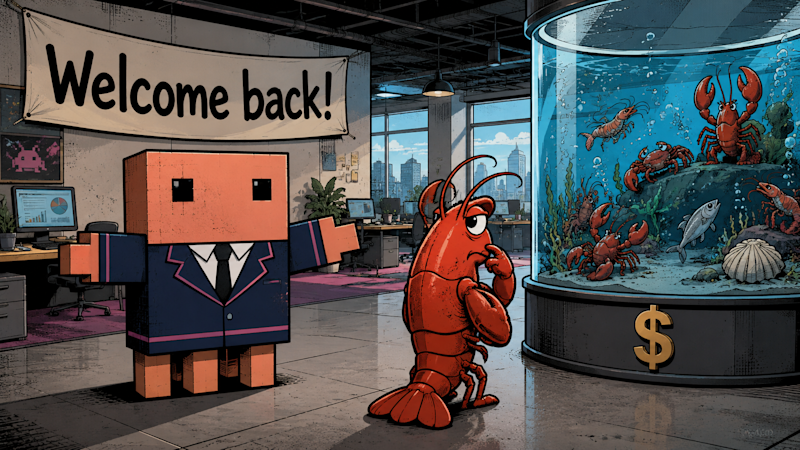
Good news, Open Claw fans — you can once again use your Claude AI subscription to power the hit, open source, autonomous AI agentic harness! But, there's a big catch with how it's being enacted.
Details
A few hours ago, Anthropic announced via its official developer communications account on X, @Claude Devs, that it is changing its Claude paid subscription tiers, introducing a new subcategory of "Agent SDK" credits for all paid subscribers, which they can now allocate specifically for "programmatic" uses, including external, third-party agents such as Open Claw.
The move us a major reversal from the Anthropic's policy introduced in early April 2026 that expressly prohibited its AI subscriptions from being used to power these kind of non-Anthropic agents and harnesses, after Anthropic said they caused capacity and service issues.
The problem was that some Claude subscribers were paying
To be clear, even when it enacted the old prohibition against Open Claw and similar agents last month, Anthropic never fully cut off the capability for Claude to be used in Open Claw. Rather, it redirected users to pay through the company's application programming interface (API), which is billed by usage (priced per million tokens, rather than a flat monthly rate as the subscriptions offer), or pay for extra usage credits atop their subscriptions.
Now, Anthropic is giving Claude subscribers another way to use their subscription bill to pay for third-party agents.
However, the restoration comes with a significant catch: programmatic usage is no longer subsidized by the general subscription pool but is instead restricted to a fixed, non-rollover monthly credit. In other words, if you allocate your subscription credits for usage in third-party agents but don't end up using them, they simply expire at the end of the month.
Why did Anthropic block Claude subscriptions from Open Claw (and other third-party agentic AI harnesses) in the first place?
To understand why this restoration matters, one must look at the technical friction that led to the initial ban on April 4, 2026.
Anthropic’s first-party tools, such as Claude Code and Claude Cowork, are engineered to maximize "prompt cache hit rates"—a method of reusing previously processed text to save on expensive compute cycles.
Third-party tools like Open Claw, which allow users to run autonomous agents through external services like Discord or Telegram, were often unoptimized for these efficiencies. Boris Cherny, Head of Claude Code, noted that these third-party services were "really hard for us to do sustainably" because they bypassed the caching mechanisms that allow Anthropic to offer flat-rate subscriptions.
The sheer volume of data being re-processed by inefficient agents was threatening the stability of the system for the broader user base. Even with Anthropic’s massive expansion into new hardware—including access to the 300MW Colossus 1 data center and its 220,000+ GPUs—the demand for agentic workflows was outpacing sustainable supply.
The new "Agent SDK credit" system solves this technical bottleneck by shifting the cost of inefficiency back to the user. By providing a dedicated dollar-amount credit, Anthropic no longer has to "eat the difference" on unoptimized third-party code. If an agent is inefficient and burns through tokens, it simply drains the user's
The restoration of third-party access is segmented across Anthropic’s billing tiers, creating a new hierarchy of "programmatic power." Here's how much Anthropic is giving each user in terms of the new Agent SDK credits:
This system introduces a sharp divide between "interactive" and "programmatic" workflows. If you are chatting with Claude in a browser or using Claude Code in a terminal to write code interactively, you are still drawing from your standard, high-capacity subscription limits.
However, the moment you use the claude -p command for non-interactive tasks, run a Git Hub Action, or connect a third-party tool like Open Claw, the system switches to the dedicated Agent SDK credit.
Once the Agent SDK credit limit (
Crucially, for those who found the original subscription model to be an infinite resource, this is a hard cap. Credits do not roll over, meaning the "use it or lose it" nature of the system forces a monthly reset of the developer’s budget.
The licensing implications of this move are profound for the "agentic" ecosystem.
By explicitly allowing third-party apps like Conductor and Open Claw to authenticate via the Agent SDK, Anthropic is legitimizing a workflow it had previously attempted to block.
However, in doing so, it has ended the era of "compute arbitrage". In the early part of 2026, a $20 Pro subscription could be leveraged via Open Claw to run agents that would cost hundreds of dollars on a standard API key.
By moving to a metered credit, Anthropic is aligning its subscription model with its Developer Platform (API). While it offers a "free" buffer for subscribers, it ensures that high-volume, production-level automation is moved to predictable, token-based billing.
This protects the company's margins while still offering a "sandbox" for developers to experiment without the immediate overhead of an API-first account.
Community reactions are perhaps unsurprisingly negative
While Anthropic executives framed the update as a "simplification", the developer community has largely branded it as a significant reduction in the value of their subscriptions. The backlash focuses on the sharp disparity between the previous effective usage and the new, metered reality.
Popular AI You Tuber and developer Theo Browne (@theo) of T3.gg warned developers that this change constitutes a massive devaluation for those using external tools. "If you use any of the following with your Claude sub, your usage must got cut by 25x," Theo stated, listing T3 Code, Conductor, Zed, and Jean as affected platforms. He concluded with a sharp warning: "They’re disguising this as 'free credits'. Don’t fall for it".
Kun Chen, a solo builder and former L8 engineer at Meta, Microsoft, and Atlassian, interpreted the move as a full surrender of Anthropic's market lead. "it's official. Anthropic pulled the plug on ALL programmatic use of claude subscription," Chen posted, adding that he had found himself "increasingly bullish about Open AI" as a result. Chen argued that "Anthropic's only lead was on coding, and gpt 5.5 has flipped that already," signaling a potential migration of elite developer talent.
Other builders questioned the practical utility of the credits offered. Ben Hylak, co-founder and chief technology officer at AI agent observability and governance startup Raindrop.ai, voiced concern over the sustainability of Anthropic's infrastructure. "this is either really silly, or shows how bad of a spot anthropic is in re: gpus," Hylak noted, before bluntly asking users to "guess how many turns $20 in API credits last".
The frustration extended to the marketing of the change. Ever Never, creator of inkstone.uk, expressed disbelief at the framing of the policy. "Wait what?! You take away more ways to utilize the subscription I am paying for?! And you dare to make it look like a win?". This sentiment highlights a growing rift between Anthropic and its power-user base, who feel that previously inclusive features are being rescinded under the guise of an "upgrade."
The bottom line for Anthropic subscribers and AI builders
Anthropic’s "restoration" is a tactical move to retain developers while strictly managing the physical limits of compute. By June 15, the "agentic" era for Claude subscribers will be a metered one.
The company has successfully reclaimed control over its margins, even if it has cost them some of the goodwill of their most vocal power users.
For the individual developer or enterprise AI builder relying on Anthropic models for Open Claw, however, it's clearly an improvement over the blanket ban from last month.
Deep insights for enterprise AI, data, and security leaders
By submitting your email, you agree to our Terms and Privacy Notice.
Key Takeaways
-
Anthropic reinstates Open Claw and third-party agent usage on Claude subscriptions — with a catch
-
Good news, Open Claw fans — you can once again use your Claude AI subscription to power the hit, open source, autonomous AI agentic harness
-
A few hours ago, Anthropic announced via its official developer communications account on X, @Claude Devs, that it is changing its Claude paid subscription tiers, introducing a new subcategory of "Agent SDK" credits for all paid subscribers, which they can now allocate specifically for "programmatic" uses, including external, third-party agents such as Open Claw
-
The move us a major reversal from the Anthropic's policy introduced in early April 2026 that expressly prohibited its AI subscriptions from being used to power these kind of non-Anthropic agents and harnesses, after Anthropic said they caused capacity and service issues
-
The problem was that some Claude subscribers were paying
200 per month under Anthropic's Claude Pro and Max subscriptions, but consuming hundreds, even thousands of dollars of tokens (units of information) above those prices through their Open Claw (and similar autonomous) agents


